There is a familiar rhythm in the blockchain industry a project launches with sweeping promises introduces a vast array of features and constructs an ecosystem so elaborate that even the documentation reads like a graduate course in distributed systems.
For years this excessive complexity was interpreted as brilliance. Innovation was synonymous with accumulation more layers and more features and more solutions to problems that had not yet materialized.But recently the pendulum has begun to swing back.
Developers have started to express fatigue with networks that demand entire mental frameworks just to deploy a contract. Users are increasingly unwilling to endure unpredictable fees multi minute finality and interfaces that feel like prototypes. Institutions who were once told blockchains could replace financial infrastructure now quietly admit that very few can handle the operational realities of markets.
In that shifting landscape Injective stands out not because it shouts the loudest, but because it is one of the few that seems to have recognized early that the future of finance is not maximalist. It is minimalist.
And that makes Injective strangely modern not because it tries to predict where the market is going but because its architecture happens to align with where the industry has already decided it needs to go.
The Minimalist Premise: Finance Doesn’t Need Everything It Needs What Works
Minimalism in software design is often misunderstood. It does not mean lack of features. It means correctly identifying what is essential and building around it with discipline. Injective’s architecture reflects this philosophy with unusual fidelity.
Rather than designing a chain capable of every possible computation Injective optimizes for what financial applications actually require:
🔸Deterministic execution
🔸High volume throughput
🔸Minimal latency
🔸Predictable fees
🔸Interoperability with existing liquidity hubs
🔸MEV resilience tooling that developers can use without reinventing their workflows
It is impressive not because it is bold but because it is restrained. Injective’s design reads like a rebuttal to the industry’s excess a chain that rejects the idea that capability should come at the cost of clarity.
The more I examine it the clearer the underlying thesis becomes: finance is complicated enough the infrastructure supporting it doesn’t need to be.
An Architecture Built Around the Weight of Real Markets
To understand Injective’s role, one must understand that financial markets are not merely fast they are unforgiving. Traders measure latency with impatience. Arbitrage strategies punish delay. Market makers expect reliability not aspiration. And liquidity does not tolerate bottlenecks.
Injective behaves like a blockchain that internalized these truths early. Its sub second finality is not a marketing number it is a prerequisite for order book based trading. Its low fees are not a gimmick. They are the economic foundation for high frequency interaction. Its interoperability isn’t a convenience it is how liquidity from different ecosystems can converge without degraded performance.
Most critically Injective’s MEV resistant architecture introduces something few chains have meaningfully delivered fairness under pressure. When markets spike in volatility the exact moment blockchains typically degrade Injective is designed to remain composed.
The entire system behaves like infrastructure that assumed from day one that it would be used heavily simultaneously and by participants who do not accept excuses.
Why Injective’s Quiet Engineering Matters More Than Flashy Innovation
There is something refreshing about a blockchain whose primary innovation is not an exotic cryptographic technique or a reinvention of execution semantics but a commitment to engineering that is disciplined, coherent and tailored.
Injective’s approach reminds me of the early days of the internet when the protocols that survived were not the ones that dazzled academically but the ones that simply worked. TCP/IP wasn’t flashy. DNS wasn’t glamorous. HTTP wasn’t elegant.But they were stable. And stability always wins.
Injective has that same understated quality. It doesn’t try to impress with unnecessary abstraction. It doesn’t produce whitepapers that require translation. It doesn’t force developers to adopt new mental models. Instead it presents itself as infrastructure something you rely on, not something you constantly evaluate.
It is the blockchain equivalent of a well run airport: transparent, efficient and only noticeable when something goes wrong which is increasingly rare.
An Unusual Observation: Injective Is One of the Few Chains That Feels Finished
Most blockchains today feel like perpetual construction sites. Their roadmaps stretch endlessly into the future full of features that sound compelling but rarely reach a stable state. There is a sense of incompleteness a nagging feeling that the system is forever one upgrade away from being usable at scale.Injective feels strangely different.
Not finished in the sense of being static it continues to evolve but finished in the sense that the core design appears settled. There is an architectural confidence that is unusual in this industry. Its components fit together without friction. The chain does not exhibit the architectural sprawl that plagues many modern L1s.It feels like it was built according to a plan that was thought through before the first line of code was written.
This gives Injective an advantage that is difficult to quantify but easy to feel psychological stability. Builders like working with systems that do not surprise them. Users trust applications that behave predictably. Institutions prefer infrastructure that evolves responsibly rather than aggressively.Injective projects a sense of architectural maturity the calm of a system that knows what it wants to be.
The Real Competitive Edge: Injective Attracts Builders Who Care About Precision
A blockchain’s identity is not determined by its documentation. It is determined by the types of builders it attracts.
Injective tends to draw teams that value precision. Market infrastructure builders risk management protocols derivatives platforms synthetic asset systems automated market engines developers who need things to be exact not approximate. These teams choose Injective precisely because it minimizes variables.
If Ethereum is the city where every experiment can coexist and Solana is the metropolis of high performance computation Injective is beginning to resemble a financial district a place where specialized operations concentrate.
Financial ecosystems consolidate naturally. They do not spread across dozens of chains. They cluster around environments that offer the lowest friction the tightest guarantees and the strongest reliability.Injective has quietly become that environment for a growing number of sophisticated builders.
Interoperability as a Strategic Weapon Not a Feature
The blockchain industry tends to misunderstand interoperability as charity a willingness to share liquidity or communicate across networks. Injective treats interoperability differently. It treats it as an economic principle.
Liquidity follows the path of least resistance. Users gravitate toward environments where they do not need to think about where their assets currently reside. Builders flourish where they can tap into established ecosystems without compromising performance.
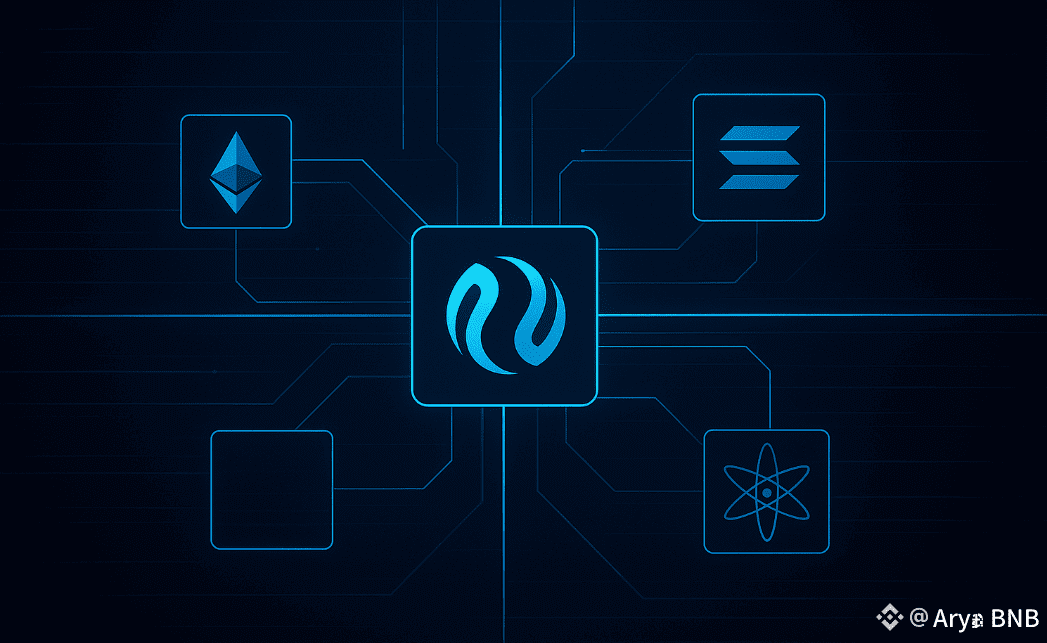
Injective’s native connections to Ethereum, Solana and the Cosmos universe allow it to act as a conduit rather than an island. It does not compete with these networks for liquidity its channels liquidity across them. In doing so it sidesteps the strategic mistake many chains make: viewing interoperability as a threat rather than an amplifier.
When viewed through this lens Injective is less a standalone chain and more a connective tissue an execution layer that unifies liquidity from multiple ecosystems into market infrastructure that behaves as though it is native.This is not merely convenient. It is strategically formidable.
The Hidden Strength: A Developer Experience That Doesn’t Demand Reinvention
Financial builders tend to be conservative not philosophically but structurally. They gravitate toward environments where tools are stable APIs do not shift unpredictably and debugging does not feel like spelunking into a procedural cave.
Injective’s developer experience operates in that spirit. It does not require mastering new DSLs reinventing workflows or learning obscure abstractions. It allows builders to focus on the logic of markets rather than the quirks of the chain.
This may not sound glamorous but in the world of financial engineering it is invaluable. Most market infrastructure teams do not want to become experts in virtual machines. They want to build products.By giving them reliability instead of novelty Injective earns their long term loyalty.
The Broader Context: Blockchains Are Entering Their Professional Phase
For the first decade of blockchain history experimentation was the norm. Protocols were laboratories. Networks were testbeds. Mistakes were tolerated as long as new ideas emerged.
But the industry has begun shifting into a more professional and more industrial phase. Expectations are rising. Institutions are watching. Regulators are observing. Users are demanding quality. And financial platforms are migrating from demos to production.This shift places enormous pressure on blockchains to behave like real infrastructure. And most simply do not.
Injective is one of the few that seems not only ready for this transition but built for it. Its architecture is not idealistic. It is pragmatic. Its goals are not academic. They are operational. Its commitments speed determinism fairness are aligned with the pressures of real world financial activity.
Put simply Injective behaves like a chain built for an industry that is finally growing up.
What the Future May Look Like: Finance Without the Bulk
If the broader market continues leaning toward minimalism toward simpler, cleaner and more stable architectures Injective stands to benefit disproportionately.
It represents a model where performance is not purchased through complexity where interoperability does not create chaos and where financial primitives are reliable enough to serve as foundations instead of experiments.
Imagine a future where markets operate across chains without friction.
•Where derivatives platforms do not degrade under load.
•Where latency is measured in milliseconds.
•Where fees do not spike.
•Where liquidity moves freely.
•Where developers build without wrestling low level infrastructure.
Injective is not the only chain pursuing this vision. But it is one of the few whose architecture genuinely supports it. And that is why it feels well positioned not because it promises the world but because it has the discipline to deliver the part of the world that matters most: stability.
Conclusion: Injective May Be the Purest Expression of What Finance Actually Needs
There will always be chains that aim to reinvent computing, social systems or digital identity. There will always be networks chasing maximum expressiveness or theoretical elegance. There is room for all of them.
But finance is different. Finance punishes unpredictability. It rewards systems that are boring in the best way systems that disappear into the background and allow markets to function.
Injective offers exactly that: a blockchain that treats users like professionals builders like collaborators and markets like systems deserving of rigor.
In a world full of networks trying to be everything. Injective is content being exactly what finance requires. And that quietly, steadily almost unfashionably might make it one of the most consequential architectures of the coming decade.