
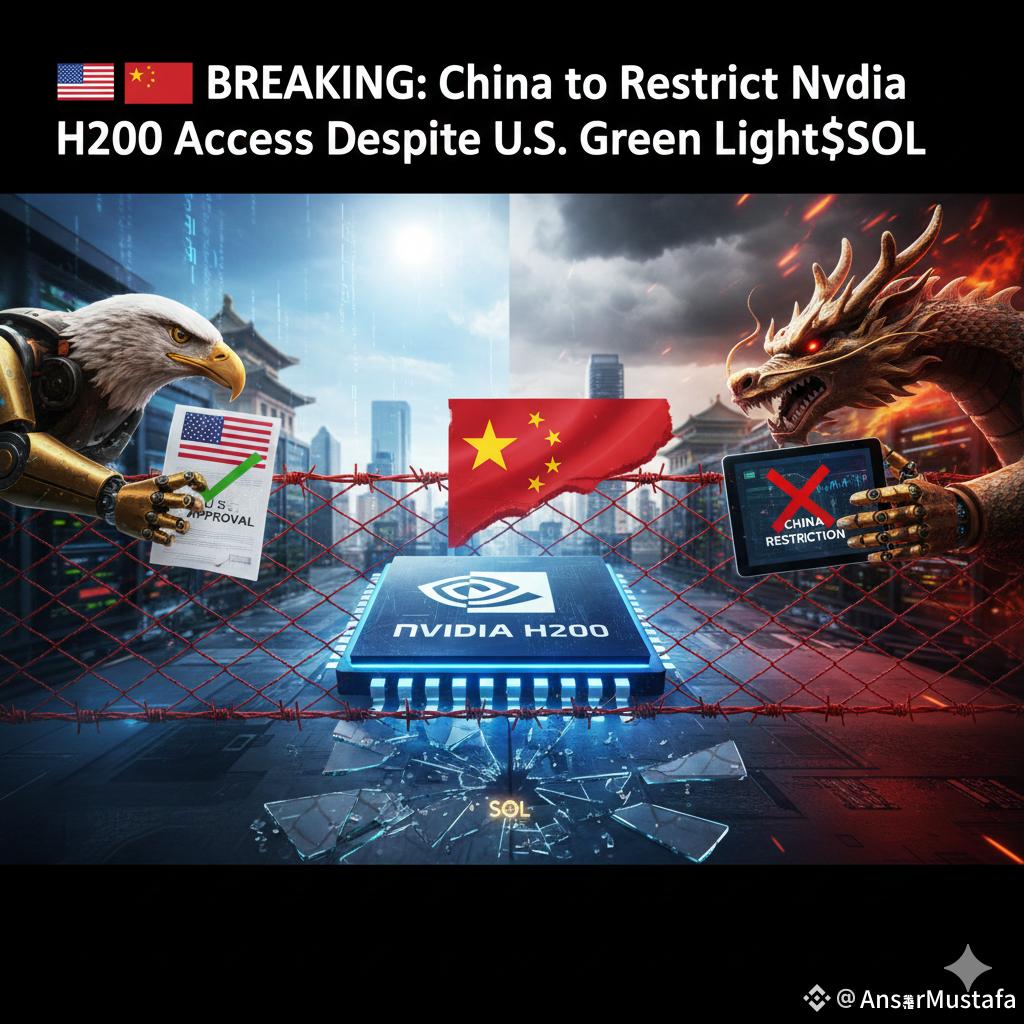
🇨🇳🇺🇸BEIJING/WASHINGTON D.C. – In a move that underscores the persistent and deepening technological rivalry between the United States and China, sources indicate that Beijing plans to impose restrictions on access to Nvidia's cutting-edge H200 AI chips, even after the U.S. government signaled a green light for their export. This unexpected development highlights China's strategic ambitions to foster indigenous AI capabilities and reduce reliance on foreign technology, despite the potential short-term impact on its burgeoning AI sector. $SOL
The Nvidia H200, a powerful accelerator designed for advanced AI workloads, represents a significant leap forward in processing power, crucial for training large language models and other sophisticated AI applications. The U.S. Department of Commerce had previously indicated that the H200, while powerful, fell within the export control parameters set to prevent China from acquiring the most advanced chips for military applications. This perceived "green light" was seen by some as a slight easing of tensions, or at least a clear delineation of acceptable trade.
However, China's reported decision to restrict access suggests a different strategy at play. Rather than simply accepting what the U.S. permits, Beijing appears to be proactively shaping its domestic tech landscape. This move could be interpreted in several ways:
Accelerating Indigenous Development: By limiting the availability of top-tier foreign chips, China might be signaling an intensified push for its own semiconductor companies to close the gap. This could create a protected market for domestic alternatives, even if they currently lag behind Nvidia's offerings.
National Security and Data Sovereignty: Restricting access to foreign hardware could also be a measure to enhance national security and data sovereignty, ensuring that critical AI infrastructure is built on technologies that China can fully control and audit.
Bargaining Chip in Tech Diplomacy: The restriction could also serve as a bargaining chip in broader tech negotiations with the United States, demonstrating China's capacity to dictate terms even when faced with U.S. export controls.
The immediate impact on China's AI industry could be mixed. While leading tech giants like Baidu, Alibaba, and Tencent have invested heavily in AI, a sudden curtailment of access to high-performance chips like the H200 could temporarily slow down their progress in developing the most advanced AI models. However, it could also galvanize investment and innovation within China's domestic chip industry, potentially leading to long-term self-sufficiency.
For Nvidia, this presents a complex challenge. China remains a massive market for AI hardware, and any restrictions could impact its sales forecasts. The company has already been navigating a tricky geopolitical landscape, designing specialized chips for the Chinese market that comply with U.S. export regulations. This new development adds another layer of uncertainty to its China strategy.
The decision underscores a fundamental divergence in the U.S. and Chinese approaches to technology. While the U.S. seeks to control the flow of its most advanced tech to China, Beijing is increasingly determined to forge its own path, even if it means short-term economic adjustments. As both nations continue to jostle for supremacy in the AI race, such unilateral actions are likely to become more common, further fragmenting the global technology landscap$BTC

