
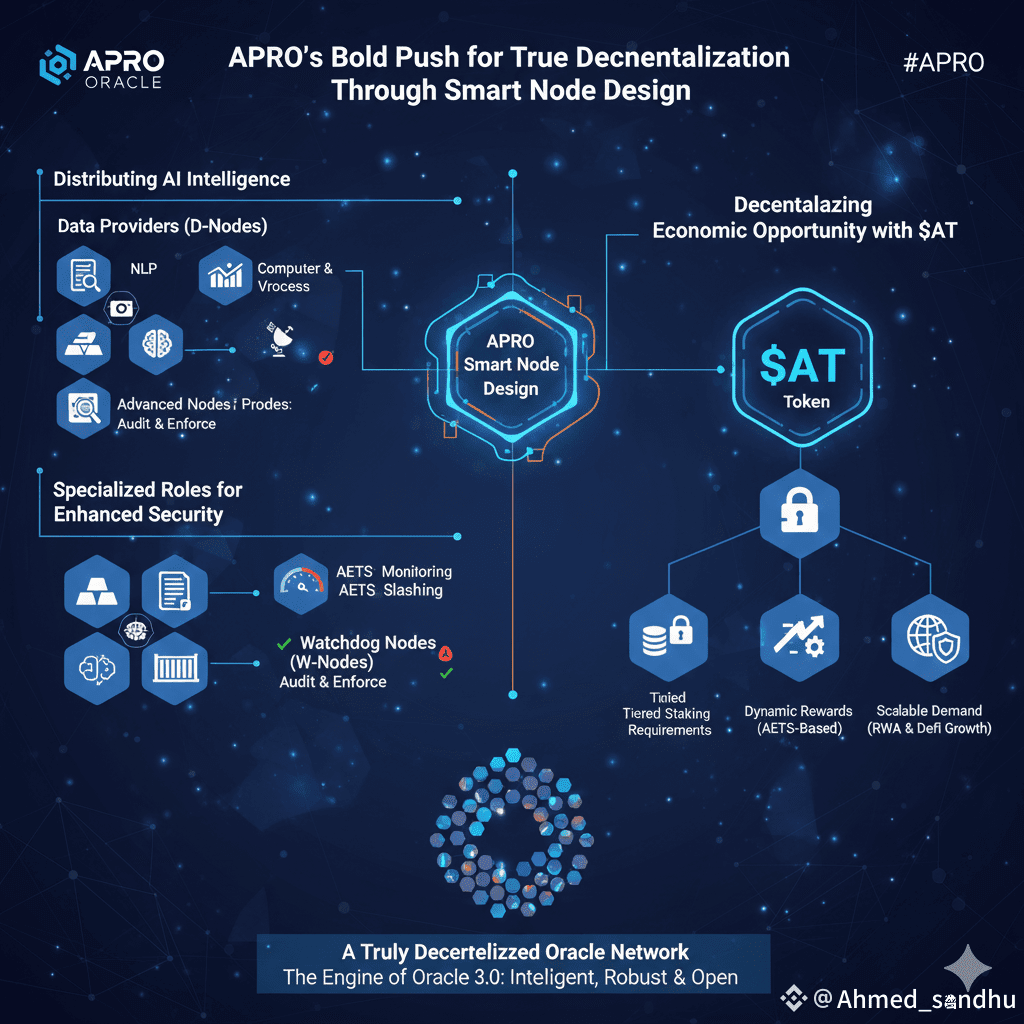
The ultimate goal of Web3 is to eliminate centralized points of failure, but the oracle layer—the conduit of external data—often remains a subtle bottleneck. Traditional oracles, while decentralized in concept, often rely on a handful of high-cost, high-specification nodes, leading to homogeneity and potentially centralization of data-processing power.
APRO Oracle is challenging this model with a Smart Node Design that is not just about distributing nodes, but about distributing intelligence, capability, and economic opportunity. This design represents a bold push for true decentralization, making the network more robust, adaptable, and resistant to Sybil attacks.
🧠 The Need for Smart Nodes in Oracle 3.0
The demands of Oracle 3.0—handling complex Real-World Asset (RWA) data, utilizing Multi-Modal AI, and cross-chain delivery—require nodes that are more than simple data relays. APRO’s nodes are designed to be "smart" by incorporating both AI computation and economic versatility.
1. Distributing AI Intelligence
APRO requires its nodes to run sophisticated AI models (such as NLP for contract verification and Computer Vision for physical asset checks). Distributing this AI processing power across a wide and diverse network of nodes achieves two critical goals:
Decentralized Verification: No single party controls the intelligence that validates complex data.
Redundancy and Security: If one node or a regional cluster fails, the AI-powered verification process continues unimpeded across the globally distributed network.
2. Specialized Roles for Enhanced Security
APRO moves beyond the "one-size-fits-all" node model by enabling specialized node roles, enhancing overall network integrity:
Data Providers (D-Nodes): Focus on ingesting, processing, and validating specific types of data (e.g., financial feeds, legal documents) using their AI models.
Watchdog Nodes (W-Nodes): Focus on auditing the outputs of the D-Nodes and enforcing consensus. They monitor the network's overall health and the AI-Enhanced Trust Score (AETS), ensuring data veracity before commitment to the blockchain.
This specialization prevents any single type of node failure from compromising the entire data chain, providing layered security.
💰 Decentralizing Economic Opportunity with $AT
The key to achieving true decentralization is making node participation economically accessible and rewarding for a diverse set of global participants. The $AT token is central to this effort:
Tiered Staking Requirements: APRO can design tiered staking requirements using the $AT token, allowing participants with different levels of technical and capital commitment to run specialized nodes. This lowers the barrier to entry, attracting a broader base of validators globally.
Dynamic Rewards: Node rewards are tied directly to the AETS and the integrity of the data provided. Nodes that consistently provide high-quality, verified data are rewarded more highly, creating a virtuous cycle where economic incentive drives decentralized data quality.
Scalable Demand: As the RWA and DeFi markets grow, the demand for APRO’s high-integrity data streams increases, driving demand for the $AT token and, in turn, increasing the rewards for node operators.
🌐 The Result: A Truly Decentralized Oracle
APRO’s Smart Node Design is a commitment to decentralization as a core principle, not just a buzzword. By distributing the computational intelligence and economic incentive among a versatile, high-performing network powered by the $AT token, APRO achieves:
Resistance to Censorship: A geographically and economically diverse node network is harder to shut down or compromise.
Higher Data Quality: Competition among specialized, economically incentivized nodes drives data accuracy higher than any centralized solution.
Future-Proofing: The architecture is designed to integrate future AI advancements and new RWA data types without requiring a complete overhaul.
APRO's Smart Node Design is the engine of Oracle 3.0—making the network not just a reliable messenger, but the most decentralized and intelligent source of real-world truth for the blockchain.
What types of AI capabilities do you think are most important for APRO's Watchdog Nodes?

