Recently, a friend who just entered the crypto market sought help late at night, which was quite shocking—
Her bank card was frozen directly due to a transaction of 680,000 U fiat currency, and all funds were classified as 'involved amount', with no end in sight for the thawing.
The cause of this nightmare was simply her trusting the buyer's words: 'Don't worry, it's all money transferred by family, absolutely safe.'
This kind of tragedy is not an isolated case; it hangs like a sword over all OTC traders, ready to drop at any moment. In the face of a complex and changing on-chain environment and severe law enforcement risk control, relying solely on the matchmaking of centralized platforms is like walking blindfolded in a minefield.
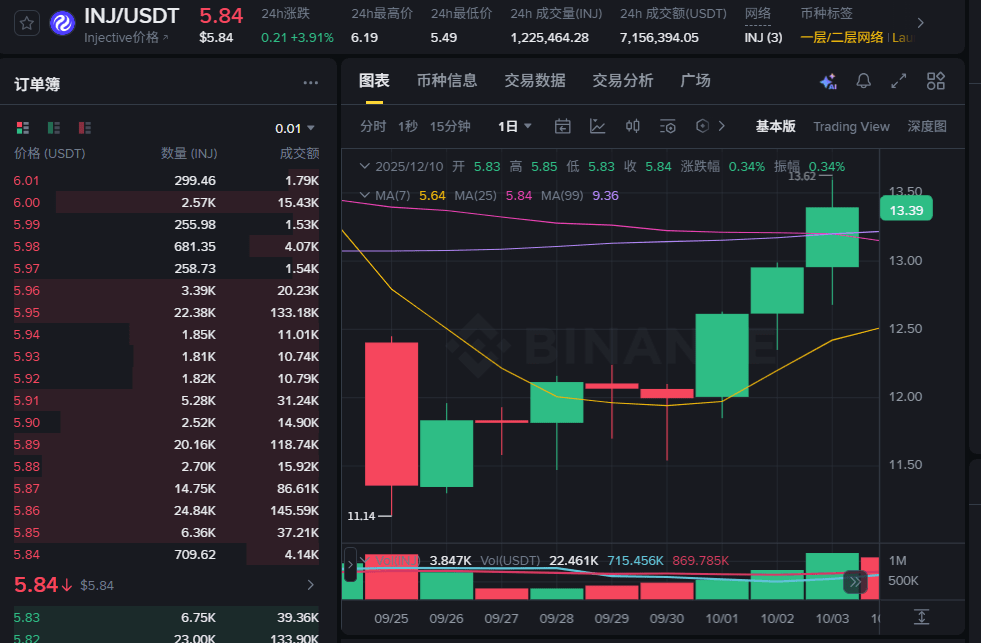
However, when we step out of the traditional framework to examine the industry, underlying public chains like Injective, which are built specifically for finance, are fundamentally reconstructing the paradigm of value exchange. It not only provides a fast and almost zero-cost trading experience but more importantly, its completely decentralized and transparent on-chain order book mechanism makes every transaction publicly verifiable and immutable. This may open another door for us to think: how to technically construct a more transparent and trustworthy trading environment, thereby avoiding the traps of unknown funds?
1. Why does your 'safe transaction' explode at the slightest touch?
Most newcomers have a fatal misconception: thinking 'the other party pays first, and then I release the currency' is an iron law.
But the real risk is precisely hidden behind that string of numbers you received — the source of funds.
Once the payer's money involves fraud, money laundering, or other criminal activities, and is reported by others, your receiving account will immediately trigger the joint risk control system of the bank and public security.
This is not a platform rule issue, but a thunderous means of financial regulation.
Your account will instantly:
Frozen by the bank
Under investigation by the police
Funds directly listed as 'involved funds'
At this point, you have turned from a trader into a 'related party' in the case.
2. The larger the amount, the greater your risk is not additive, but multiplicative.
The amount involved in this case is as high as 680,000, which is by no means a small sum.
From industry handling experience:
The larger the amount, the more you cannot rely solely on online submitted materials.
The longer the process drags on, the higher the probability that the system will classify you as a 'suspicious transaction party', and the risk of passive deductions will also rise sharply.
Time is the enemy here.
3. 'First-level risk card' — you may not even have time to react.
If classified as 'first-level risk', according to current regulations:
The funds involved can be deducted and returned directly to the upstream victims without your consent.
This means that what you lose is not only time but possibly the ownership of the funds.
Must take the initiative, never 'wait for notification'.
4. How to communicate effectively with the handling unit? (Key phrases)
Don't just ask 'when will it be unfrozen', but focus on the core:
'What specific case is this fund associated with? What is its classification?'
'What materials do I need to provide for the unfreezing? Is there a clear list?'
'Can we expedite the unfreezing process by refunding part of the disputed amount?'
'What is the statutory processing time? What progress has been made so far?'
Progress clearly and orderly, which is far more effective than emotional urging.
5. If you do not agree with the handling result
Within the legal framework, you still have relief channels:
Submit a written supervision application to the higher-level public security organ or the same-level people's procuratorate.
But the premise is: all your transaction evidence must be complete, authentic, and clear.
6. Unfreezing materials list (none can be missing)
The more comprehensive the materials, the stronger your persuasiveness for 'normal transactions':
Source of funds proof: Where did your U originally come from? When did you buy it?
Complete transaction record: Screenshots of the platform orders sold this time, on-chain transfer hashes (if any).
Identity and income proof: Work proof, daily income bank statements, proving that the card is used for normal life.
All communication records: All chat records with buyers, especially the part where the other party promised 'fund security'.
Platform certification information: Your real-name authentication on the trading platform, merchant identification, etc.
7. Why are OTC frozen cards so frequent now?
The regulatory net is tightening. The following behaviors have become high-risk red lines:
The other party requests to change the receiving card
A stranger suddenly makes a payment on your behalf.
Multiple people transfer money to your account.
The core trigger point of this incident is 'card changing payment + multiple payments on behalf of others'.
8. The ultimate pit avoidance guide for all newcomers
Fiat transactions, in essence, are not about price but about whether 'the other party's source of funds is clean'.
Remember three iron laws:
Absolutely do not change cards, do not make payments on behalf of others, and do not accept multiple transfers.
'Well-reviewed merchants' cannot be fully trusted; they can only reduce the probability, not eliminate the risk.
Large transactions must be split and the stability of the other party's source of funds must be verified in advance.
Never gamble with your bank account security by relying on 'he pays first'.
9. Looking ahead: Is transparency and on-chainization the future?
Looking back at this incident, a deep question emerges: can we technically avoid such risks?
This is exactly the answer being explored by new public chains like Injective. Through a completely transparent and on-chain verifiable order book, Injective places the key links of transactions in the sunlight, with all transaction traces being traceable and auditable. Although this mechanism cannot directly solve the issue of the source of fiat funds, it provides a higher level of transparency and trust foundation for the entire crypto ecosystem — when the flow of assets is clearly visible on-chain, the cost of trust will be greatly reduced.
Perhaps, the future of transaction security not only requires cautious OTC operations but also relies on underlying facilities like Injective that deeply integrate financial logic with the transparent characteristics of blockchain. It is not just a tool but an evolution of the paradigm of 'how to trade safely'.
In this market, every penny you earn is a realization of cognition and risk.
From today on, please engrave 'fund security' in the premise of every transaction.