

@KITE AI Most conversations about autonomous agents still orbit around capability. Can they plan a sequence of actions? Handle edge cases? Chain tools together without falling apart? The questions are important, but they assume we’ll just trust software to do things for us without giving us a solid way to check its actions, its reasons, or whether it obeyed the rules we set.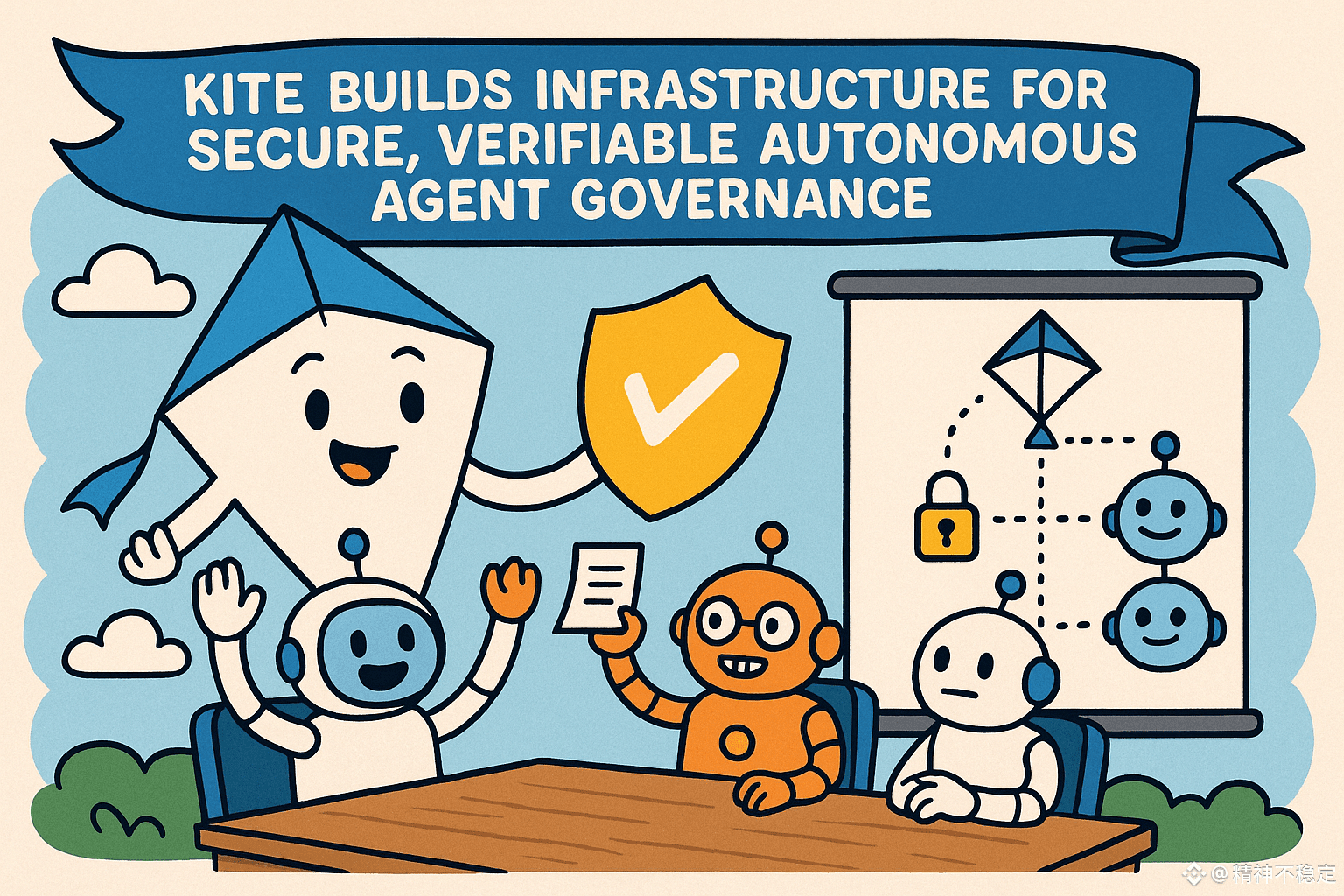
@KITE AI steps directly into that gap. Instead of building “smarter” agents, it builds the rails underneath them the infrastructure that makes decision-making and action-taking auditable, enforceable, and governable from the outside. It treats agents not as clever black boxes to be trusted, but as untrusted systems that must earn trust through structure, constraints, and verifiable evidence.
The core idea is that autonomy without governance doesn’t scale. A single engineer can babysit a prototype agent, watch logs, and intervene when something looks odd. That breaks the moment you have dozens of agents triggering thousands of actions across payments, infrastructure, customer data, or internal tools. Humans can’t keep up, regulators won’t accept “we think it behaved correctly,” and security teams need more than a vague assurance that guardrails exist somewhere in the code.
Kite’s focus is to turn all of that into infrastructure: identity, policy, execution, and evidence. Every agent becomes a first-class actor with an identity, not just a process calling APIs. Every action routes through a control layer that decides whether it’s allowed, under what conditions, and how it must be recorded. Instead of “the agent called Stripe,” you get “this specific agent, under this policy, executed this payment, with this justification and this cryptographic trail attached.” Governance stops being a slide in a deck and becomes something you can query.
That level of specificity changes how organizations think about risk. When you know every agent action is mediated by a shared policy engine, you can start to reason about permissions like you do for humans: roles, scopes, contextual checks, approvals for high-risk operations. When an agent wants to push to production, or modify a contract, or move money above a threshold, it doesn’t just “decide” to do it. It asks the infrastructure, which can demand a human sign-off, a second factor, or additional evidence, and only then allow the action to go through.
Verifiability is where it deepens.
Logs aren’t enough. They can be messy, edited, or missing stuff. Kite’s aiming for a system where every agent move is a little action you can easily verify.
Inputs, policies evaluated, decisions taken, downstream effects—all captured in a way that can be reconstructed later and checked against expectations. That’s as useful for debugging and reliability as it is for compliance. When an incident happens, you don’t just see that something broke; you see the chain of reasoning and constraints that led there.
There’s also a subtle but important shift away from trust in models and toward trust in systems. Models will remain probabilistic, opaque, and occasionally wrong.
You’ll never make them perfectly safe. It’s way more practical to plan for mistakes and set things up so any screw-ups only cause minimal trouble.
Kite leans into that philosophy. It doesn’t try to force determinism where there isn’t any; it wraps the non-deterministic core in deterministic controls.
A lot of practical work sits behind that sentence. You need a clean separation between the part of the system that “thinks” and the part that “acts.” You need a consistent interface for actions so that policies can be written once and applied to many agents and tools. You need secure channels and attestations so that when an agent claims it ran in a specific environment with specific constraints, that claim can be verified, not just trusted. You need observability that’s designed for intention, not just for performance metrics.
The result, when it’s done well, is that organizations can move from experimentation to production without pretending there’s no risk. A team can let an agent orchestrate real workflows, but still say, with a straight face, what it is allowed to touch, how it is supervised, and how they would prove that it followed the rules last Tuesday when no one was watching. That’s the difference between a demo and a system that can live inside a bank, a hospital, or a critical internal platform.
None of this is especially glamorous. Infrastructure rarely is. But it’s the kind of work that determines whether autonomous agents remain a series of impressive prototypes or become a reliable part of how software operates in serious environments. Kite is betting that the future belongs to systems that can answer hard questions: Who did what? Under which policy? With what evidence? And what happens if we need to roll it back?
As agents become more capable, those questions stop being optional. They become the baseline. Governance, in this sense, isn’t a brake on progress. It’s what allows autonomy to be used at all in places where stakes are real, regulators are attentive, and mistakes have lasting consequences. By treating governance as infrastructure rather than an afterthought, Kite isn’t just protecting organizations from their agents; it’s giving them a way to actually use those agents with confidence.

