Breaking news is circulating in the market: Analysts indicate that the Federal Reserve may launch a new round of quantitative easing (QE) in January 2026. Although it has not been officially announced, the market has begun quietly pricing in this expectation — the S&P 500 index is approaching historical highs, seemingly preparing for a future liquidity feast.
If this expectation materializes, global liquidity will enter a new expansion cycle. History tells us that when the liquidity gates reopen, funds will not only flow into the stock market but also into high-beta assets like cryptocurrencies. The prosperity of the crypto market has always relied on one key infrastructure: reliable, real-time data services.
This is precisely the moment when @APRO-Oracle may welcome a historic opportunity.
Why?
The multi-chain ecosystem will accelerate its explosion.
Driven by liquidity, funds will seek more growth opportunities. Ethereum, Solana, Bitcoin Layer 2, emerging public chains, etc., will greet active development. Application cross-chain deployment will become the norm, whilecross-chain data servicesare exactly APRO's core advantage. It can serve multiple chains with a unified interface, avoiding data silos, which is the most scarce capability in the multi-chain era.The demand for complex financial derivatives is surging.
In an environment with abundant liquidity, DeFi will no longer be satisfied with simple lending and trading. Structured products, derivatives, options, and other complex protocols will emerge in large numbers. These products have high requirements for oracles' timeliness, accuracy, and resistance to manipulation, which is exactly the moat that APRO focuses on building through verifiable data and random number service (VRF).RWA and AI agents are ushering in scale.
More traditional assets will go on-chain (RWA), and more AI agents will participate in on-chain trading and management. Both requiretrusted, verifiable off-chain dataas the operational foundation. APRO's AI parsing and verification capabilities for unstructured data (such as contracts, financial reports) may become the key driver for large-scale application implementation.
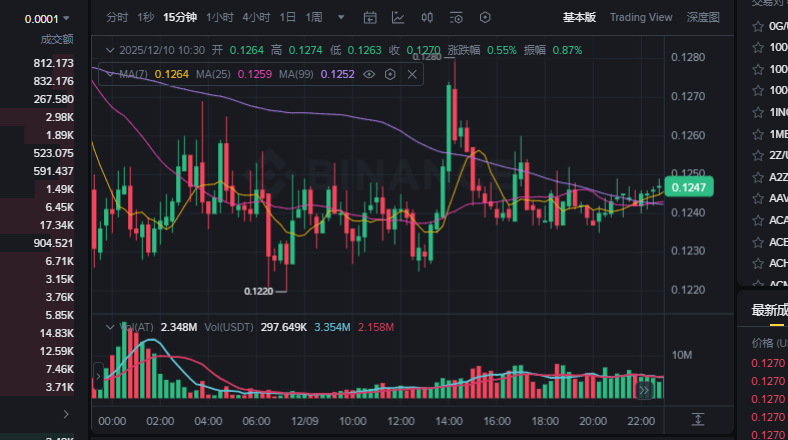
AT, as the governance and utility token of the APRO network, will directly capture the value of ecological growth: more chains need to connect, more data needs to be called, more nodes provide secure staking—these will all translate into substantive demand for AT.
When the market is still debating 'when will the interest rate cuts come', the real strategists are already focusing on 'after liquidity arrives, which facilities are the most irreplaceable'. Oracles, especially new generation data networks like APRO that are multi-chain, verifiable, and highly available, are likely to become the essential path for value flow in the next cycle.
This is not speculation, it is the inevitability of infrastructure. When the tide comes in, you need to pay attention not only to which ships will float, but also to which ports will become the center where countless ships converge.