
Some oracle teams talk about trust like it is easy. It is not. Anyone who watched the past few years of chain failures knows that most “trustless” systems still rely on a long chain of humans who pull data from scattered places. One weak link, and the whole thing tilts. That is the part that drew attention to APRO’s AI verification system. It tries to fix the issue without acting like tech alone solves everything.
APRO began rolling out the system in pieces during early 2025, and by July the team said the core checks were live for all test feeds. That detail matters because this isn’t a lab demo anymore. The updates run on real markets, with live price swings and messy news cycles. The AI has to deal with that noise, which is the point.
People often hear “AI” and expect magic. The work here feels more like plumbing, but smarter. Normal oracle filters spot giant jumps or missing fields. Useful, but attackers know how to slip under those lines. Markets also move fast. Some days the entire screen looks like an alert system. Static rules fail in these scenes.
APRO’s models handle patterns a bit like a tired market analyst who has seen enough weird moves to sense when something feels off. The system compares feeds against other markets, checks time patterns, looks for stale data and even cross-checks with simple news signals when it makes sense. If a value feels wrong, it pauses everything and kicks the item into a deeper review. It is not glamorous. It just works in the way a guardrail works.
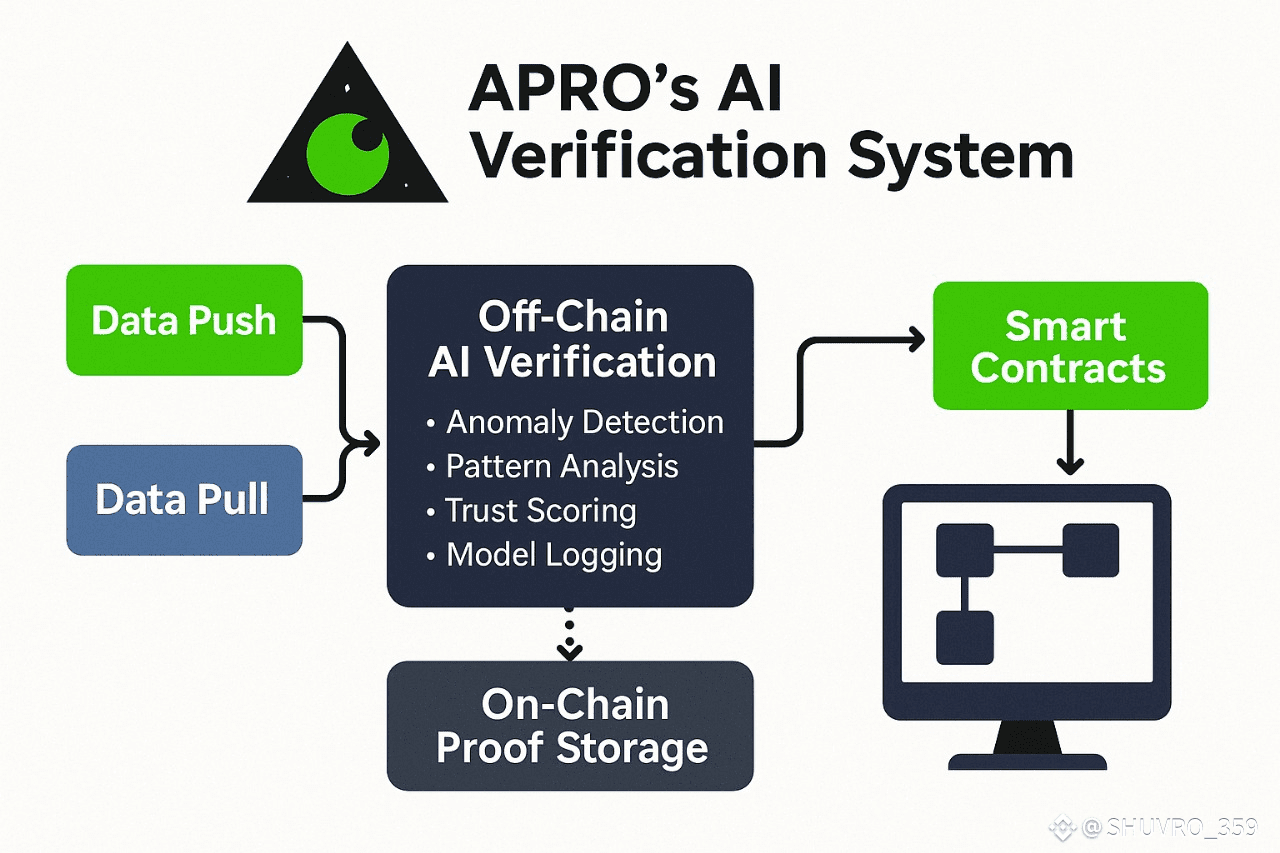
The setup has two parts. One sits off chain and handles the heavy tasks, pattern checks, anomaly scans, trust scores and model logs. This is the busy workshop area. The on chain layer is smaller. It stores proofs, signs data packets and keeps a visible log for anyone who wants to check what happened. The split seems practical. You get speed without turning the chain into a giant compute machine.
When APRO talks about transparency, this is the part they point to. The chain stores enough proof to show the work, not all the clutter. Users see what changed, when it changed and which checks fired. A simple layout that feels more honest than most.
Some apps like regular updates. Others want fresh data only when a contract asks for it. APRO supports both. Data Push sends values at fixed times, which works well for price feeds. Data Pull answers direct requests from contracts, helpful for apps that hate stale input.
Both paths share the same AI checks, so the user does not need to trust that one side is stricter than the other. The system scores each feed, trust, timing, pattern, peer match. If something drops below threshold, it either gets flagged or blocked. No drama.
The interesting part is not the normal data. It’s the moments when the system hesitates. Sometimes markets spike for real reasons. Sometimes the spike comes from a sketchy source. The AI tries to sort these without jumping to conclusions.
A few testers pointed to events from early 2025 when fake price jumps hit smaller chains. APRO ran similar attacks during trials. The AI flagged the values because they did not match cross-market checks. Not heroic, just logical. Slow drift attacks also show up. Those are sneakier. A price changes by tiny bits until it bends the curve. APRO’s logs help track these long paths, and the system sends alerts when the trend starts looking forced.
By August 2025, APRO had test feeds on Ethereum, Base, Solana and BNB Chain. Anyone building across chains knows how strange it gets when the same asset shows different values because feeds update at different speeds. APRO’s system lines them up and looks for gaps. If one chain starts drifting far from the others, the AI tries to find the reason, whether it is sync lag, provider failure or a bad source. It highlights the odd part so devs do not squint at charts for hours.
APRO updated its SDK in April 2025. The new version lets devs fetch data with a simple call. It also exposes scores and proof notes so apps can decide how strict they want to be. Some apps will reject anything that looks even slightly odd. Others may accept values with mild warnings. At least the choice is clear.
The explorer tool shows the full data path. Source, checks, proof, final value. A bit like watching security footage, but for data.
Randomness is hard to get right. APRO uses entropy from trusted nodes, checks it for bias and posts the result with proofs on chain. This helps games, raffles and any contract that needs public fairness. The AI part keeps an eye out for patterns that would make random outputs too predictable.
The team said it plans to add more data types by late 2025. Weather, sports, freight, basic economic stats. These are messy fields with odd schedules. A clean feed system rarely works for all of them. That is why the AI checks matter. They can adapt, at least a little, without rewriting everything each time a new source joins.
What APRO seems to aim for is simple. Let the system audit itself at every step. Let users see the logs. Keep the rules clear. If it scales, contracts will not need human review for every strange price swing or feed delay.
Some oracle projects chase big slogans. APRO’s AI system feels more like a tool someone built because they were tired of cleaning up after broken feeds. Practical, not flashy. If the system keeps improving, it may become one of those parts of the chain world that people forget about only because it finally stopped breaking.

