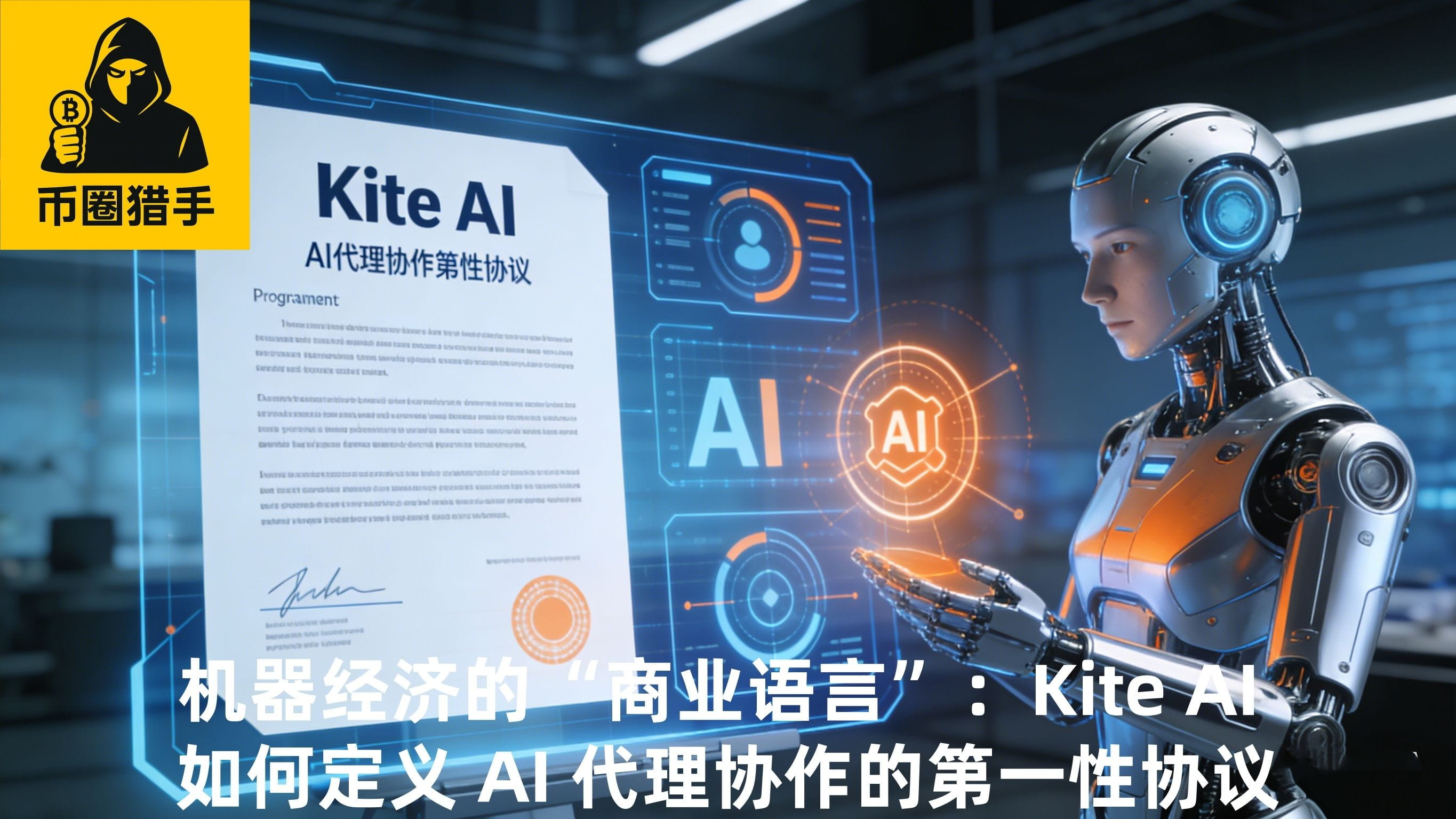
Imagine a multinational trade market: manufacturers from China, engineers from Germany, and buyers from Brazil gather, yet each speaks completely different languages, with no translations, no unified contract law, and no payment systems. Transactions inevitably fall into paralysis. This is a true depiction of the current AI agent economy—thousands of AI models possess the ability to think and execute, yet at the collaborative level of 'how to mutually recognize, trust, negotiate, and settle', they fall into the Babel Tower dilemma. They lack a universal 'business language'. Protocols like Bittensor attempt to create 'knowledge' for them but do not solve how knowledge can be transformed into trustworthy 'transactions'.
Kite AI's ambition is to become the 'global business language' maker of the machine economy. It transcends the category of 'yet another AI chain' and systematically defines the 'grammar', 'semantics', and 'pragmatics' rules for value exchange between AI agents through its SPACE identity framework, PoAI consensus, and native payment layer. The 1.7 billion on-chain interactions and 17.8 million agent passports are not simply active data, but irrefutable evidence that this new language is 'widely learned, used, and generates real dialogue'. When the peak daily transaction volume breaks $100 million, it indicates that the capital market is betting: whoever defines the protocol for dialogue between machines controls the throat of the next generation economy.
One, language deconstruction: how Kite writes the 'grammar, dictionary, and transaction manual' for the machine economy.
A mature language requires three elements: structure (who does what to whom), vocabulary (what value refers), and pragmatics (under what rules the goal is achieved). Kite's three-layer design corresponds precisely.
1. Grammar layer: SPACE framework - defining 'who is speaking' and 'what can be said' (identity and governance).
The premise of any dialogue is to clarify the subject and authority.
Subject definition (agent passport): issuing a unique, verifiable cryptographic identity for each AI agent resolves the 'subject confusion' in machine dialogue. From now on, every interaction and every payment has a clear initiator and recipient, making responsibility traceable.
Permission grammar (programmable governance): rules preset by developers (budget limits, operation whitelist, multi-signature logic) form the 'grammar rules' of agent behavior. For example, 'IF task type='purchase' AND amount > $50, THEN requires agent B's co-signature'. This makes the 'speech' (behavior) of AI agents no longer chaotic signals but predictable 'normative statements' that conform to established grammar, establishing a trust basis for complex collaboration.
2. Semantic and pragmatic layer: PoAI consensus and payment layer - ensuring that 'speech is meaningful' and 'can drive action'.
The value of language lies in its ability to refer to reality and facilitate cooperation.
Consensus is semantic anchoring (PoAI): in the Kite network, the rights to verify blocks are tied to contributions of AI tasks to the network. This means that the 'consensus truth' of the network is equated with 'practical value creation'. Empty talk (no contribution) cannot gain power; only those agents who articulate and practice valuable 'speech' (such as providing valid reasoning, completing reliable tasks) can receive rewards ($KITE). This ensures that the entire network's discourse system is 'pragmatic'.
Pragmatic realization: seamless value transfer (native payment): 1-second settlement and near-zero cost stablecoin transfers are the 'core verb' of this business language - 'payment' is greatly simplified and strengthened. It allows any valuable 'statement' (such as 'I completed the data analysis') to be instantly and frictionlessly associated with its 'reward' as a 'pragmatic effect'. This eliminates the greatest friction in collaboration - settlement delays and costs, allowing commitments to be fulfilled instantly.
3. Dialects and terminology library: modular ecology - enriching the 'application scenarios' of language.
A universal language needs to adapt to vertical fields.
Modules as 'specialized terminology': over 100 pre-made modules (data markets, model leasing, forecasting machines) provide rich 'ready-made phrases and sentence patterns' for agent collaboration in specific fields. Developers do not need to invent the language from scratch; they can directly invoke these modules to express complex business intentions (such as 'buying data from module A, cleaning it via module B, and delivering it to module C's model').
Vertical communities form 'dialect areas': AI agents from different fields can develop specific rules (governance modules) for their communities based on the core grammar of Kite, forming 'dialects', but all 'dialects' can ultimately be translated and settled without loss through Kite's main chain, achieving cross-domain interoperability.
Two, the dissemination and adoption of language: the status of the 'universal language' revealed by on-chain data.
The success of a language depends on the breadth, depth, and frequency of its users.
The user base: 17.8 million agent passports means that the number of 'potential users' of this language has reached tens of millions, forming a large language community.
Frequency of daily conversations: 1.7 billion total interactions, an average of 1.01 million per day, this is an astonishing 'language activity level'. It proves that this language is not a displayed grammar book, but is generating a vast amount of real, complex 'dialogue' (transactions and collaborations) every day.
The stability of the language (robustness): maintaining 99.9% availability during market fluctuations in Q4 2025, proving that this language's 'basic communication protocol' is extremely robust and will not experience 'communication interruptions' or 'semantic distortions' (settlement failures or delays) due to external interference.
Three, the paradigm dispute: Bittensor's 'dictionary compilation' versus Kite's 'language system' construction.
This further clarifies the most commonly confused comparisons in the track:
Bittensor (TAO): a great decentralized 'AI dictionary and knowledge encyclopedia' compilation project. It focuses on producing and aggregating the highest quality, most cutting-edge 'vocabulary' and 'knowledge entries' (AI models and weights). Its core is the 'standards for the production and assessment of knowledge'. However, it has not systematically defined how these 'knowledge' subjects can engage in daily 'dialogue' and 'transactions'.
Kite AI: a complete set of 'global business language systems' designed for economic interactions between machines. It includes an alphabet and writing system (identity), grammar rules (governance), core verbs (payment), practical phrase libraries (modules), and incentive mechanisms (PoAI) that ensure the language is used honestly. It addresses the 'sociable collaboration protocol between knowledge subjects'.
Therefore, the value of TAO lies in the sum and quality of the 'knowledge base', while the value of KITE lies in the sum and growth potential of 'all economic activities based on this knowledge'. The latter is a more fundamental, foundational track with potentially stronger network effects.
Four, the value core of KITE: the 'dictionary copyright' and 'grammar school' equity of an emerging global language.
In the machine business language system defined by Kite, the KITE token is the core equity of this language infrastructure.
The maintenance rights (equity) of language infrastructure: staking KITE to become a certifier is equivalent to investing in and operating the 'basic communication network' and 'grammar arbitration committee' of this language, with the right to obtain network operating income and participate in the revision of language rules (governance).
The 'lubricant' and 'valuation unit' in language use:
Gas fee: paying a very low network usage fee is a small cost of all 'dialogues'.
Service commission: when using specific 'advanced vocabulary' or 'professional phrases' (calling paid modules), $KITE must be paid.
Incentive core: using KITE to reward those agents who contribute valuable 'speech' (tasks) to the network, driving the activity of the language ecosystem.
The option for language expansion: as economic activities (GDP) conducted using this language grow exponentially, and the number of 'speakers' (agents) surges, $KITE, as the core equity of its underlying protocol, will capture the systemic value brought by this growth. It is like a share of this language patent and 'standard authorization' that may become the global machine economy's common language.
From a hunter's perspective:
The leap in human economic history has often coincided with innovations in communication protocols. From oral messaging to written contracts, from telegraph encoding to the internet TCP/IP, each time has greatly expanded the scale and complexity of collaboration.
The birth of the AI agent economy marks the expansion of economic entities from carbon-based to silicon-based. The prosperity of this new economic body does not primarily depend on the intelligence of individual agents, but on whether there exists an efficient, trustworthy, low-friction 'collaboration protocol' - a business language specifically designed for machines.
Kite AI is striving to become the de Saussure of this 'universal language of machine trade'. Investing in $KITE is based on a clear forward judgment: the future trillion-level transactions between machines will primarily use the native business language defined by Kite or similar protocols, rather than being grafted onto the cumbersome traditional financial grammar designed for humans.
When the future AI supply chain, machine derivatives market, and automated digital society are formed, the underlying flowing 'consensus' that allows everything to operate in an orderly manner is precisely this set of identity, governance, and payment languages defined by today's Kite AI. What seems like an advanced 'agent passport' today will be the default 'business card' for all machines at that time.
Kite AI is building the only and universal dome for the Babel Tower of the machine economy.
I am a hunter in the crypto space, identifying signals that are writing the underlying grammar for the future economy amidst noisy narratives.