
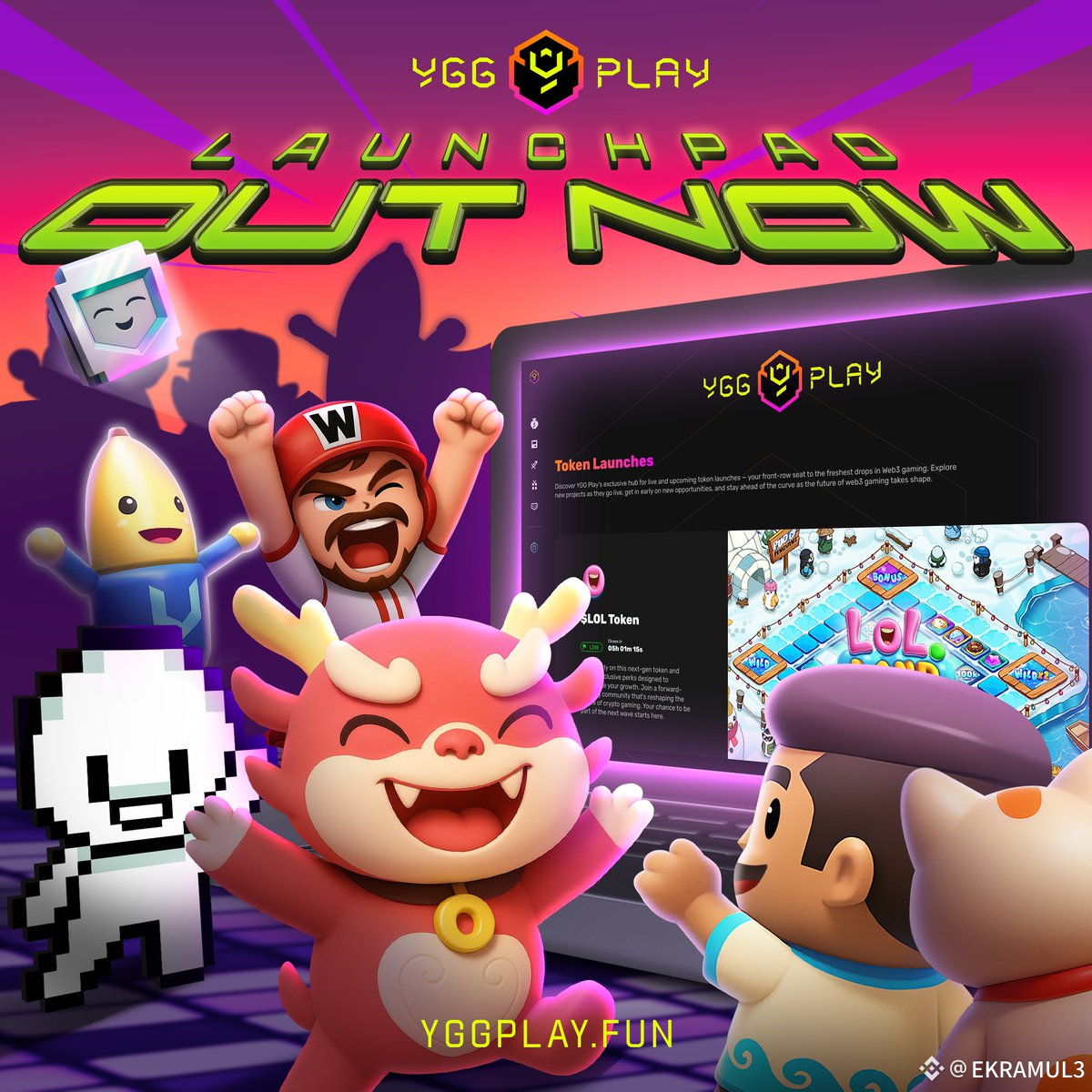
 Yield Guild Games has entered a stage where calling it a “guild” feels too small for what it has become. Over the past few years, YGG has quietly evolved into something much larger, something far more foundational than a gaming collective. It has become Web3 gaming’s largest and most efficient human coordination network a decentralized engine that organizes people, distributes opportunity, accelerates game adoption, and transforms scattered player activity into a synchronized force.
Most Web3 projects get caught up in token economics, flashy marketing, or chasing short-lived user spikes. Not YGG. They focused on something that actually lasts people. Real communities. Connections that matter. A sense of shared identity and belonging. You see this over and over in digital history social networks, MMOs, open-source groups they all thrive because of these same core elements. YGG just remembered what everyone else seemed to forget.
The result?
YGG is no longer participating in the Web3 gaming revolution.
YGG is powering it.
1. The Industry Chases ‘Users’, YGG Builds Coordinated Communities
Other gaming ecosystems treat players as temporary “addresses” in their dashboards numbers to report, metrics to optimize, funnels to convert. The relationship is transactional. When the rewards slow down, the users disappear.
YGG rejects that logic entirely.
Instead of collecting players, it connects them.
Instead of counting users, it cultivates communities.
Instead of relying on traffic, it builds tribes with shared goals.
This is why YGG has outlasted every hype cycle.
People don’t stay for incentives.
People stay for each other.
2. The SubDAO Network: The Most Powerful Cultural Infrastructure in Web3 Gaming
Every SubDAO inside YGG is more than a regional chapter it is a localized coordination hub with its own leaders, culture, incentives, and identity.
Southeast Asia: High-volume grinders
Latin America: Social-driven players
Vietnam: Organized competitive squads
Middle East: Rapid-learning explorers
India: Emerging creator-communities with strong collaboration patterns
YGG didn’t simply decentralize tasks.
YGG decentralized culture, leadership, and player intelligence.
This mosaic of SubDAOs creates a global network where each region contributes a different kind of player energy, skill, and creativity. No other Web3 ecosystem has such a dynamic human grid.
3. YGG Play: From Community Activity to Coordinated Player Movements
What most outsiders miss is how YGG Play functions beneath the surface. It is not a quest system. Not a task engine. Not a gamified interface.
It is a coordination amplifier.
Through YGG Play:
thousands of players explore new games together
feedback loops form instantly
early ecosystems get stress-tested
gameplay culture spreads virally
skill-based activity gets aggregated
community identity strengthens
What looks like normal engagement is actually real-time mobilization of a global player network. YGG is doing what no Web2 publisher has achieved so efficiently synchronizing massive player activity across multiple worlds simultaneously.
4. Social Capital → Digital Capital: YGG Turns Community Behavior Into Economic Energy
Every successful virtual world in history from RuneScape to World of Warcraft to Roblox was built on one invisible engine: community energy. YGG is the first organization to translate that energy into a measurable, portable, on-chain asset.
Inside YGG:
contribution becomes reputation
commitment becomes digital identity
collaboration becomes opportunity
participation becomes value creation
YGG turned something intangible community power into a new form of digital economic strength.
This is why new games approach YGG first.
They don’t just want users.
They want community liquidity.
5. Beyond ‘Guild’: YGG Is Becoming a Digital Society With Its Own Economic Logic
The deeper YGG evolves, the more it resembles a digital society, not a guild:
SubDAOs act as provinces
player roles act as professions
quests act as workstreams
SBTs act as identity markers
vaults act as investment banks
governance acts as civic structure
global events act as festivals
No Web3 project has ever created such a layered social architecture.
This is not community management
this is community infrastructure.
6. Why This Matters: Games Don’t Need Users, They Need Ecosystems
A game with a million users but no community will collapse within months.
A game with 50,000 coordinated players will last for years.
Studios now realize:
Players are not the resource.
Community coordination is the resource.
YGG provides exactly that.
It gives studios:
instant player liquidity
cultural penetration
global distribution
community testing
long-term retention
organic evangelism
This transforms YGG from a participant into Web3’s infrastructure for player coordination.
7. The Quiet Truth: YGG Has Already Become the Core Social Layer of Web3 Gaming
Most of Web3 is still stuck in spreadsheets, KPIs, token emissions, dashboards, and vanity metrics.
Meanwhile, YGG:
builds player identity
builds regional culture
builds global mobility
builds skill networks
builds social narratives
builds real belonging
And that is why YGG will outlive every token trend, every bull-bear cycle, and every short-term hype wave.
You can copy mechanics.
You can copy token models.
You cannot copy community coordination intelligence.
8. The Next Cycle: Web3 Gaming Will Be Won by Those Who Can Coordinate Humans at Scale
In the next era of Web3 gaming, the most valuable resource will not be:
NFTs
hardware
tokens
marketing
hype
It will be people who know how to play, collaborate, organize, build, and belong inside digital worlds.
YGG already has:
the coordination network
the SubDAO infrastructure
the cultural distribution
the community identity
the player mobility layer
the skill-based progression rails
This makes YGG the early architect of Web3’s human infrastructure layer.
YGG Is Not Just Powering Web3 Gaming It Is Rewriting How Humans Coordinate in Digital Economies
Yield Guild Games is proving a simple but powerful truth:
Technology does not build digital worlds.
People do.
And coordinated people build empires.
YGG has become the silent engine enabling that coordination not through hype, not through noise, but through a global, persistent, deeply connected community structure that no other project has even attempted to replicate.
YGG is not the future of Web3 gaming.
YGG is the foundation of it.
