
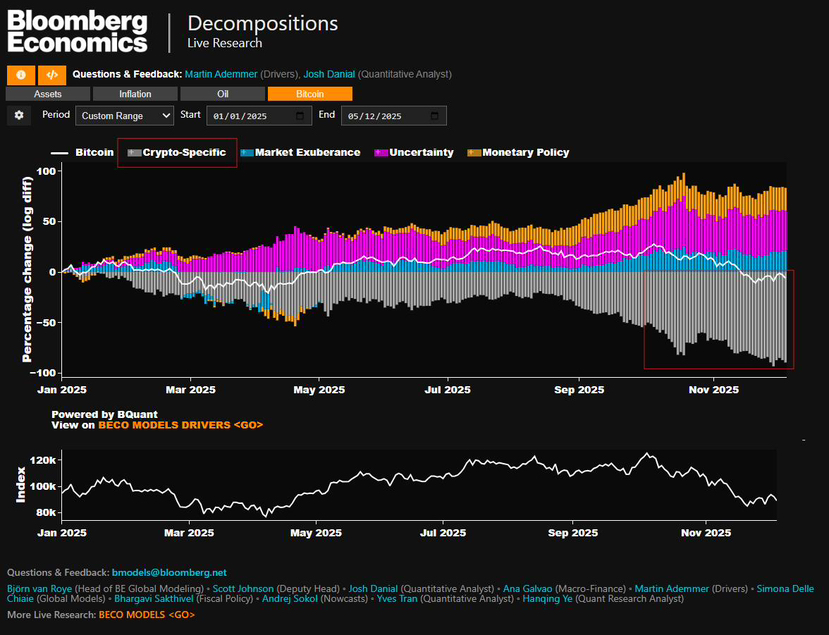
Their model of growth driver decomposition shows that the drop in Bitcoin in 2025 is almost entirely caused by internal crypto factors (see the gray area on the chart). Meanwhile, macro variables - monetary policy, market sentiment, uncertainty - on the contrary, were supportive (throughout 2025 they contributed to the price rather than pulling it down).
This confirms the hypothesis that the problem is not in the rates, not in liquidity, and not in the global economy. But in local capitulation pressure within the market: likely referring to selling by long-term holders (LTH), possibly against the backdrop of internal crises in the industry, lawsuits, or regulation.
Thesis: Bitcoin fell not because macro became worse, but despite macro becoming better.
And this is an important signal: if crypto-specific factors are resolved (or exhaust themselves), Bitcoin has the potential to quickly recover - because the fundamental environment remains positive.
In addition to this...
Two charts, one hint: Jane Street plays by its own rules.
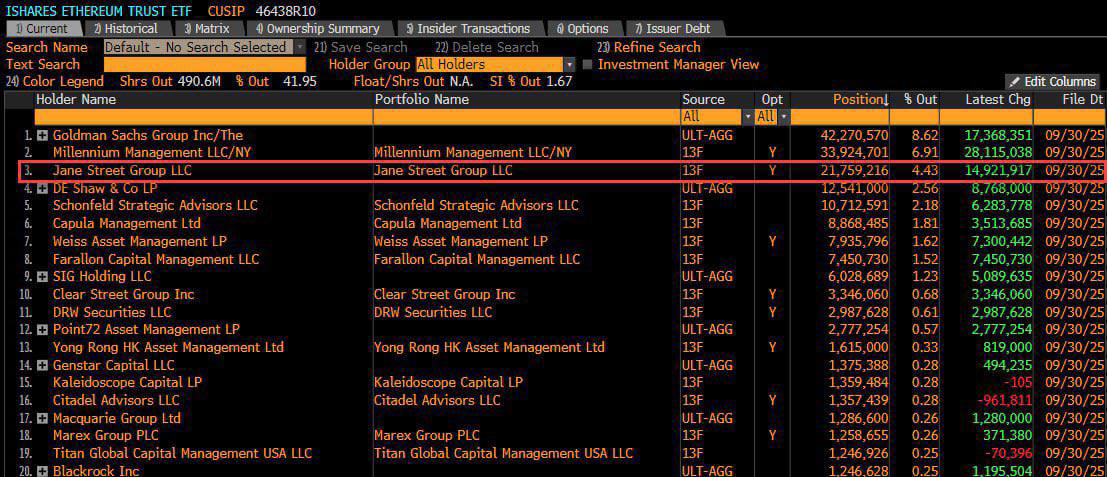
▫️The first picture - Bloomberg data: Jane Street is among the top 3 holders of the iShares Ethereum Trust ETF, with a position of nearly $1 billion. Quarterly increase - +15 million shares. This is no longer a market maker; this is a systemic holder.
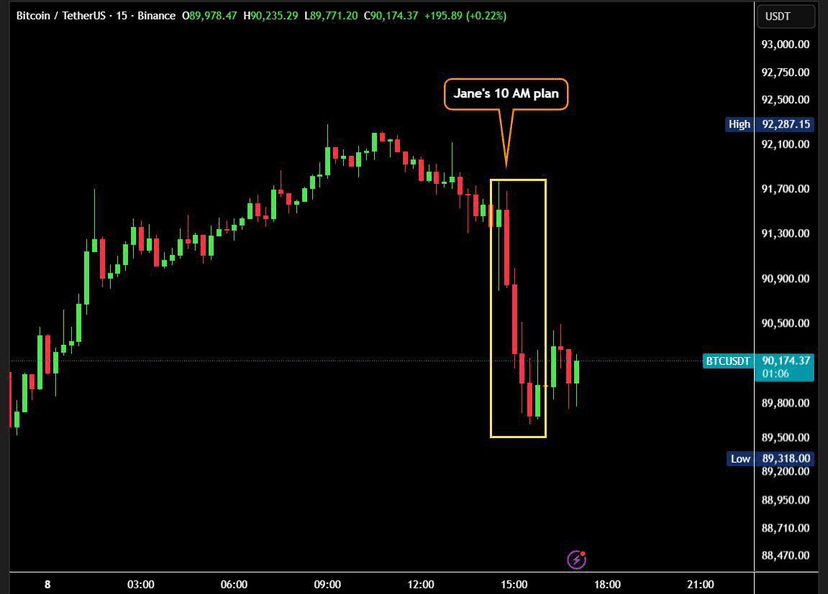
▫️The second picture - 15-minute BTC/USDT chart: exactly at 10:00 NY time, there is a sharp drop in Bitcoin, wiping out 16 hours of growth in 20 minutes. This happens almost every day since November. Clean, fast, by the template. Perfect high-frequency execution fingerprint.
The combo of these two charts speaks to the main point:
It's not the market selling. It's someone big doing a 'controlled dump' to buy lower.
And everything adds up:
• Jane Street is one of the largest HFT players in the world, with experience in arbitrage between spot and derivatives.
• They have huge positions in crypto ETFs (including $2.5B in BlackRock IBIT).
• They can simultaneously be a liquidity provider and a participant influencing the price.
The scenario looks like this:
1. They sell futures or spot at the NYSE open → create a 'scary candle'.
2. They catch liquidity lower when stop losses and option strikes trigger.
3. They buy back → stabilize → push up.
4. They repeat.
What looks like a 'market weakness' may actually be an accumulation play by insiders. And if that's the case - after this cycle ends, there will be no rollback, but rather an acceleration of growth.
BTC is falling - but not because it’s weak, but because it’s being bought through fear.

