📉
MERL three failed attempts: why $0.5 has become an insurmountable ceiling?
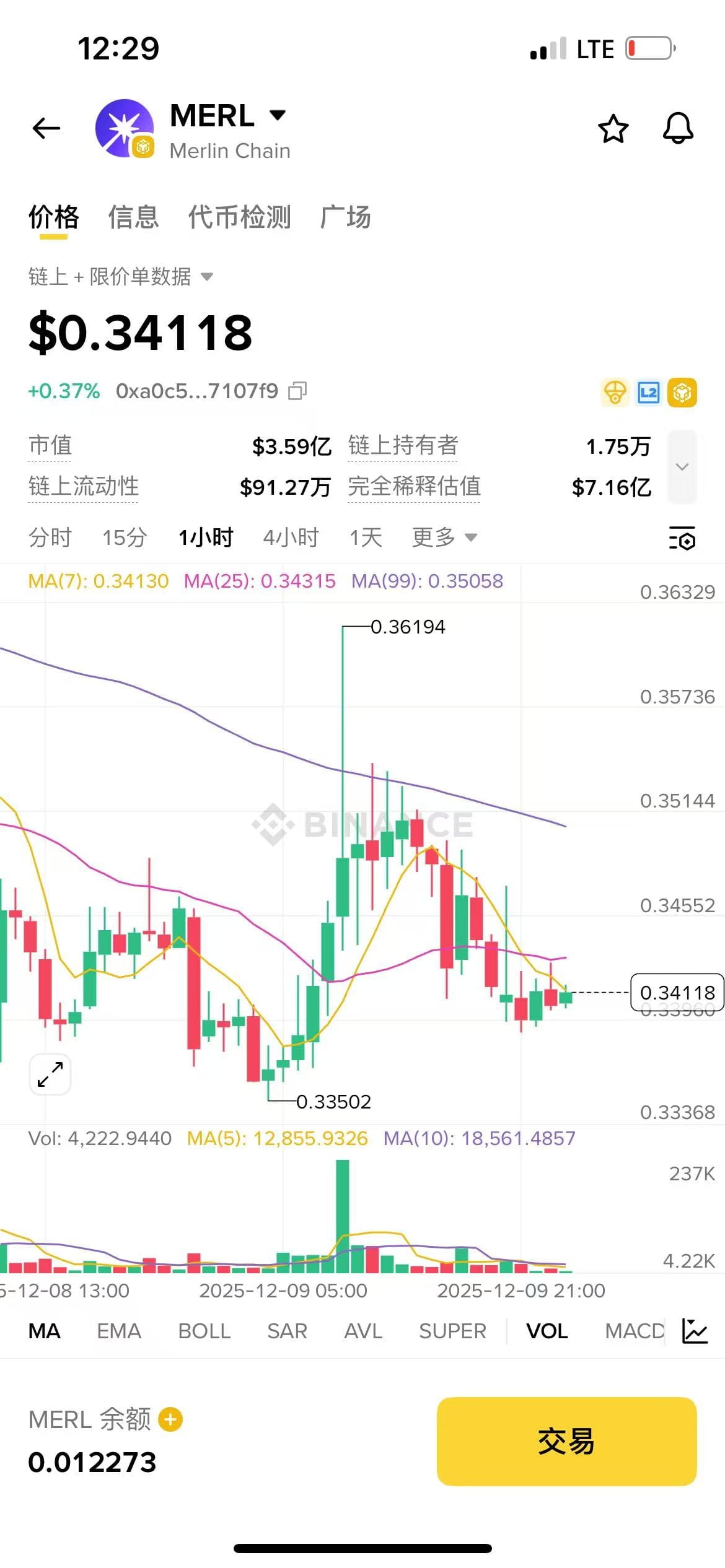
Recently, I have been closely observing $MERL 's price structure, and one thing that has become increasingly obvious is: the market's short-term sentiment is rapidly weakening, and $0.5 seems like a 'hard resistance' that cannot be surpassed at this stage.
In the past few weeks, $$MERL has attempted to break through $0.5 three times. Each time, the main funds tried to push it higher, but the results were the same—encountering resistance when touching the key range, and then falling back.
This pattern tells us two things:
First, the structural selling pressure is very clear.
Every time it approaches 0.5, the trading volume expands, but the buying pressure cannot be sustained, indicating that active funds are very cautious in this range. Everyone can see that this is a position of 'wanting to go but unable to', and the market consensus has invisibly formed an upper limit.
Second, the market's risk appetite has clearly decreased.
In terms of the overall market, BTC and ETH are both weakening in the short term, and the sentiment leans more towards a defensive state. In this generally cold pattern, it is inherently more difficult for small and medium-sized assets to break through key resistance.
As MERL approaches 0.5, it lacks an external stimulus to continuously push the market higher, making a breakthrough naturally more difficult.
Third, on-chain behavior also reveals important signals.
Many addresses have shown continuous reduction actions around the 0.48–0.5 range, and this typical short-term arbitrage behavior makes the pressure in the 0.5 area more 'real'.
In other words, the market is transitioning from an initial chasing high sentiment to a 'sell when in position' model, which is very unfriendly to trend continuation.
🔍
From structure to sentiment: MERL may have a deeper retracement in the short term.
When a coin fails to break through three times in a row, it indicates that the selling pressure is not accidental but a structural issue.
A triple top structure, while not an absolute signal, usually indicates that the short-term trend is starting to weaken.
Combining the current sentiment and capital behavior, my view is very clear:
In the short term, I would lean towards maintaining a bearish expectation.
Especially against the backdrop of an unstable market, MERL is likely to undergo a deeper technical correction.
I personally will pay attention to the 0.25–0.20 USD range, which is a position with a high historical chip density and potential reversal possibility.
If there can be volume cooperation here, funds may reallocate in this range, and the market may welcome a new direction choice.
📉
Short-term bearish, but no change in long-term observation: waiting for the market to provide a better price.
My attitude towards MERL is:
Short-term bearish, but not denying the long term.
The current trend looks more like a 'phased adjustment' rather than a structural end.
Once the market completes the retracement and clears the sentiment, the real opportunity will appear.
Currently, there is only one key point:
After the continuous failure to break through 0.5 USD, the market is unlikely to immediately organize a new round of offensive, and the short-term trend continuing to lean weak is a high probability event.
Therefore, I will continue to remain watchful, letting the price reach a more reasonable position and allowing the market to signal a change by itself.
If you are also paying attention to MERL, it might be wise to calmly observe the market structure—when the sentiment recedes, observation is often more important than action.