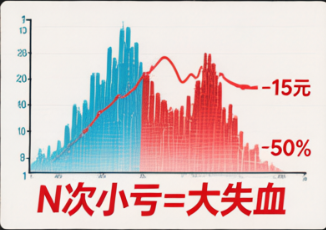
Old man Taleb is back to dismantle the platform!
The latest (trading with stop-loss) paper,
It’s like exposing the ‘stop-loss’ concept completely for others to see,
Always thinking that setting a stop-loss means safety, our little cleverness is clearly calculated by the old man using mathematical formulas, it’s all a trap!
No need for lengthy discussions! I’ve condensed the content into the following four points!
1. A stop-loss is not as simple as ‘losing to X and running away’
How many people naively think: Buying a coin for 100 yuan, setting a stop-loss at 90 yuan, will only lose a maximum of 10 yuan? Taleb sneers: Naive!
Gap down: The US stock market crashed at midnight, and the next day's opening directly dropped to 85 yuan, your stop-loss order hasn't triggered yet, and your account has already lost 15 yuan.
Slippage assassin: you set a stop loss at 90, but when the market panics, nobody is willing to take over, the actual transaction might be 87 or even lower - the 'stop loss price' is just psychological comfort, actual losses depend on the market's mood.
The old man's original words: 'The stop loss line is not a fuse; it's a paper-based firewall, easily broken by the wind.'
2. A stop loss distorts your profit and loss curve
Not setting a stop loss: your profit distribution is a normal bell-shaped curve (it could be a big gain or a big loss).
Setting a stop loss: your losses are forcibly 'cut off', but the fragments that were cut off are all piled up near the stop loss point, ugly like a wound cut by a knife.
Taleb proves with probability theory: stop losses create a 'spike' in your loss distribution, concentrated around the stop loss price - you think you've controlled risk, but in fact, you've broken a single large loss into N small losses, accumulating to more, like boiling frogs in warm water.
For example: if you lose 10% each time and run away, that's 20 stop losses in a year, losing 1000 each time, and by the end of the year - 20,000 is gone! If you don't set a stop loss, you might only lose 2000 once, and the remaining money can wait for a rebound.
3. On the surface, 'steady as a rock', but in reality, 'chronic suicide'
Many people love stop losses because they see their account fluctuations decrease, feeling that 'risk is controllable'. Taleb directly pours cold water on that: it's an illusion!
Frequent stop losses = transaction fees + emotional wear: each stop loss incurs a commission, and too many times equals working for the brokerage; worse is the mental breakdown - just as you cut losses, the market rebounds, repeatedly slapping your face, and finally you can't help but go all in, losing even more.
Missing out on a rebound = chronic blood loss: you set a 10% stop loss, and when the stock price drops 9%, it triggers, only for the next day to surge 20% - you missed out on a 20% gain to avoid a 10% drop, a typical case of picking sesame seeds and dropping watermelons.
4. In front of a 'black swan', stop loss is just a joke
Who is Taleb? The author of 'The Black Swan'! He understands the power of extreme conditions the best:
No liquidity during a crash: the 2008 financial crisis, the 2020 negative oil prices, and the 10.11 cryptocurrency crash, the market collapsed instantly, and stop loss orders couldn't be executed in time, leading to direct liquidation.
Missing out during a surge: you set a 5% stop loss, and after a stock is suspended, it resumes trading at the upper limit, and you get washed out - the stop loss helped you avoid a 5% decline but made you miss a 50% upward trend.
The old man summarizes with a sharp tongue: 'In thick-tailed markets (where extreme conditions frequently occur), setting a stop loss is like using an umbrella in the rain - when it rains hard, the ribs of the umbrella break first.'
Taleb never said 'you can't set a stop loss', he just tore away a layer of modesty:
Stop loss is not insurance, it's another form of risk transfer - turning a large single loss into multiple small losses, converting 'risk' into 'daily wear and tear'.
The key is not whether to set a stop loss, but why to set a stop loss:
If you set a stop loss out of fear of losing money, you are likely to be played by the market; if it's based on strategic logic, that's another matter.
The last sentence is a big truth
'Stop loss' is like a weight loss pill - the advertisement says 'lose 10 pounds easily', but in reality, it may cause diarrhea, insomnia, and rebound weight gain.
Taleb's paper tells you:
There is no shortcut to losing weight, and there is no 'universal stop loss' in trading.
If you want to live well, either build muscle (enhance cognition) or just lie down (stay away from leverage) - don't expect a band-aid to cure cancer.