
How to find strong tokens?
How to pick strong coins in a bull market?
How to define strength?
"In a certain period, rising significantly", the latter part "rising significantly" does not refer to the absolute increase but rather to the relative increase. For example, if we start comparing from the 1st of this month, then regardless of the token, we uniformly calculate the increase during this period.
Apart from the significant increase during this period, the second definition is that it can be strong continuously, rising continuously, rather than just rising once and ending.
The third definition is that during this period, it falls less and rebounds higher. When it is continuously rising and strong, it only experiences small pullbacks during this process, and subsequent rebounds and increases happen faster and higher.
Describing this with language is not particularly intuitive. Let's switch to the actual market to take a look.
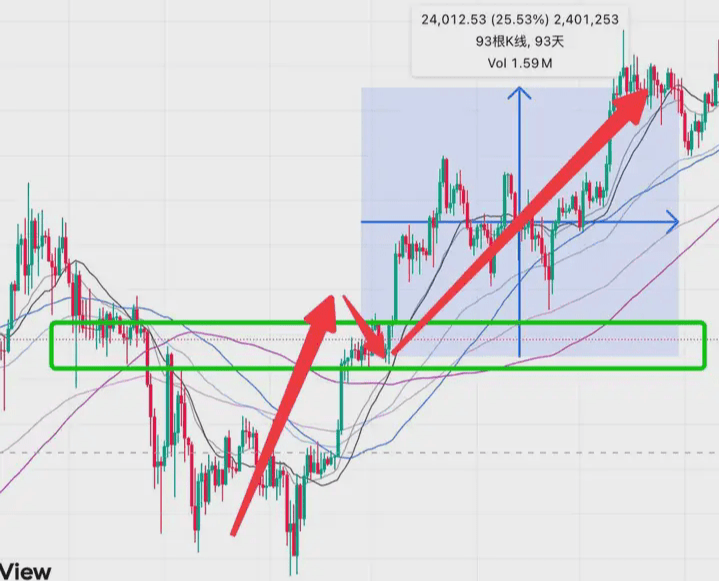
Here I captured three images. The first is the daily chart of Ethereum against USDT, the second is the daily chart of Bitcoin during the same period, and the third is the daily chart of Hyperliquid during the same period. What phenomena can we observe among these three images?
First, we need to select the time span. The bottom is from April 28, 2025, to July 30, 2025, which is the Bitcoin trend during this period. This daily trend is actually when Bitcoin just stood on the daily moving average and pulled back to the daily 20 moving average.
Based on the dual moving average trading system, I will definitely wait for this asset to stand on a dense daily moving average before going long. So I only observed and calculated the rise of Bitcoin after it stood on the daily moving average. Bitcoin has risen about 25% in these 93 days.
 Similarly, when we switch to Ethereum's K-line, we can clearly see that during the same time period from April 28, 2025, to July 30, 2025, the relative rise of Ethereum is 119%.
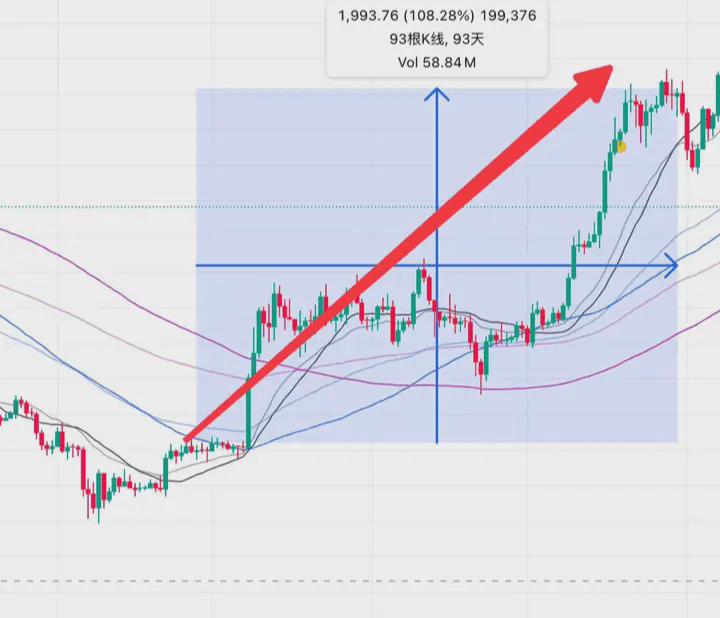 Therefore, by comparing Ethereum and Bitcoin, we can see that by selecting the same time frame, comparing these two tokens, Ethereum is stronger than Bitcoin.
Because Ethereum has risen more and more continuously, and it shows in this segment that it falls less and rebounds more, or it falls less and rises more, and it is continuously strong and continuously rising.
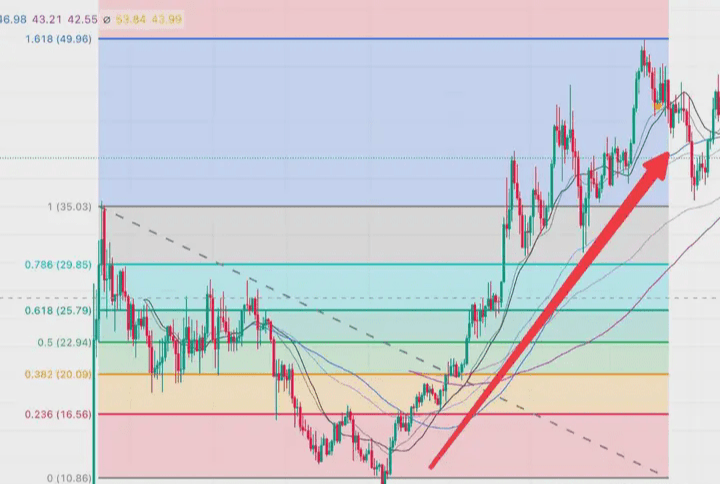 Finally, we switch to Hyperliquid. In the same time frame, from the lowest point to the highest point, it has risen about four times.
So in the same time frame, Hyperliquid will have a stronger rise, and during this rise, it has continuously gone up without any significant pullbacks, or if there are pullbacks, they come back to the daily moving average and then directly V up again, creating new highs.
So comparing Hyperliquid and ETH, in the same time cycle, I find Hyperliquid to be stronger than ETH.
The basic premise of selecting strong coins
Now everyone knows how to define the strength of strong coins. The next part is the basic premise we need to know when selecting strong coins. The first is the reference object, and the second is the method.
So what do we mean by reference objects? Many brothers like to ask: 'Is this token strong? Can this token be traded? Do you think a certain token is strong?' Questions like these cannot be answered directly. Why? Because if you look at a single asset to ask about its strength, we cannot make a comparison.
To judge the strength of a token, you must first have a reference object. Among the reference objects, I usually choose three: one is BTC, one is ETH, and one is SOL.
Bitcoin, I generally consider it as a reference object for the entire market, and all tokens can be compared with Bitcoin. For Ethereum, I generally compare Ethereum-related altcoins with Ethereum. As for SOL, it is also simple; I compare Solana-related altcoins with Solana.
I believe many brothers may have questions about why we should compare like this. Is it superfluous? Actually, it is not. When we usually trade, large positions tend to trade more in BTC, ETH, SOL.
Because these three tokens are the leading tokens in the entire market, with relatively good volatility, they have a very large capacity, and liquidity is also relatively good, making it easy to enter and exit.
So if right now, suddenly I am asked to trade other altcoins, I definitely need to have a judgment: why should I trade this altcoin instead of directly trading BTC, ETH, and SOL? It must be because this altcoin is stronger.
So, at this time, we need to compare it with these three tokens to see if this altcoin is strong and if it is more worthwhile to trade it.
After finding the first reference, the second step is to find where the moving averages are dense. Here, it is recommended to choose larger time frames. What is meant by larger time frames?
That is, daily and weekly lines, because selecting daily and weekly large time frames has stronger continuity and is relatively more stable.
So the third step is to directly compare. Words without action are just empty talk; let's switch to the market to take a look.
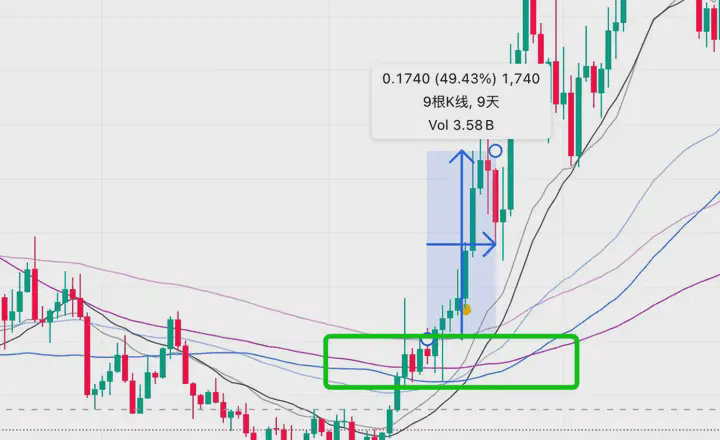
The following is the K-line of BTC/USDT. First, what do we look at? We first look at whether BTC stands above the daily moving average. The green box shows that it has stood above. After standing above the daily moving average, we can see that from July 15 to July 23, it was basically in a sideways trend.
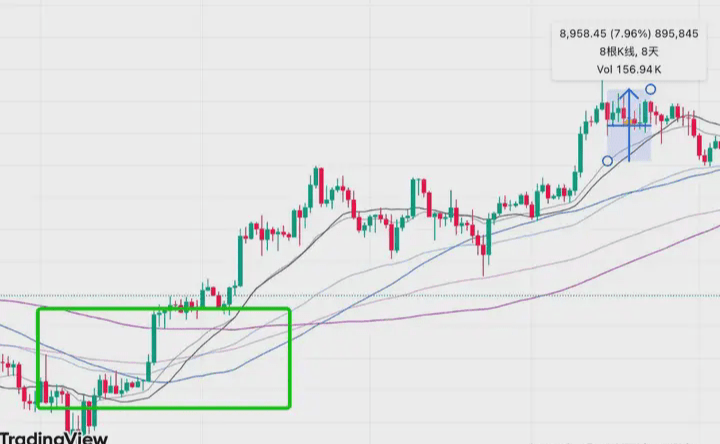 During this sideways period of BTC, ENA has actually risen a lot. It is the same time frame, and after both stand above the daily moving average, this wave of rise occurred. So through this method, we can know that in this same time frame, ENA is stronger than BTC.
 How to select strong coins?
Now, I believe everyone should know how to define the strength of strong coins and the basic premise for selecting strong coins. The third part is that I will share how I select strong coins.
First, we need to clarify our thoughts and our trading ideas. We need to know what kind of strong coins we are looking for, whether we are looking for those stronger than BTC or those stronger than ETH and SOL. We must clearly understand what we are looking for.
When we know we are looking for tokens that are stronger than what reference object, the next step is to choose what capacity of tokens to look for. Because many small altcoins may seem strong, but their capacity is very small.
If your volume is a bit larger, for example, if you have 200,000 dollars, 300,000 dollars, or even 1 million dollars, when it comes to very small altcoins, we may not be able to trade them anymore. We can only trade larger altcoins or mainstream tokens.
The second step is to clarify what to trade with the dual moving average trading system. When it comes to trading with the dual moving average trading system, many brothers may chuckle and instinctively say, of course, to trade strong tokens.
Not at all. What I want to express here is what you use this dual moving average trading system to trade this strong token for. Is it to trade fixed odds trading opportunities based on this dual moving average trading system, or just to trade trend rolling position opportunities?
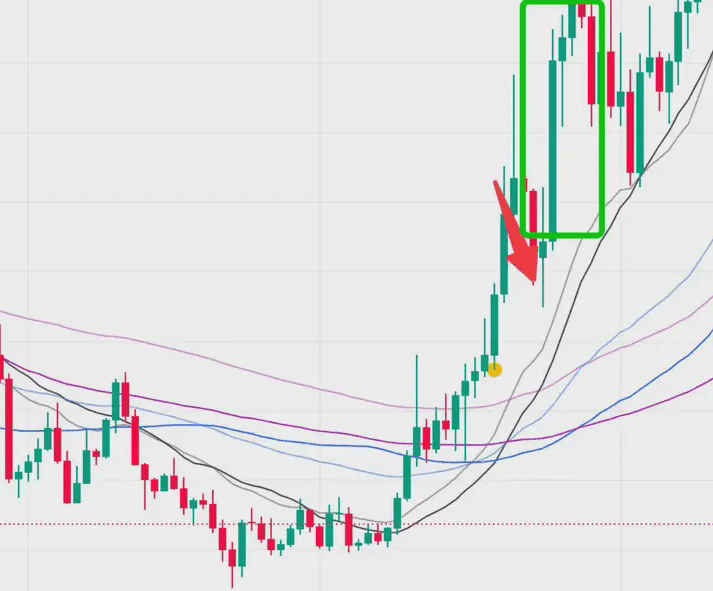
Taking ENA as an example below, in the right green box, it is stronger than BTC. I traded ENA during this period, as its odds were more suitable and its volatility was better. Next, based on the dual moving average trading system, we need to search for trading opportunities.
In the daily chart of ENA token, the red arrow indicates the first pullback to the 20-day moving average. Based on the dual moving average trading system, I will definitely find a position at the red arrow, backing against the black line of the daily moving average to go long. So I am actually trading the small segment of the market indicated by the green box.
 In this market, there are actually two choices. The first is that I only open positions at the pullbacks of the moving average. After opening a position, I first set the stop loss and then directly set a take profit position or two take profit positions for partial take profit.
So this is fixed odds take profit. Because before opening the position, I have already calculated what my odds for this trade are, how much I will stop loss, how much I will earn, and where I will take profit. This is called fixed odds trading. After opening the position, I may not add to the position; the subsequent actions are only to take profit and close the position.
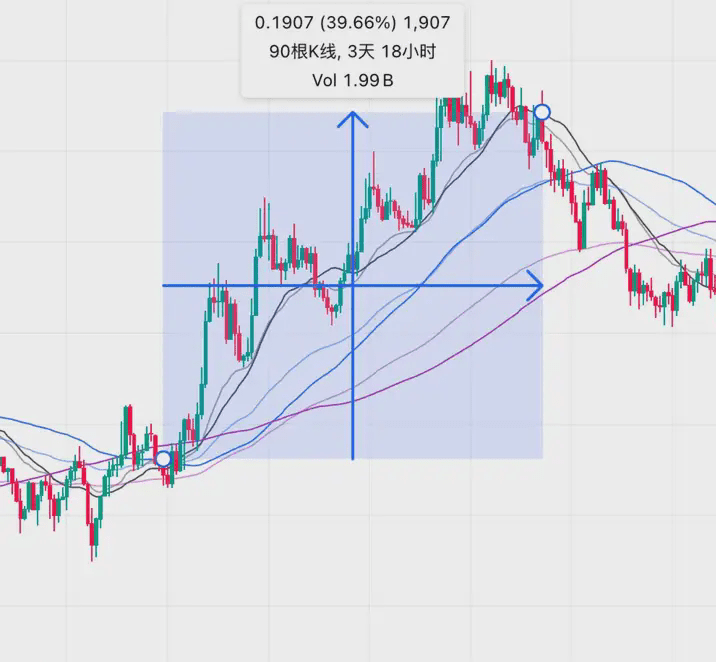 In addition to trading fixed odds, we can also trade trend rolling positions. In the green box section of the ENA token, where it pulls back to the daily moving average and then creates new highs, if you have already formulated a trading strategy before trading, you want to roll positions and go long on it.
So your trading method is different from fixed odds. How is it different? We can switch to a smaller time frame, for example, switch to a one-hour timeframe. After switching to one hour, the last rise actually corresponds to the rise in this green box on the one-hour timeframe.
In this trend, as the ENA token continues to rise, adding positions on pullbacks, through this kind of continuous strong upward rolling position strategy, we can roll our small position into a large position, thus reaching our profit expectations or a certain index price, and then directly close all positions.
We can roughly measure that after reaching the first break of the one-hour 20 moving average, it has risen by 36%.
Let's conservatively calculate that if it rises by 30%, actually through rolling positions, we can still earn at least 5 to 10 times. Of course, the failure probability of rolling positions is also quite high. Therefore, try to use small accounts and control the position well.
If you haven't encountered your own trading system yet and don't know how to judge trends or how to trade, I strongly recommend that everyone take a close look at the article about the dual moving average trading system. I believe it will definitely help your trading.
Dual moving average trading system 01 Trading indicator concept and time dimension introduction.
Dual moving average trading system 02 How to open a position? How to close a position? This article has a lot of dry goods #buy point #sell point #take profit #stop loss
Next, let's actually go to the exchange to see where to select.
First, the top navigation bar has a 'Market' button. We can click it to enter the overview of the exchange. Inside, we can see popular coins, gainers, volume leaders, etc. We can detect an abnormal token in the market page of the exchange.
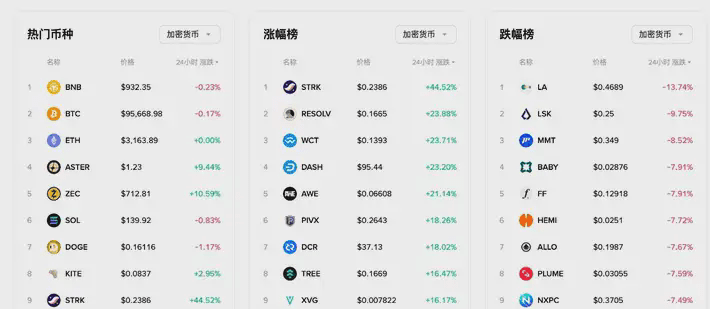 Just to give an example, in the popular list, ASTER ranks well. If we are familiar with and interested in this token, then we can switch to TradingView to find ASTER.
By using the method just mentioned to find a reference object, and then comparing, we can see whether ASTER is strong during this period and whether it is worth trading now. If it is not particularly strong, wouldn't it be safer and easier to trade Bitcoin, Ethereum, or Solana?
By examining data anomalies from different dimensions, find potentially anomalous assets, then switch to TradingView to search for this token, find the daily K-line of this token, and compare it with the reference objects to see if the tokens that have anomalies during the same period are strong.
If it's strong, then you can trade it.
So actually finding strong coins is a tough job, nothing else, just hard work. To find strong coins, you need to look at market conditions more often every day, observe the charts, and look at data from different dimensions. Find potential anomalies from the data, spending a little more time each day to look at them one by one.
Finally, I hope everyone can find suitable strong tokens in future markets and earn more through trading.
Thank you for watching. I am Xiaofei, glad to meet everyone. Xiaofei focuses on Ethereum contract spot ambush, the team also has positions ready to take off, taking you to become the dealer and also a winner.#加密市场反弹 $BTC$ETH


