
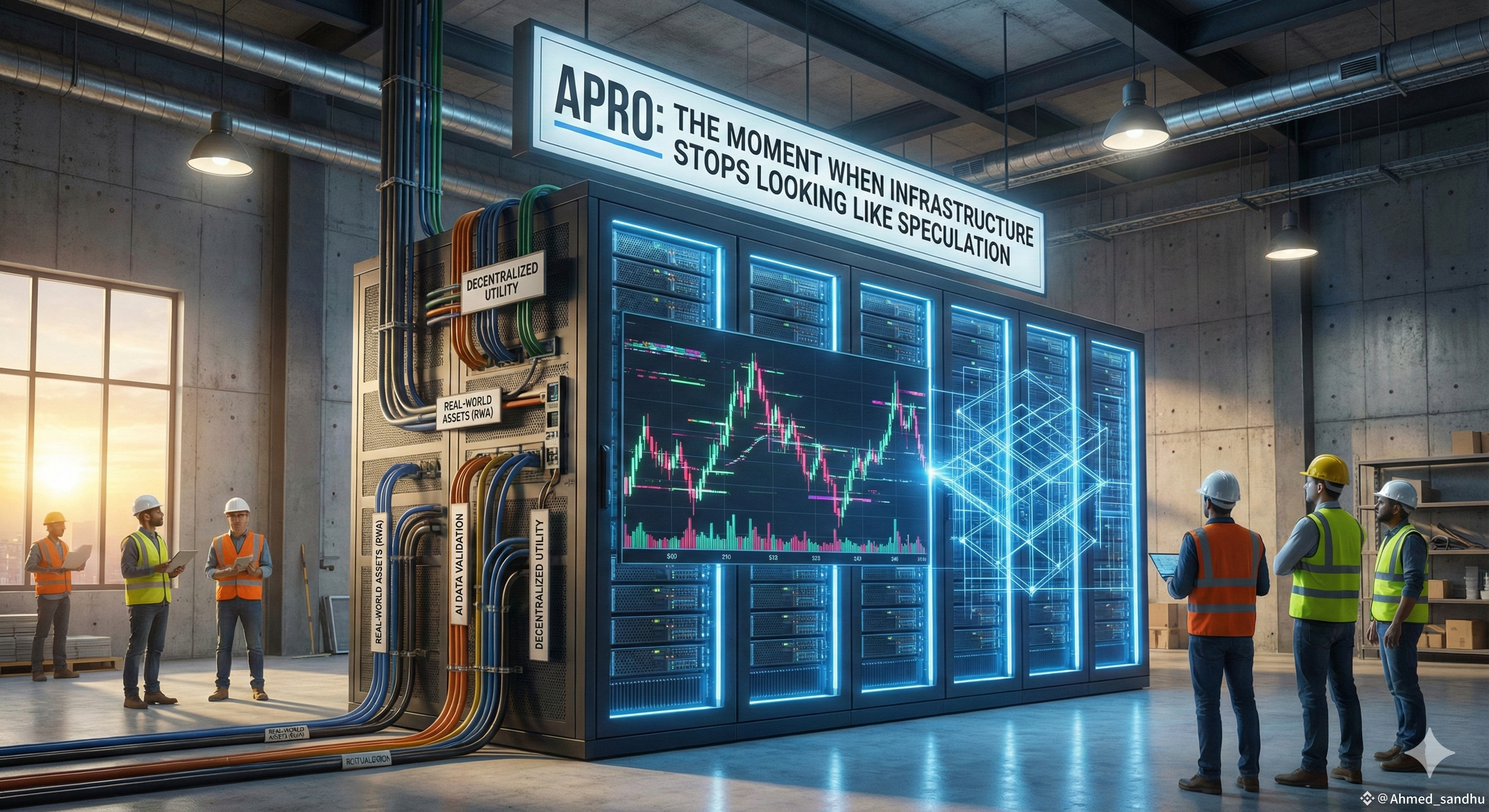
The cryptocurrency market is often defined by two distinct seasons: the season of promises and the season of plumbing. For years, capital has chased the promises—the "next Bitcoin," the governance tokens with no governance, and the yield farms with no real yield. But a quiet rotation is underway. As the dust settles on the latest hype cycle, the market’s gaze is shifting toward the "plumbing"—the boring, critical infrastructure that actually makes the decentralized internet work.
APRO (AT) has emerged as the flagship of this rotation. It represents the moment when a project stops trying to be a "crypto gem" and starts behaving like a digital utility grid.
The "Oracle 3.0" Thesis
To understand APRO’s value proposition, one must understand the "Oracle Problem." Blockchains are blind; they cannot see the outside world (stock prices, weather data, election results) without a bridge.
Oracle 1.0 (The Early Days): Simple price feeds. Necessary, but limited.
Oracle 2.0 (The Expansion): Broader data sets, but often centralized or slow.
APRO (Oracle 3.0): APRO is positioning itself as the AI-driven, verifiable data layer for the next generation of the web.
It is no longer just about telling a smart contract what the price of ETH is. It is about verifying complex Real-World Assets (RWAs)—like proving a shipment of gold has arrived in a port or validating AI-generated data streams without human interference.
Utility Over Hype: The Mechanics of APRO
The distinction between speculation and infrastructure lies in dependency. A speculative asset relies on new buyers to sustain its value. Infrastructure relies on usage. APRO is building a system designed to be used, regardless of market sentiment.
1. The Push/Pull Architecture
Unlike legacy oracles that spam blockchains with costly data updates (pushing data even when no one needs it), APRO utilizes a hybrid model:
Push: For high-frequency assets where speed is critical (e.g., perpetual trading).
Pull: A "data on demand" model where smart contracts only request (and pay for) data when they actually need it.
This efficiency reduces gas costs and makes the protocol economically viable for dApps that couldn't afford traditional oracles.
2. The AI Validation Layer
This is APRO's "moat." As AI agents begin to transact on blockchains, they need data that hasn't been hallucinated or manipulated. APRO integrates an AI validation layer that cleans, verifies, and structures data before it hits the chain. This positions APRO not just as a crypto tool, but as a critical piece of the emerging AI-to-Blockchain economy.
The End of "Vaporware"
The most telling sign that APRO is leaving the speculative zone is its integration footprint. With support for over 40 blockchains and partnerships with major protocols (like Lista DAO and massive RWA initiatives), the project is entrenching itself in the ecosystem.
Key Insight: When a protocol becomes difficult to remove without breaking the applications built on top of it, it ceases to be a "token" and becomes "infrastructure."
A Shift in Tokenomics
For investors, the AT token represents a bet on the usage of this network. In a speculative model, token price is driven by marketing. In an infrastructure model, token demand is driven by:
Staking: Nodes must stake AT to validate data (ensuring honesty).
Payment: dApps pay in AT (or stablecoins converted to AT) to access data feeds.
Governance: Deciding which data sources are trusted.
The recent market movements—moving past the volatility of airdrops and exchange listings—suggest that the "smart money" is looking at AT's burn rates and utilization metrics rather than just its chart patterns.
Conclusion: The Boring Revolution
APRO is not trying to be the loudest project in the room. It is trying to be the most necessary.
When you flip a light switch, you don't speculate on the price of copper wire; you just expect the light to turn on. APRO is building toward a future where decentralized data is as reliable as that light switch. For the crypto market, this transition—from betting on the future of tech to using the tech in the present—is the ultimate signal of maturity.
Would you like me to...
Dive deeper into the tokenomics (AT) and how the "burn mechanism" works?
Compare APRO directly against competitors like Chainlink (LINK) or Pyth Network?
Create a summary of recent partnerships that are driving APRO's adoption?



