

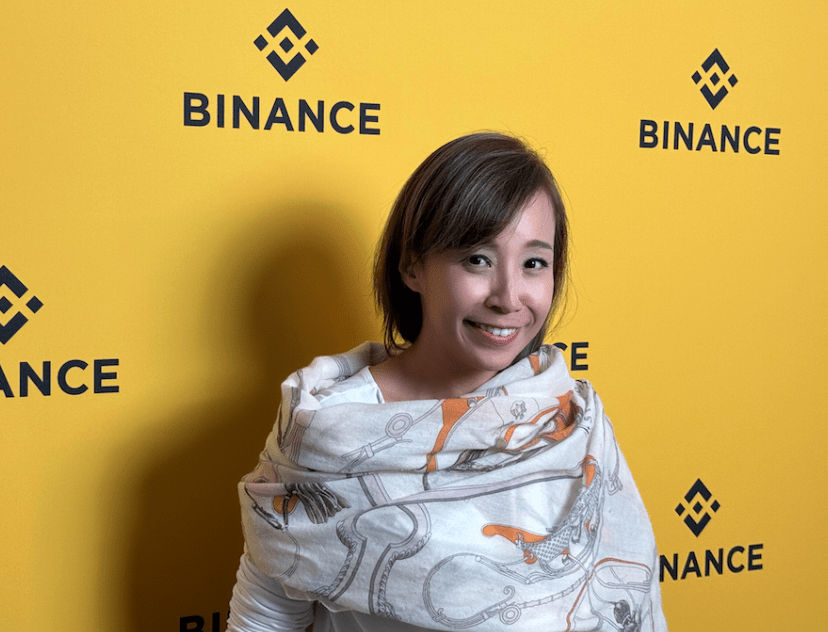
During Binance Blockchain Week in Dubai, ChainNews conducted an exclusive interview with Catherine Chen, Head of VIP and Institutional Business at Binance. Her expertise reveals a complete picture beyond the familiar "Binance exchange," and also unveils the potential role the Binance empire will play in the emerging digital finance era.
Binance's "VIP Team" is actually a global financial infrastructure department.
Binance is often viewed as a retail exchange, but on the institutional side, its role has expanded to include a global crypto infrastructure provider. Catherine, Head of VIP and Institutional Business at Binance, stated in an interview that the VIP department goes far beyond business and customer service; it's a comprehensive product and technology center responsible for assisting global financial institutions in accessing crypto assets. She explained, "Our mission isn't to cater to large clients, but to build the entire infrastructure so that financial institutions can securely enter the crypto world."
This department encompasses sales, customer service, product teams, technical engineering, and multiple business lines, functioning similarly to an "enterprise-level fintech provider."
Binance Wealth: Enabling Small Financial Advisors to Offer Crypto Products "Under the Binance Brand"
Speaking about Binance Wealth, launched last year, Catherine clarified that this is not Binance entering the wealth management field, but rather serving a large number of small financial advisors (IFAs) globally.
In Latin America, this model has rapidly gained popularity: smaller IFAs, which already sell overseas insurance policies, funds, and structured products, lack the capacity to build their own crypto infrastructure. Binance provides brand licensing, technology, and product lines, while the IFAs maintain relationships with their clients.
In other words, Binance has become a crypto backend provider for small financial advisors.
Binance Prestige: The Institutional Turning Point for ETF Launch
The Binance Prestige, launched this year, is a product tier above Weath, targeting ultra-high-net-worth individuals (UHNW) and family offices (FOs). Catherine points out that after institutions like BlackRock issued Bitcoin ETFs, traditional family funds have clearly changed their attitudes: "Previously, it was the second generation playing with cryptocurrencies, but after the ETFs came out, the older generation started seriously asking if they wanted to allocate to them."
Prestige offers:
Customized encrypted asset allocation
Stablecoin pricing, pursuing carry yield
Crypto native products (staking, yield-based, structured)
Large-scale OTC execution and strategy design
These are services that traditional private banks find difficult to provide.
Crypto as a Service: Front-end for financial institutions, back-end for Binance
Catherine believes another important product this year is Crypto as a Service (CaaS).
This service allows banks, brokerages, digital banks, e-wallets, and even non-financial applications (ride-hailing apps) to offer crypto trading within their own app/web interfaces, while Binance handles the entire backend: liquidity, matching engine, custody, and wallet infrastructure.
"The crypto transactions you see in your bank's app may all be provided by Binance."
Each financial institution can adjust its functions according to regulatory requirements and risk appetite, such as: only offering in-account trading, not allowing deposits, only allowing withdrawals, and modular combinations.
The most complete implementation cases to date are in the Middle East and Central Asia, including Bahrain, Kazakhstan, and Kyrgyzstan, where local central banks are generally quite open.
Ceffu's Agreement with Third-Party Banks: A Solution When Financial Institutions "Don't Want to Handle Crypto"
Catherine also introduced a common model used by Binance's institutional clients — Banking Tri-Party (a three-party banking protocol).
Typical architecture:
Clients (institutions or large clients)
Traditional financial institutions (banks)
Binance (liquidity provider)
Operational method: Assets are held in custody by Ceffu, and liquidity is linked to Binance for trading. Clients do not need to hold large amounts of assets on exchanges, and banks can manage risk within their own regulatory framework. This model is suitable for financial institutions that want to engage in crypto but do not want to directly handle the token or fully open their retail operations.
"This is currently the most mature and realistic transition solution."
Why are emerging markets developing faster than Taiwan?
Catherine said it was because they knew they didn't have time.
Catherine observed that policymakers in the Middle East and Central Asia are more proactive than in most countries: they are well aware of the vulnerability of their currencies, see cryptocurrencies and CBDCs as opportunities to enhance financial competitiveness, and have a clear regulatory stance that allows industries to quickly integrate. In contrast, Taiwan remains at the discussion stage when it comes to the issue of stablecoins.
Guests from Taiwan remarked that many speakers at Taiwanese stablecoin forums were not crypto natives, and discussions often remained at an abstract level. "Taiwan's biggest problem right now is: who wants to issue stablecoins? What digital economy will they be integrated into? These questions remain unclear."
Market fluctuations do not affect VIP clients?
Catherine: "Long-time users are very clear about where the risks are."
When asked if Bitcoin volatility had caused a large number of institutions to withdraw, Catherine laughed and said:
"ETF users will be nervous, but Binance VIPs are mostly experienced traders. They may reduce their positions, but they won't leave the market."
She believes that VIP clients who have experienced multiple bull and bear markets have mostly already established an effective risk framework.
How does Binance VIP service make money?
The core issue is transaction fees. Regarding one of the most perplexing questions from outsiders, Catherine's answer was surprisingly simple: "We rely on transaction fees. Everything else is free if possible, and if a fee is necessary, it only covers the cost."
This means that Binance doesn't make money by selling tools, solutions, or consulting services. Its goal is to create a stable trading environment and deep liquidity, encouraging more institutions to use Binance as their trading and infrastructure backend. This makes Binance's cost structure in B2B partnerships highly competitive.
Finance and crypto will eventually converge; the real question is: where will Taiwan stand?
From Catherine's sharing, we can see that:
Binance is transforming from an exchange into a "global crypto infrastructure provider".
Emerging markets are actively embracing crypto and CBDC.
Traditional financial institutions are also seeking lower-risk entry points.
Crypto assets have become a new allocation item for family offices and UHNW users.
Her final words were the most weighty of the entire interview: "Traditional finance and crypto finance will converge; the question is, is your market ready?"
In the financial innovation experiments already launched in Singapore, the Middle East, and Latin America, will Taiwan choose to accelerate, observe, or miss out? The answer will depend on the regulatory attitude and industry collaboration capabilities in the coming years.
This article, "Binance VIP & Institutional Business Head: Exchanges are just the entry point; what truly matters is the global underlying infrastructure of crypto finance," first appeared on ChainNews ABMedia.

