

By late 2025, conversations around @Lorenzo Protocol liquidity are starting to split into two very different camps. One side assumes that time alone guarantees depth, stability, and resilience. The other suspects most of the confidence is borrowed from broader market recovery rather than anything Lorenzo itself has structurally earned. The truth sits somewhere quieter, shaped less by narratives and more by mechanics that rarely make headlines.
Liquidity at Lorenzo’s bank layer does not behave like a simple pool of idle capital waiting to be deployed. It is reactive. It expands and contracts based on usage patterns, rate incentives, and risk appetite in the surrounding ecosystem. Heading into 2026, what matters most is not the headline total value figure, but how that liquidity is composed and how quickly it can adapt under stress.
A large portion of Lorenzo’s liquidity today is functionally patient capital. It comes from participants who treat the protocol more like infrastructure than a trade. These users are not chasing short-term yields. They are optimizing for predictable returns, system reliability, and long-term access to leverage or settlement services. That distinction matters because patient liquidity behaves very differently during volatility. It leaves slower, but it also arrives slower, and both dynamics shape how the bank holds up when conditions shift.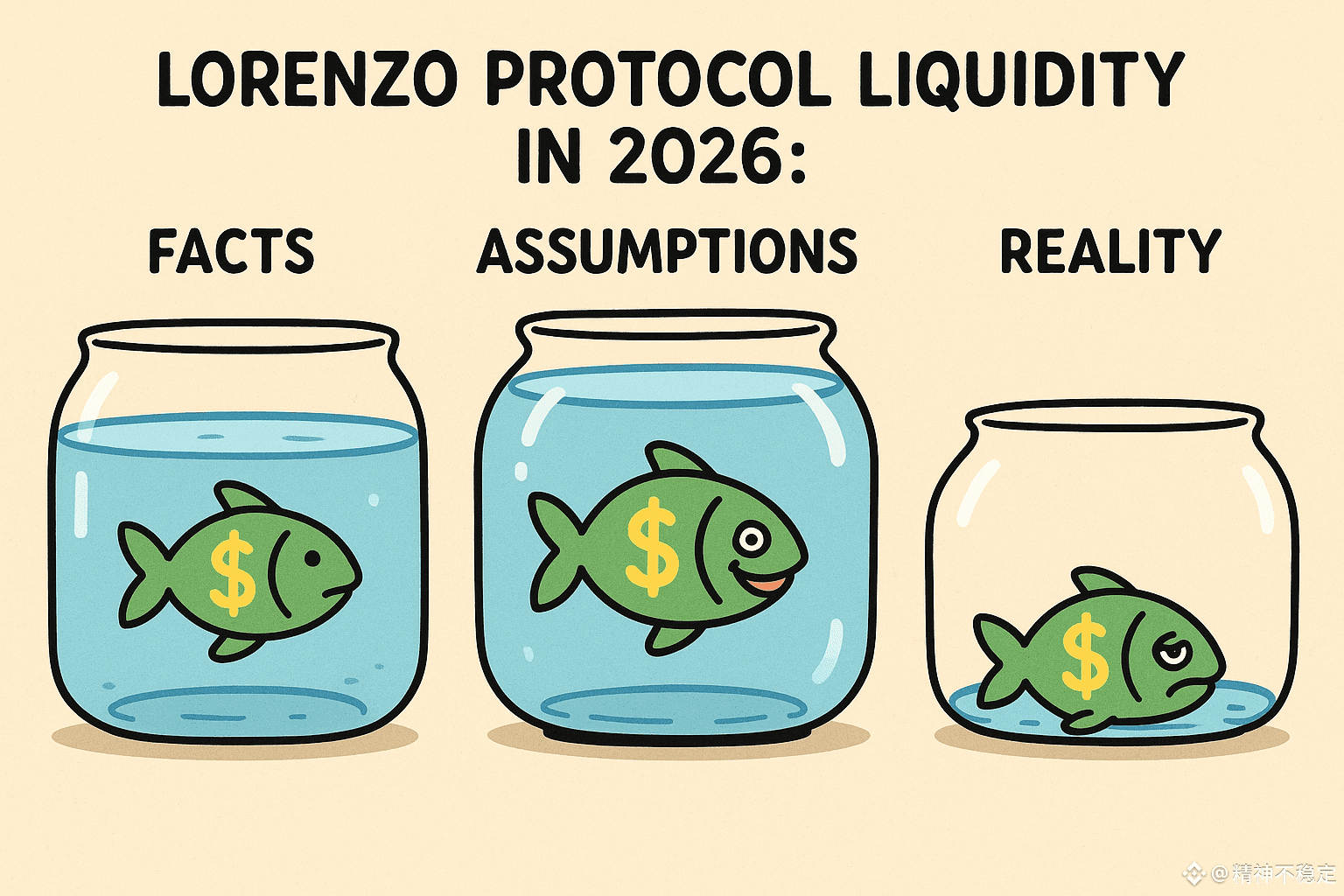
At the same time, Lorenzo has not escaped the structural reality of modern DeFi banks. Incentives still do heavy lifting at the margin. When rates elsewhere spike, Lorenzo feels it. When competing protocols introduce aggressive liquidity programs, capital rotates. What Lorenzo has done better than many peers is reduce how violently those rotations affect core operations. Rate smoothing mechanisms and conservative collateral thresholds have limited sudden drains, even during periods when on-chain liquidity broadly thinned.
One misconception that continues to circulate is that projected growth into 2026 implies exponential liquidity expansion. That assumption ignores how Lorenzo’s risk controls deliberately cap growth speed. The bank is not designed to absorb infinite liquidity overnight. Its architecture prioritizes solvency over scale. This slows expansion during bull phases, which can frustrate speculators, but it also reduces forced deleveraging when markets turn. The result is liquidity that grows in layers rather than spikes.
Another under-discussed factor is where Lorenzo’s liquidity actually sits. A meaningful share is technically mobile but practically sticky. Funds may be withdrawable at any time, yet they remain because users rely on integrations built around Lorenzo’s bank layer. Automated strategies, treasury routing, and cross-protocol settlements all create soft lock-in. This is not contractual lockup, but behavioral friction. It strengthens liquidity resilience without introducing artificial constraints.
Looking toward 2026, the largest variable is not market direction but composition. If future inflows skew toward short-term yield seekers, liquidity may look abundant while becoming more fragile. If growth continues to come from institutional-style allocators and protocol-native treasuries, total liquidity might rise more slowly but become meaningfully tougher. Current on-chain patterns suggest the latter is gaining ground, though it remains early.
There is also the question of liquidity usage efficiency. Lorenzo’s bank does not need every deposited unit to be actively deployed at all times. Idle liquidity acts as shock absorption. Over the past year, utilization rates have climbed, but not to the point where buffers disappear. This balance is intentional. Entering 2026, maintaining unused capacity may matter more than maximizing yield metrics, particularly if macro conditions tighten.
Critics often point to the absence of dramatic liquidity milestones as a weakness. In reality, the lack of spectacle is partly the point. Lorenzo’s bank is being positioned as something closer to a financial utility than a growth experiment. That framing changes how success should be measured. Stability during dull periods often reveals more than expansion during hype cycles.
None of this means Lorenzo is immune to risk. Smart contract dependencies, governance capture, and correlated collateral exposures remain live concerns. Liquidity can vanish faster than models predict if confidence breaks. What differentiates Lorenzo is not immunity but preparedness. Stress modeling appears to be influencing real design choices, not just documentation.
As 2026 approaches, the most accurate picture of Lorenzo Protocol’s bank liquidity is neither scarcity nor abundance. It is sufficiency with constraints. Liquidity that is structured to survive unfavorable scenarios rather than dominate favorable ones rarely excites social feeds. It does, however, tend to remain present when excitement elsewhere fades.
Facts suggest a measured, intentionally limited liquidity base that prioritizes continuity. Hype assumes inevitable dominance and exponential inflows. The gap between the two is where realistic expectations should live. Lorenzo’s bank is unlikely to be the loudest system in the room next year. It may, quietly, be one of the ones still standing when the room empties.
@Lorenzo Protocol #lorenzoprotocol $BANK

