
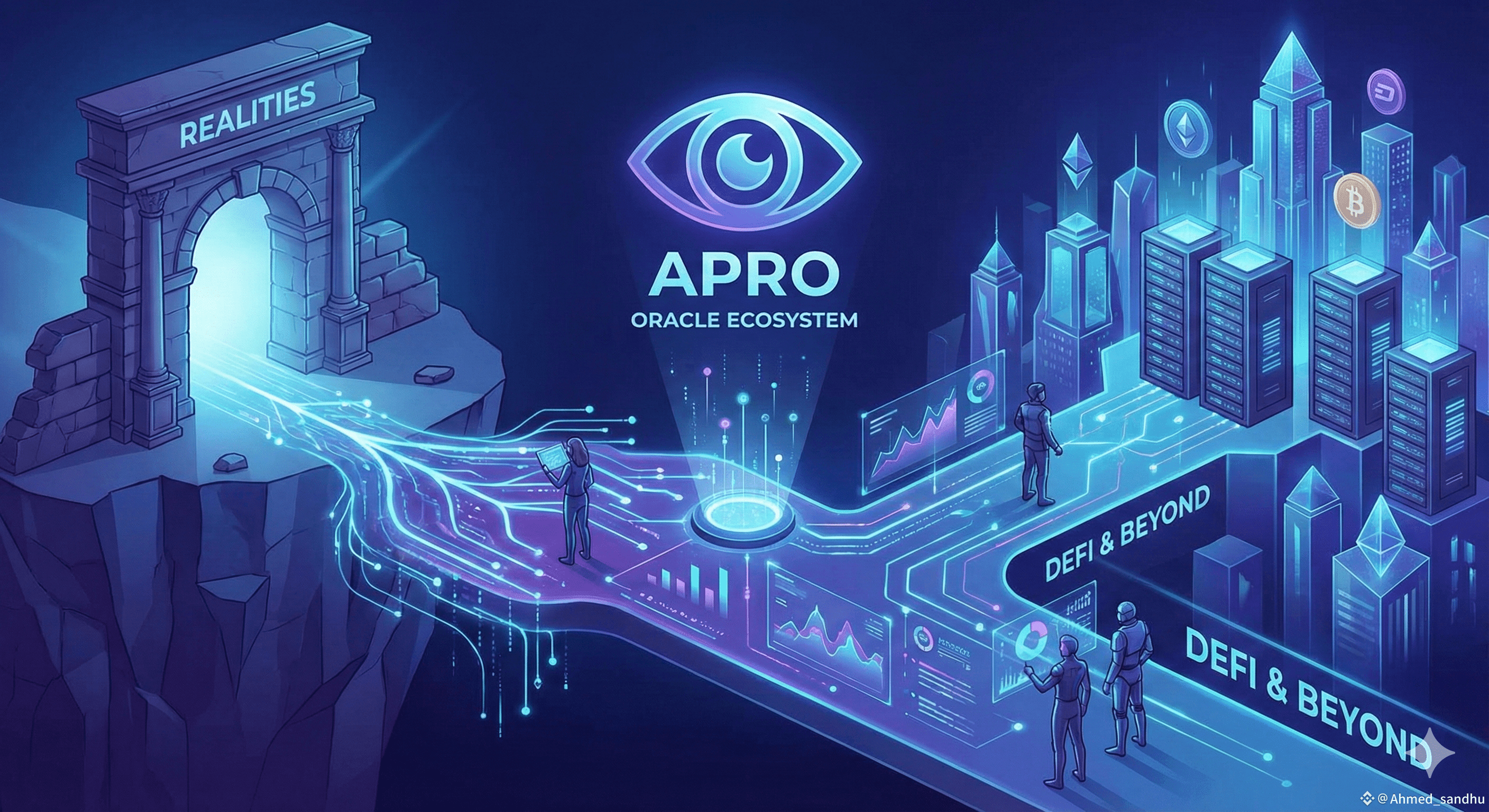
In the rapidly evolving landscape of Web3, the "Oracle Problem"—the inability of blockchains to access off-chain data natively—has long been a bottleneck. Traditional oracles acted as simple couriers, ferrying price feeds from the real world to the chain. However, as Decentralized Finance (DeFi) matures and intersects with Artificial Intelligence (AI) and Real-World Assets (RWAs), simple data transport is no longer sufficient.
Enter APRO Oracle, a next-generation decentralized network that is not just moving data, but understanding it. By integrating an AI-driven verification layer with a hybrid architecture, APRO is bridging the gap between physical realities and digital assets, powering a new era of "Oracle 3.0."
The Architecture of Trust: Oracle 3.0
At its core, APRO distinguishes itself from legacy providers through a unique Hybrid Architecture that combines off-chain processing with on-chain verification. This design solves the classic trilemma of speed, cost, and security.
Off-Chain Computation (OCMP): Heavy data processing, aggregation, and initial validation happen off-chain. This ensures that the network can handle high-frequency data without clogging the blockchain or incurring massive gas fees.
On-Chain Verification: Only the finalized, cryptographically verified proofs are submitted to the blockchain. This guarantees the integrity of the data while maintaining the trustlessness required by DeFi protocols.
This system supports two distinct operational models tailored for different needs:
Data Push: A real-time streaming model ideal for high-frequency trading and derivatives markets where millisecond latency matters.
Data Pull: An on-demand model where decentralized applications (dApps) request specific data only when needed, optimizing efficiency for less time-sensitive protocols.
AI-Driven Insights: The "Smart" Oracle
The true differentiator for APRO is its integration of Artificial Intelligence into the data pipeline. While traditional oracles blindly transmit data, APRO’s AI-enhanced Oracle Machine actively validates it.
1. Intelligent Anomaly Detection
Market manipulation and "flash crash" data errors have cost DeFi protocols millions. APRO’s AI verification layer analyzes historical patterns and market sentiment in real-time. If a data source reports a price that statistically deviates from the norm (e.g., a sudden 99% drop in an asset price not reflected elsewhere), the AI flags it as an anomaly, preventing bad data from triggering false liquidations.
2. "Educating" Data for LLMs
As AI Agents begin to manage portfolios and execute trades, they require data formatted for cognitive processing. APRO cleans, structures, and semanticizes raw data, effectively "educating" it so that Large Language Models (LLMs) can easily ingest and act upon it. This creates a bridge where AI agents can reliably interact with on-chain economies.
Powering the Bitcoin Renaissance (BTCFi)
While APRO is multi-chain (supporting 40+ networks), it has carved a unique niche as the premier oracle for the Bitcoin Ecosystem.
Bitcoin’s scripting limitations historically made DeFi difficult. APRO addresses this by providing specialized support for:
Runes & RGB++ Protocols: Enabling complex token standards on Bitcoin.
Lightning Network: Facilitating high-speed, low-cost data for Layer-2 payments.
BTC Layer 2s: Providing the critical price feeds and data consistency needed to build lending and borrowing platforms directly on Bitcoin.
Beyond DeFi: RWAs and the Tokenization of Reality
The title "Bridging Realities" is most evident in APRO’s support for Real-World Assets (RWAs). To bring assets like real estate, commodities, or treasury bills on-chain, protocols need more than just price; they need proof of existence and status.
APRO’s ecosystem is designed to ingest complex, non-financial data—such as shipping logistics, weather patterns for crop insurance, or legal document verification—validating the state of physical assets before they are tokenized. This capability is essential for the next trillion-dollar wave of institutional crypto adoption.
The Engine: The $AT Token
Fueling this ecosystem is the native $AT token, which aligns incentives across the network.
Staking & Security: Node operators stake $AT to participate in the network, ensuring they have "skin in the game" to provide honest data.
Governance: Holders vote on protocol upgrades and the addition of new data sources.
Payment: Developers and dApps pay for data requests using $AT, creating a circular economy where network usage directly drives token demand.
Conclusion
APRO Oracle represents a shift from passive data transmission to active data intelligence. By securing the Bitcoin economy, enabling AI agents, and validating Real-World Assets, APRO is not merely a tool for DeFi—it is the foundational infrastructure for a smarter, more connected Web3. As the boundaries between the physical and digital worlds continue to blur, APRO’s ecosystem stands ready to bridge the divide.
Would you like me to dive deeper into how APRO’s "Data Pull" mechanism specifically benefits developer costs compared to traditional "Push" oracles?


