
Spend enough time watching the flow of a decentralized community and you begin to notice something unexpected: the culture of a network often reveals itself not in loud announcements or sweeping policy changes, but in the quiet ways its token moves. Who stakes. Who votes. Who chooses to sit on the sidelines, observing the rhythm before deciding where they belong. In the case of Yield Guild Games, the $YGG token became a kind of compass subtle, often misunderstood, but essential for tracing how the guild evolved from an experimental gaming collective into a decentralized ecosystem with its own internal politics, economics, and identity.
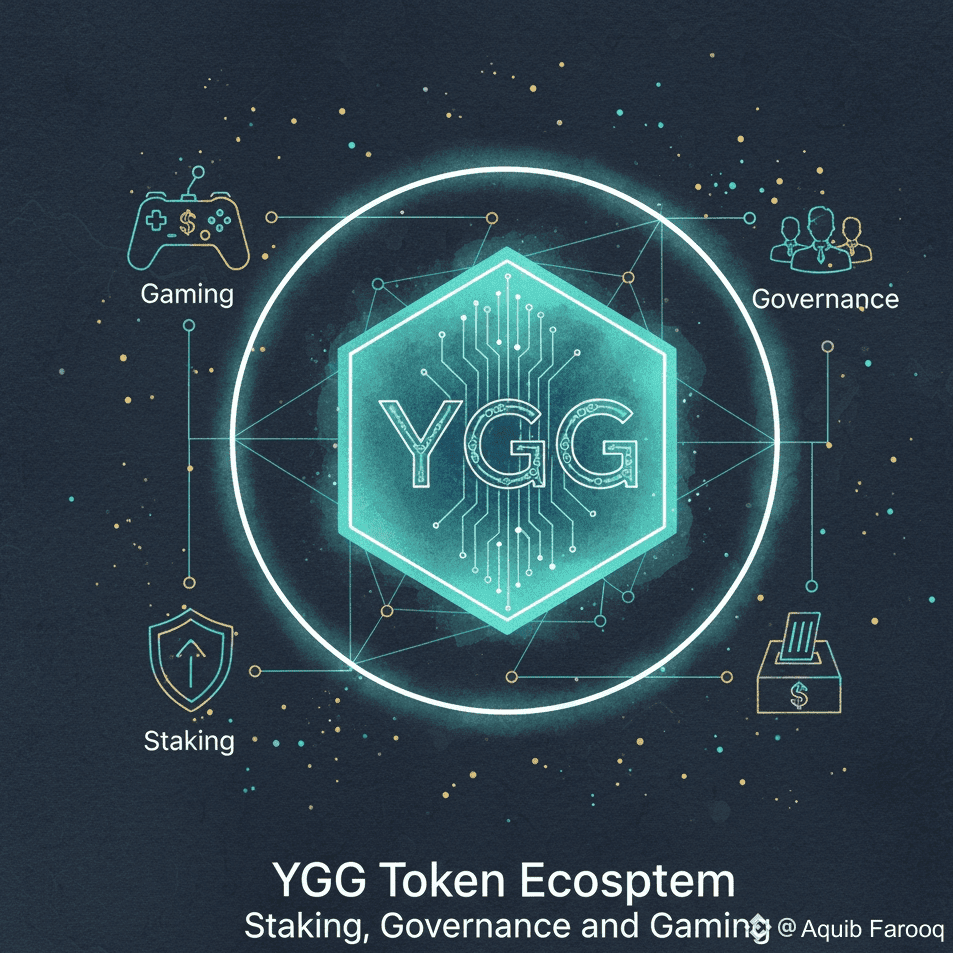
To talk about YGG is to talk about how a community organizes itself around shared ownership. Tokens in Web3 are often framed reductively—as speculative assets, governance weights, or yield mechanisms. YGG’s token carries elements of all three, but its role is more intertwined with the social fabric of the guild. It’s a credential, a voice, and sometimes a promise: that those who contribute meaningfully to the ecosystem should have a say in its direction.
The earliest days of the token’s life were marked by excitement and uncertainty. Play-to-earn was booming. Games were introducing new reward structures at dizzying speed. The market moved in waves—some rational, some euphoric, some short-lived. Yet beneath the volatility was a real question: how do you coordinate thousands of players, managers, sub-guilds, and analysts in a way that feels fair, scalable, and transparent? The YGG token emerged as the connective tissue, embedding incentives where community governance needed reinforcement and providing a mechanism for decision-making that wasn’t reliant on informal hierarchies.
Staking became the first entry point for many. On paper, it offered yield; in practice, it created commitment. Stakers weren’t passive capital they were people who believed the guild deserved long-term structure. Their tokens weren’t locked away so much as pledged. The longer they staked, the more aligned their interests became with the guild’s mission. This wasn’t staking as yield farming; it was staking as a loyalty mechanism, one that quietly filtered the transient from the invested.
Governance was the next layer, and it revealed something more complicated. While many DAOs treat voting as a perfunctory exercise, YGG’s governance process often felt like the guild’s heartbeat—messy at times, thoughtful at others, always reflective of how decentralized communities wrestle with collective responsibility. Token holders debated Treasury allocations, SubDAO structures, reward mechanisms, and community funding. Some proposals were technical, others philosophical, but each required people to think beyond their own narrow outcomes. Voting turned into a cultural practice: a way of saying I’m here, and I care enough to read, reflect, and decide.
The gaming component the part most people associate with YGG—sits at the intersection of these mechanics. A token without utility risks becoming a hollow symbol. YGG avoided that by grounding its economy in the activity of its players. Rewards from game participation, yield from NFT assets, and performance from SubDAOs all flowed back into a system that recognized contribution not as a transaction, but as value creation. The token’s utility emerged from the actual labor of the community: playing games, managing assets, onboarding new members, sharing strategies.
What makes the YGG ecosystem compelling is that its design doesn’t treat governance, staking, and gaming as separate modules. They’re interdependent. Players who excel in-game often rise into community leadership roles. SubDAO coordinators become some of the most active governance participants. Stakers—those with long-term confidence in the guild—tend to be the ones who push for sustainable economic design rather than short-term extraction. The token sits quietly at the center of these interactions, almost like a witness to the community’s evolution.
There’s a broader significance here that goes beyond YGG itself. The metaverse, in its most earnest definition, is not a place but a labor market dynamic, borderless, and deeply shaped by the people who choose to participate. If traditional economies rely on institutions and governments to maintain order, token-based ecosystems rely on economic alignment and social cohesion.
But none of this means the system is perfect. Governance can be slow.
And maybe that’s the real lesson inside the YGG token ecosystem: that value in Web3 is rarely purely financial. It emerges from continuity, from shared norms, from the collective weight of thousands of small decisions made by people who believe in the organization’s future even when the charts don’t flatter it.
In a landscape where tokens often feel interchangeable, YGG stands out because it is inseparable from the people who use it. It’s not just staked—it’s lived with. Not just voted with but argued over, interpreted, and carried through cycles of enthusiasm and skepticism. It functions less like a financial instrument and more like a medium through which the community negotiates what kind of future it wants to build.
As the metaverse continues to take shape unevenly, unpredictably the YGG token ecosystem offers a reminder that governance isn’t a feature. It’s a practice. And staking isn’t a reward mechanism.
The token doesn’t define the guild. The people do. But the architecture they’ve built around $YGG ensures that their voices, their labor, and their vision have a place to converge. In a world crowded with experiments, this one feels unusually grounded—not because it has all the answers, but because it keeps inviting the community to help shape them.
@Yield Guild Games #YGGPlay $YGG
