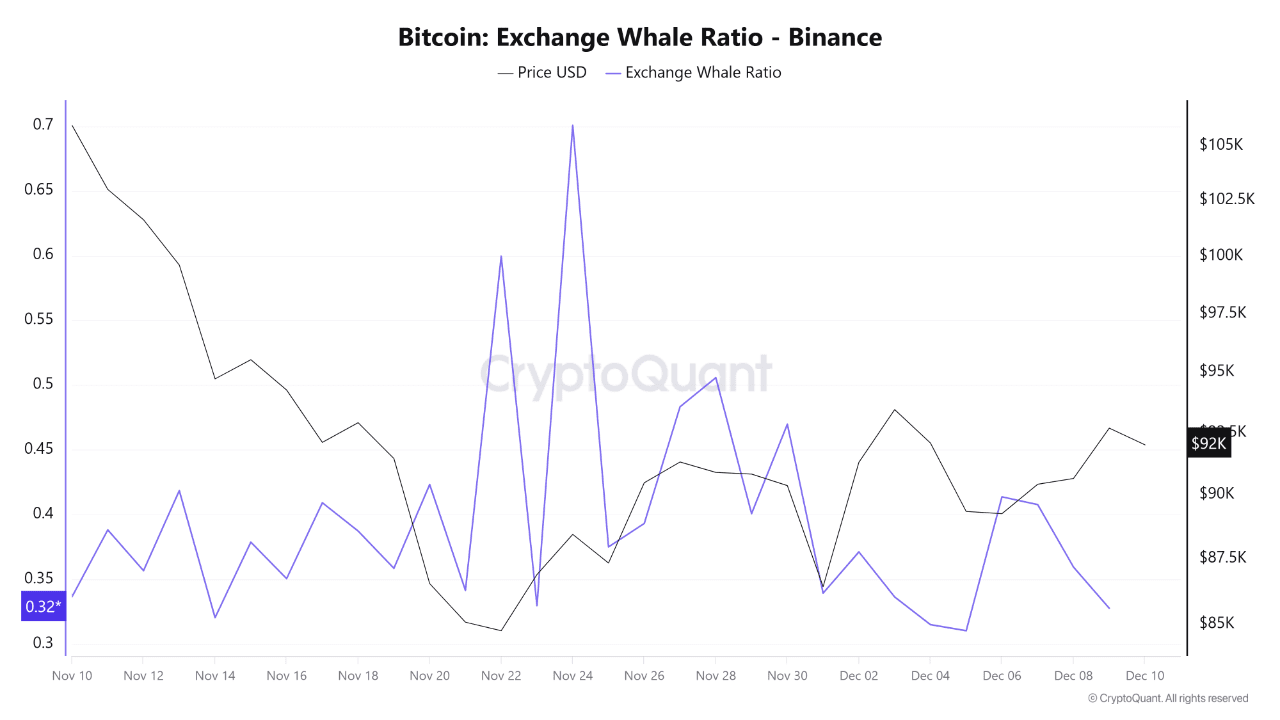
The ratio of large players has sharply decreased from about 0.7 in mid-November to around 0.3 by December 10. This indicates a clear reduction in the amount of BTC that large players are sending to exchanges, signaling decreased selling pressure and a lack of aggressive distribution.
Typically, before major macroeconomic events such as Federal Reserve decisions, large players tend to reduce risks by moving BTC to exchanges and decreasing positions. This time, however, both inflows and outflows remain extremely low. The lack of exchange-related movements indicates a lack of preparation for selling and suggests a "wait and see" position. Large players seem to be keeping their assets in cold storage, which is usually a positive sign ahead of high-volatility events.
While BTC has recovered from $85K to $92K, the whale ratio has continued to decrease. This shows that the price recovery was not accompanied by selling initiated by whales, and that whales have not suppressed the rally. Instead, they seem to be maintaining accumulation positions and waiting for the Fed's response, with most large holders likely keeping their exposure on spot.
There were several sharp spikes around November 22–24, likely short-lived attempts at selling or risk reduction, but these movements quickly faded and did not continue.
Throughout December, whales are clearly acting more as observers than active sellers. This calm behavior usually serves as a supportive signal for the price.
As I have emphasized in previous analyses based on chain and technical data, I expect BTC to initially move towards $100K, and then undergo a broader correction. The data on the whale ratio from Binance aligns well with this forecast.