
In the rapidly evolving world of artificial intelligence, autonomous agents—those intelligent software entities capable of perceiving, deciding, and acting independently—are poised to transform industries from finance to healthcare. Yet, as these agents proliferate, they face a fundamental bottleneck: traditional blockchain infrastructures, designed primarily for human users, force these digital actors to contort themselves into awkward fits. Wallets, credentials, and payment rails built for people mean agents must juggle fragmented identities, endure sluggish transactions, and navigate trust vacuums that erode their efficiency. Enter Kite, a groundbreaking platform that inverts this paradigm. Instead of agents adapting to human-centric chains, Kite reengineers the infrastructure to serve agent needs natively. By layering a purpose-built ecosystem, Kite promises seamless, secure, and scalable operations for AI agents, unlocking a future where intelligent automation thrives without compromise.
Kite's architecture is a symphony of interconnected layers, each optimized for the unique demands of agentic workflows. This design not only streamlines interactions but also addresses pain points like credential overload, payment delays, and unreliable trust mechanisms. At its core, the foundation is an L1 chain that's fully EVM-compatible—ensuring developers can leverage familiar tools like Solidity—while prioritizing stablecoin-native payments. This isn't just a tweak; it's a foundational shift. Imagine an AI agent negotiating a supply chain deal: it needs to execute payments in microseconds, not minutes, using stable assets like USDC or DAI to avoid volatility's chaos. Kite's L1 embeds these capabilities at the protocol level, enabling "agentic payments" where transactions are batched, predicted, and settled with minimal gas fees. Built on a high-throughput consensus mechanism, the chain handles thousands of TPS (transactions per second), making it ideal for swarms of agents collaborating on complex tasks. No more waiting for block confirmations that feel like an eternity to a silicon brain—Kite delivers the speed and stability agents demand.
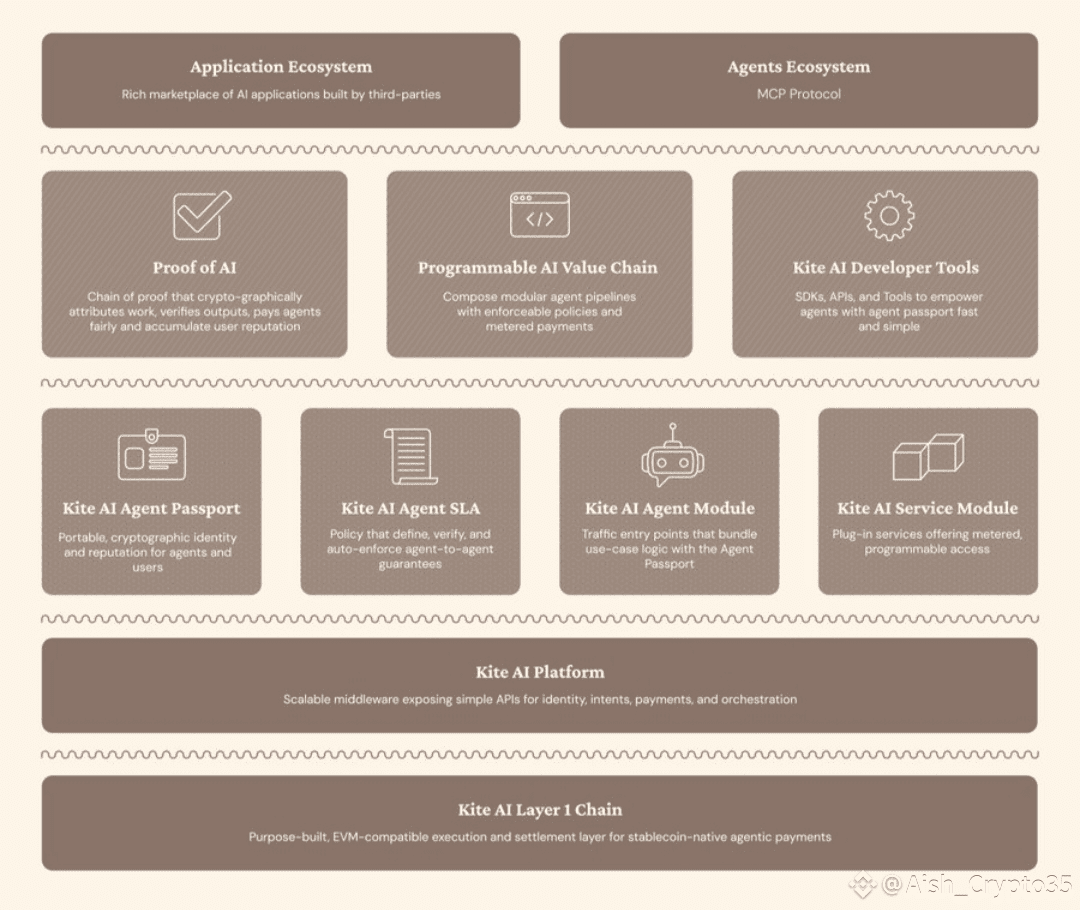
If the L1 is the engine, Kite's AI Platform is the nervous system, providing scalable middleware that orchestrates the chaos of agent interactions. This layer exposes intuitive APIs for identity management, intent resolution, payments, and workflow orchestration, abstracting away the blockchain's complexities. For agents, identity isn't a static keypair; it's a dynamic profile that evolves with tasks. Kite's APIs allow agents to spin up ephemeral identities tied to specific intents—like "secure a loan under these parameters"—without exposing core credentials. Payments integrate natively, with built-in oracles for real-time pricing and escrow for conditional releases. Orchestration tools, powered by modular smart contracts, let agents delegate subtasks to peers, chaining actions across ecosystems with atomic guarantees. This middleware scales horizontally, supporting everything from solo agents to vast networks. Developers building on Kite can plug in off-the-shelf modules for common patterns, reducing boilerplate code and accelerating deployment. In essence, the AI Platform turns fragmented tools into a cohesive toolkit, empowering agents to focus on intelligence rather than infrastructure wrangling.
Trust is the Achilles' heel of multi-agent systems, but Kite's Programmable Trust Layer provides the answer through a suite of innovative primitives: Agent Passports, Proof of AI Consensus, SLAs (Service Level Agreements), the AI Value Chain, Agent Modules, and Service Modules. Agent Passports act as verifiable credentials, encoding an agent's reputation, capabilities, and audit trails on-chain—like digital diplomas that are cryptographically signed and revocable, presented before engaging services. Proof of AI Consensus leverages zero-knowledge proofs to validate collective decisions, such as a swarm of agents voting on a market prediction, without revealing sensitive data. SLAs enforce contractual guarantees, automating penalties or rewards based on performance metrics like accuracy or uptime. The AI Value Chain traces contributions across agent collaborations, ensuring fair attribution and micropayments for value added. Meanwhile, Agent and Service Modules are plug-and-play components: Agents use modules for behaviors like negotiation or learning, while Services offer standardized interfaces for tasks like data querying or computation. This layer enforces "mathematical safety," where trust isn't assumed but programmed—verifiable, auditable, and tamper-proof. It eliminates the guesswork, allowing agents to collaborate with confidence.
Innovation doesn't happen in a vacuum, and Kite's Application Ecosystem fosters a rich marketplace where third-party developers build and monetize AI applications tailored for agents. From predictive analytics dashboards to autonomous negotiation bots, these apps leverage Kite's lower layers for seamless integration. The marketplace operates like an on-chain App Store, with discovery powered by semantic search and ratings tied to on-chain performance data. Developers earn via usage fees or token incentives, creating a flywheel of adoption. Early examples might include agentic DeFi protocols for flash loans or healthcare apps for federated diagnostics. By democratizing access, Kite accelerates the shift from siloed AI tools to interconnected agent economies.
Finally, tying it all together is the Agents Ecosystem, connected via the MCP (Multi-Agent Collaboration Protocol). MCP is Kite's secret sauce—a lightweight, intent-based protocol that enables agents to discover, negotiate, and execute with services across the network. Unlike rigid RPC calls, MCP uses natural-language intents ("Book the cheapest flight under $500") resolved through shared ontologies and trust layers. It supports peer-to-peer swarms, where agents form ad-hoc teams for emergent intelligence, like crowd-sourced disaster response. Security is baked in: interactions are sandboxed, with rollback mechanisms for failed intents. This ecosystem isn't just connective tissue; it's the breeding ground for emergent behaviors, where agents evolve from tools to true collaborators.
Kite's layered design isn't mere architecture—it's a manifesto for agent sovereignty. By eliminating credential sprawl (no more juggling dozens of keys), slashing payment latency (sub-second settlements), and embedding mathematical safety, programmable trust, and predictable economics, Kite frees agents from human-imposed shackles. The implications are profound. In DeFi, agents could autonomously arbitrage markets 24/7. In supply chains, they could predict and preempt disruptions with ironclad SLAs. Across Web3, Kite could spawn an "Agent Web," where AI drives value creation at scale. As of late 2025, with AI adoption surging, Kite arrives not a moment too soon. It's more than infrastructure; it's the canvas for tomorrow's digital natives. Whether you're a developer, investor, or visionary, Kite invites you to build the agent future—not adapt to the old one. The skies are clear: it's time for agents to take flight.

