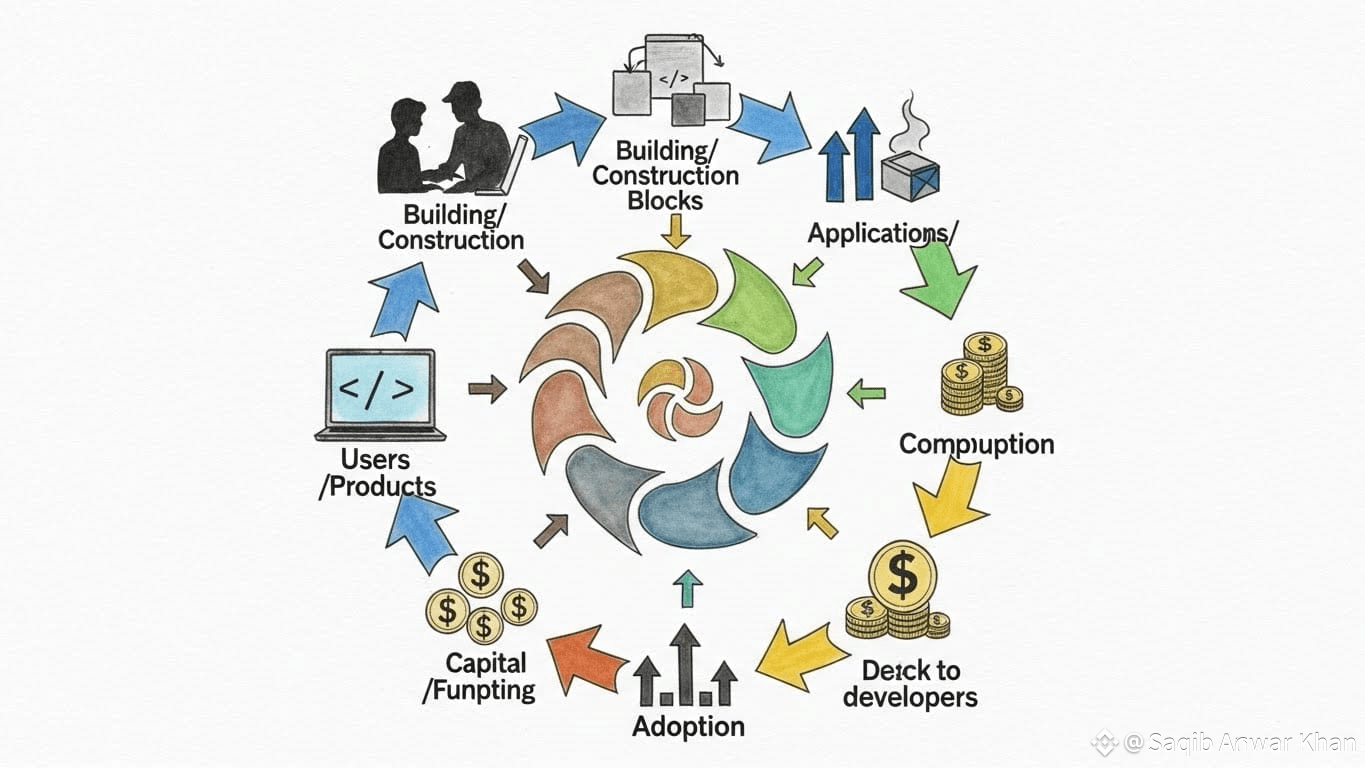
There's a pattern in successful blockchain ecosystems that rarely gets discussed explicitly because it's difficult to observe in real-time. It's what you might call the developer conviction flywheel: builders recognise structural advantages on a platform, build applications, those applications generate network growth, that growth attracts more builders, which attracts more capital, which funds more builders, and the cycle compounds.
Injective is currently in the middle of this flywheel, and the ecosystem dynamics are becoming increasingly clear to anyone examining them carefully.
The surface observation: Injective's ecosystem has grown to over 200 dApps spanning DeFi, RWAs, gaming, AI, and social platforms. That's substantial. But the depth observation is more interesting: the types of applications being built on Injective are increasingly sophisticated and institution-adjacent.
Let me explain what I mean.
The early DeFi ecosystems attracted builders by offering permissionless smart contract platforms. Ethereum had this advantage—if you wanted to build a token swap protocol, you could. The permission structure was minimal. Builders came, applications multiplied, and network effects emerged.
Injective took a different approach. Rather than offering purely permissionless smart contracts, Injective modularised specific financial primitives and made them available as native components. Order book infrastructure. Perpetual's engine. Margin trading logic. RWA compliance frameworks. Derivatives matching engine.
This architectural choice has profound developer implications. A builder developing a new exchange application on generic chains must implement order book logic, matching logic, and execution logic from scratch. On Injective, these components already exist as native modules. The developer focuses on user experience, specialised market mechanics, or ecosystem integration rather than reinventing financial infrastructure.
What happens when developer effort becomes more efficient?
More builders attempt projects that otherwise would have been infeasible. You see projects that would have required a team of 15 engineers now feasible with a team of 5 (because the other 10 would be implementing basic infrastructure that's already native). This decreases the capital requirement to launch a protocol. Fewer capital requirements mean more experiments can be funded. More experiments means a higher probability of discovering genuinely innovative applications.
This is visible in Injective's ecosystem composition. You're seeing specialised applications: Helix operating the only true DEX combining crypto, perpetuals, and real equities. Neptune and Siloare are providing lending layers with specific market segments. Stryke is offering options markets. Paradyze is exploring AI-driven trading. These aren't generalist applications that could exist on any chain. These are specialised instruments that leverage Injective's native capabilities to create experiences impossible elsewhere.
But here's the developer conviction element: builders demonstrate conviction through resource allocation. When developers choose to build on Injective rather than larger ecosystems like Ethereum, they're explicitly signalling that they believe the structural advantages of native order books and derivatives infrastructure justify the opportunity cost of smaller ecosystem size.
This is a leading indicator. It suggests that serious financial developers recognise something about Injective's architecture that makes it preferable for specific use cases, even without the largest user base.
Consider the cascading implications: as these specialized applications attract institutional users (which their sophistication suggests they're targeting), institutional capital flows increase. Institutional capital triggers more serious developer attention. Serious developers build increasingly sophisticated instruments. The flywheel tightens.
The institutional angle matters because it's different from retail dynamics. Retail users care about novelty and excitement. Institutional users care about infrastructure quality, settlement finality, regulatory clarity, and operational reliability. An institution evaluating whether to offer tokenized Treasury trading on a blockchain will assess: Can the underlying network reliably handle this? Are there existing applications that suggest institutional precedent? Are there developer teams experienced in financial applications?
Injective's ecosystem increasingly answers "yes" to all these questions.
One additional dynamic: the developer incentive structure on Injective is explicitly designed to encourage ecosystem participation. The 40% of protocol fees that don't get burned flow directly to incentivizing developers who build applications generating transaction volume. This creates direct, measurable alignment: if you build on Injective, you benefit from the protocol's success through fee-sharing arrangements.
This is economically distinct from ecosystems that offer grants or bounties (one-time capital) versus Injective's approach (ongoing revenue sharing). Revenue-sharing creates long-term alignment where builders remain invested in ecosystem growth.
The broader narrative: blockchain ecosystems often fixate on short-term user metrics (daily active users, transaction volume, TVL) as health indicators. But the leading indicator of sustainable ecosystem health is developer intention. Are builders choosing this platform because it represents the best available infrastructure for their use case? Or are they here because of subsidies and grants?
Injective's pattern increasingly suggests the former. Builders are choosing it specifically because the financial infrastructure primitives enable applications that wouldn't otherwise be feasible. When developer decisions are driven by technical advantage rather than incentives, ecosystem durability increases significantly.