
There’s a certain moment, when you’ve spent enough time around DeFi systems, where complexity stops looking impressive and starts feeling exhausting. You begin craving designs that are clear, honest, and intentional. Lorenzo’s vault architecture hit me in that way. Not because it is simple though part of it is—but because it separates complexity from simplicity with unusual discipline. The protocol didn’t try to cram everything into one abstraction. It split its world into two: Simple Vaults and Composed Vaults.
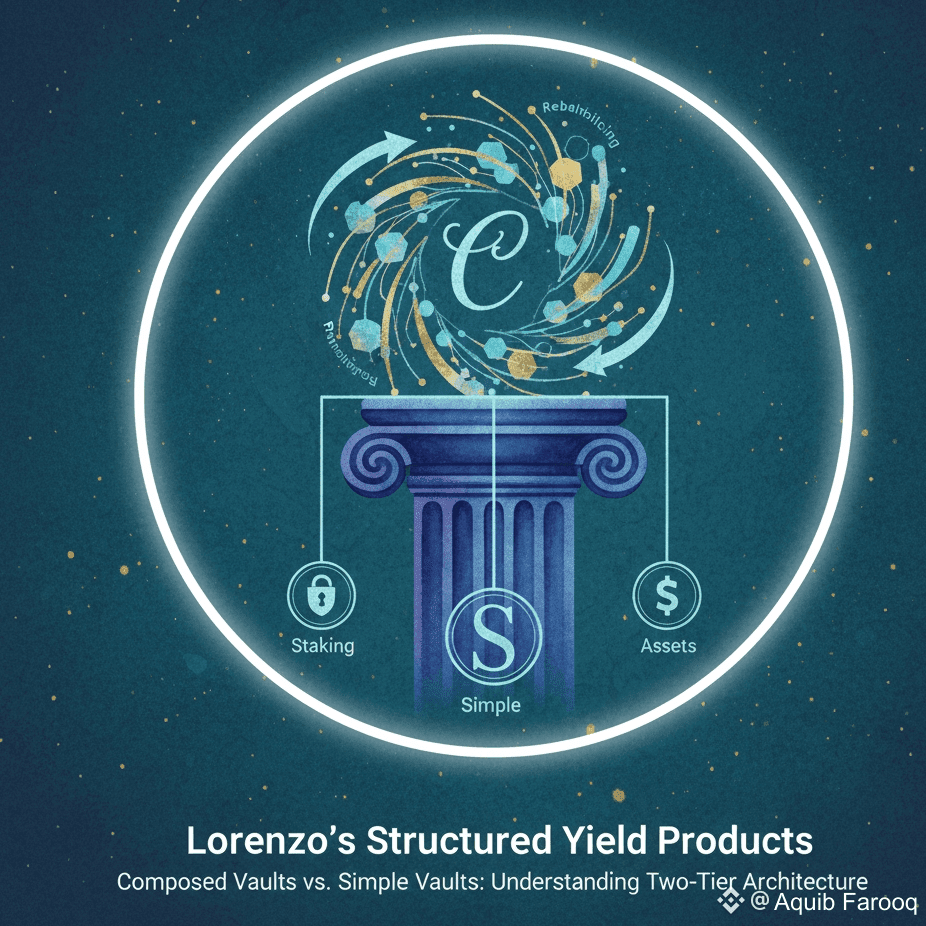
And the more time you spend with that structure, the more you realize it’s less a technical decision and more a philosophy: keep the foundations stable, and let the upper layers improvise.
Simple Vaults are the first half of that idea. They don’t hide what they do. They wrap a single yield strategy—staking, lending, LPing, whatever the market demands and they do it without ornamentation. You deposit. The strategy executes. You earn. There’s something refreshing about that in a space that often mistakes opacity for innovation.
Simple Vaults remind me of the clean, dependable mechanisms you’d find in traditional finance—bond ladders, fixed-rate notes, money market baskets. Tools that don’t need to be loud. Tools you rely on because they’ve been built with clear constraints.
Composed Vaults, by contrast, feel like stepping into a very different kind of workshop. They are orchestral in nature—multiple Simple Vaults bundled, weighted, shifted, and rebalanced depending on the broader conditions. Here, the protocol stops being just a container for yield and becomes a system for allocation. Composed Vaults don’t merely execute strategies; they blend them. They make decisions. They react. They evolve.
If Simple Vaults are instruments, Composed Vaults are the score.
The beauty of this split becomes obvious when you imagine trying to build one without the other. If Lorenzo had only Simple Vaults, the protocol would feel like a collection of isolated tools—useful, but lacking cohesion. If it had only Composed Vaults, everything would become abstract, too layered, too far removed from the strategies that actually create yield. The two-tier structure anchors one in clarity and the other in adaptability.
And perhaps the most human part of this design is how it mirrors the way we handle risk in real life.
Most people don’t invest purely in raw instruments. They build combinations—some stable, some opportunistic, some hedged, some thematic. Lorenzo captures that pattern on-chain with an elegance that doesn’t feel forced.
What intrigued me most was the rebalancing aspect. Composed Vaults handle it automatically, at the contract level, without the hand-waving you often see in DeFi around “expected performance.” The architecture is quiet, almost understated, but incredibly deliberate. When conditions change—volatility spikes, yields shift, funding rates flip the vault doesn’t panic. It adjusts. It slides weight from one Simple Vault to another like a portfolio manager shifting exposure across asset classes.
There’s something calming about that behavior. It hints at a future where users don’t have to babysit their or chase the next temporary yield spike. They can let a system operate with discipline, while still benefiting from dynamism.
The deeper I looked, the more I realized the brilliance isn’t in any single vault type. It’s in the relationship between them. Simple Vaults give the architecture truth. Composed Vaults give it intelligence.
Build the small pieces to be trustworthy.
Build the large pieces to be adaptive.

