
On Thursday (December 11), during the Asian market, Bitcoin continued to hover around $90,000 after the Federal Reserve cut rates by 25 basis points. The Federal Reserve acknowledged the high uncertainty surrounding the U.S. economic outlook, and market focus shifted to the Bank of Japan's decision.
Bitcoin fluctuated narrowly between $91,000 and $92,000 throughout the trading session, with limited reaction to the Federal Reserve's rate cut. On-chain capital flows have kept volatility low.
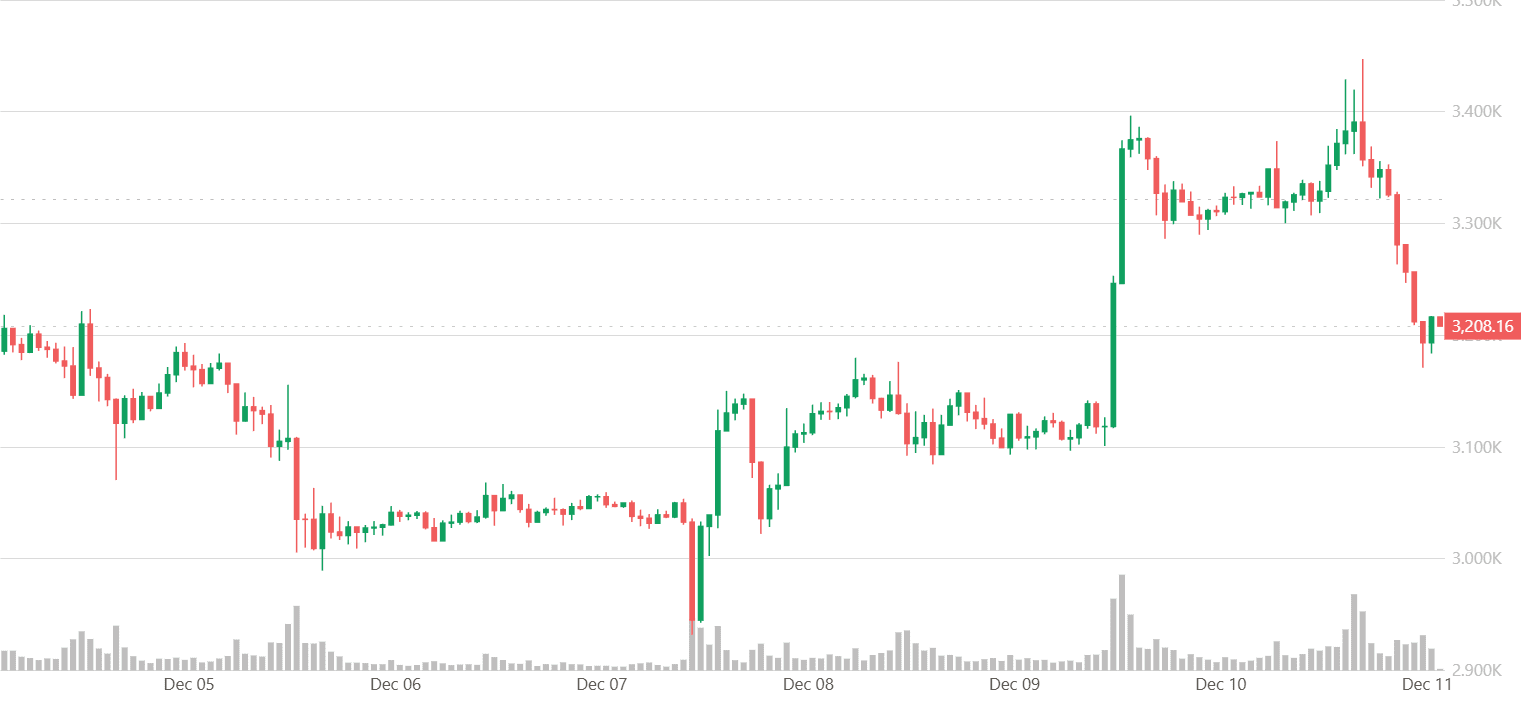
The Ethereum trend is similarly calm, maintaining around $3,270, with no clear catalysts driving it out of the recent range.
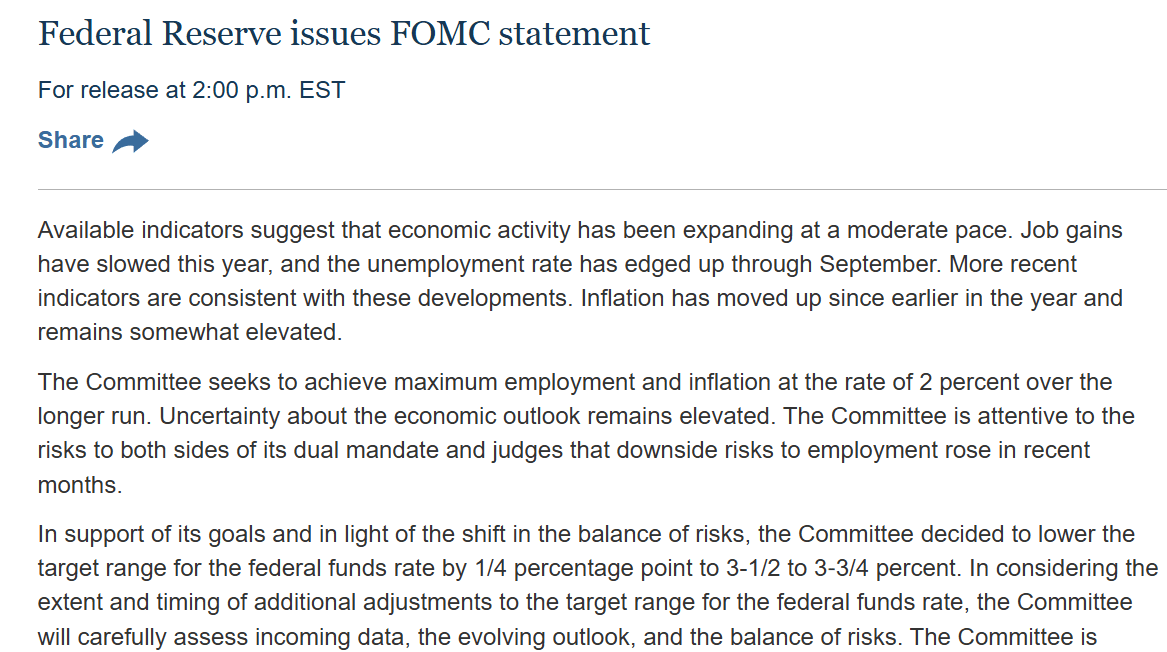
The Federal Reserve lowered interest rates as expected.
On Wednesday, the U.S. Federal Reserve lowered the benchmark interest rate by 0.25% and stated it would restart short-term Treasury bond purchases. Notably, this decision was not unanimous within the Federal Open Market Committee (FOMC): two members voted to keep rates unchanged, while another member advocated for a larger rate cut.
In the post-meeting statement, the Federal Reserve did not clearly indicate that it would continue to cut rates next year, instead stating that it would 'carefully assess the latest data, changes in the economic outlook, and risk balances.' In the updated economic and interest rate forecasts, Federal Reserve officials continue to expect two rate cuts next year. However, internal viewpoints have widened, with one official even expecting up to six rate cuts next year (each by 25 basis points).
Sygnum Bank's Chief Investment Officer Fabian Dori stated in a statement to Decrypt: 'Given the Fed's concerns about a weakening labor market and persistent inflation, it is not surprising that the Fed is not committing to further rate cuts in the coming months.'
Due to a brief government shutdown, the November CPI report has been postponed to December 18, and the latest employment data has not yet been released. Thus, this rate decision was made in the absence of some key data. Meanwhile, the ADP National Employment Report showed that employers cut 32,000 jobs last month. The report added that job growth has been stagnant in the second half of 2025, with manufacturing particularly weak in November.
The Federal Reserve is effectively in a 'tightrope' state: cutting rates too quickly may exacerbate price pressures from tariffs, while cutting rates too slowly may leave the labor market persistently weak, leading to an economic recession.
Nevertheless, this rate cut had long been anticipated by the market. According to CME FedWatch, before the meeting, traders expected a high probability of 89% that the Federal Reserve would cut rates by 25 basis points for the third consecutive time.
The next Federal Reserve chair is key.
As the decision was announced on Wednesday, U.S. President Donald Trump is considering candidates for the next Federal Reserve chair. National Economic Council Director Hassett (Kevin Hassett) is widely viewed as a leading candidate, but according to Yahoo Finance, the interview process has just begun.
In a Politico interview released on Tuesday, Trump stated that 'willingness to immediately cut rates' is a key criterion for screening candidates. Current Chair Powell's term will end next May, and the Federal Reserve has previously been cautious on rate cuts.
Analysts from investment bank Compass Point wrote in a recent report: 'A Federal Reserve chair who clearly supports cryptocurrencies could accelerate the integration of blockchain into the banking system.' They mentioned that Hassett had previously led the drafting of a 168-page report on digital asset regulation for the National Economic Council.
On the prediction platform Myriad, traders on Wednesday estimated that the probability of Hassett being nominated to replace Powell before March next year is 73%.
Throughout Trump's second term, he has pressured Powell to cut rates, but due to last year's belief that inflation would be harder to ease due to changes in trade and immigration, the Federal Reserve did not implement its first rate cut until September of this year, and then again in October.
On Tuesday, Trump expressed his dissatisfaction with Powell again during an economic speech in Pennsylvania, calling him a 'bad Federal Reserve chair' and questioning the legitimacy of other Federal Reserve officials nominated by former President Biden, suggesting that these officials could also be dismissed in the future.
Bitcoin is in a weak state.
According to data compiled by Bloomberg, as the first cryptocurrency, Bitcoin dropped as much as 2.7% during the Singapore trading session on Thursday morning, briefly falling below $90,000, lower than the previous day's intraday high of $94,490. Smaller tokens like Ethereum, Ripple, and Solana also fell back.
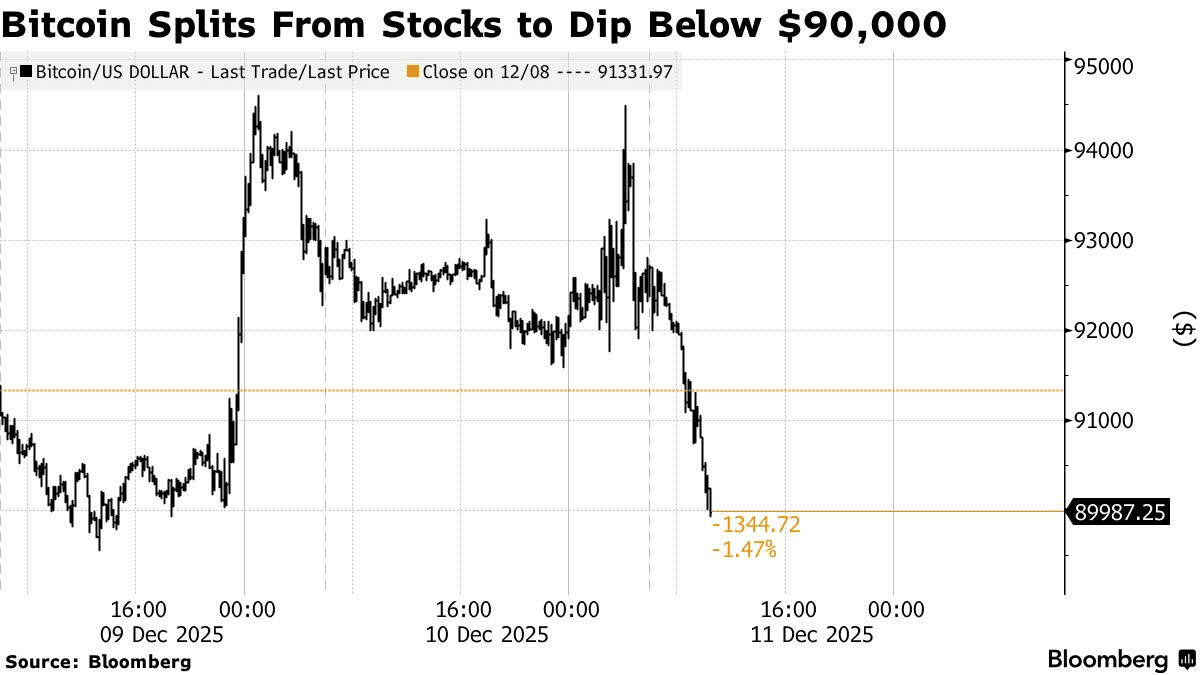
Bitcoin is currently in a weak state after experiencing several weeks of selling since early October, during which a significant liquidation event wiped out about $19 billion in leveraged positions. Although Asian stocks rose on Thursday following Wall Street's lead due to Federal Reserve Chair Jerome Powell's push for a 25-basis point rate cut, this move did not significantly improve the sentiment of crypto traders.
'This is a clear decoupling phenomenon,' said Sean McNulty, head of derivatives trading for FalconX Asia Pacific.
Led by Michael Saylor, Bitcoin asset management company Strategy Inc. purchased 10,624 Bitcoins valued at $962.7 million between December 1 and 7, marking the company's largest acquisition since July.
However, this still failed to keep Bitcoin's price above $94,000, 'which indicates that demand is being overwhelmed by structural selling pressure,' Mc Nulty stated.
Mc Nulty added that Bitcoin's next important support level is $88,500, while $85,000 is the 'critical bottom line.'
Selling pressure is about to wane.
CryptoQuant noted in its latest report that Bitcoin inflows to exchanges have significantly dropped from November's highs, and whales have also reduced the amount they deposit into exchanges, thereby reducing short-term selling pressure and allowing the market to maintain stability within a narrow range.
CryptoQuant also stated that when Bitcoin first dropped below $100,000, whales incurred losses of over $600 million, with cumulative losses estimated at $3.2 billion. Since mid-November, short-term holders have been selling at negative yields, a pattern that typically only emerges after market sentiment has fully capitulated. Historically, this usually indicates that selling pressure is about to wane.
In this context, despite several macro factors, Bitcoin remains stable around $92,000.
QCP stated that the current stability should not be mistaken for firm market confidence. The trading desk noted that ETF inflows have only improved moderately, while derivatives positions remain cautious, and the market is still in a wait-and-see mode.
Focus shifts to Japan
Market focus now turns to Tokyo. The prediction market generally expects the Bank of Japan to raise rates by 25 basis points at its meeting on December 19. QCP pointed out that the next major driver will come from Japan, as Japanese long-term bond yields are approaching decades-high levels, and policymakers have expressed concern about the speed of rising yields.
The current market is generally stable, but future trends will depend on how Japan's decision-making reshapes global risk appetite.
Bitcoin Technical Analysis
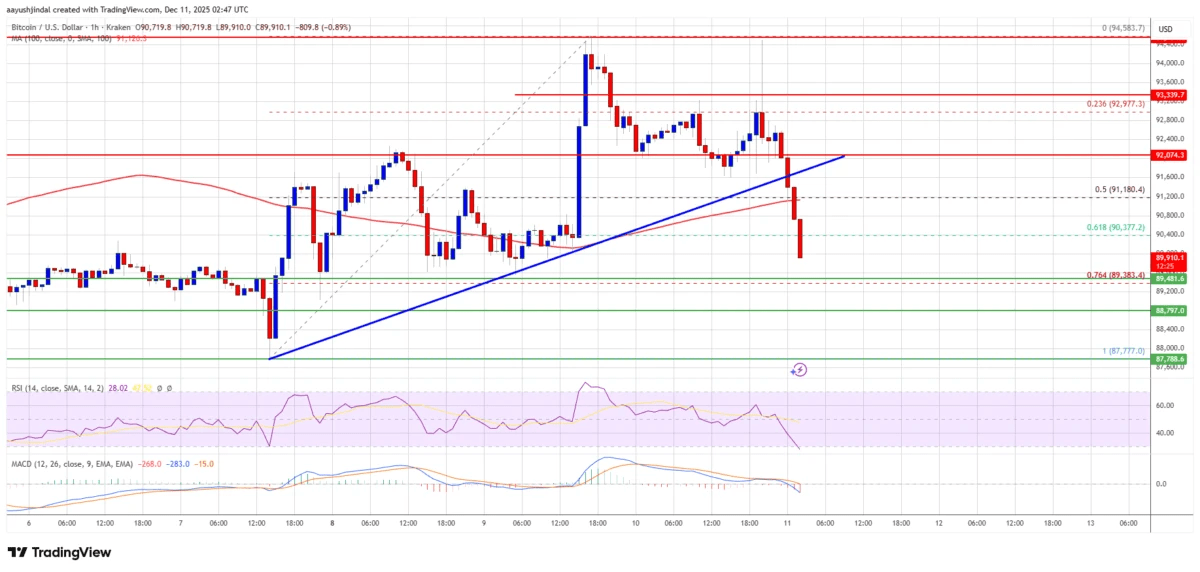
Bitcoin's price failed to gain enough momentum to break through the $94,000 and $94,500 resistance levels. BTC then began a downward adjustment and fell below the $92,000 support. The price clearly dropped below the 50% Fibonacci retracement level of the range from the low of $87,777 to the high of $94,583. Additionally, the price in the BTC/USD hourly chart also fell below the ascending trendline support at $91,600.
Bitcoin is currently trading below $91,200 and is below the 100-hour simple moving average. The price is approaching the $89,500 support, as well as the 76.4% Fibonacci retracement level of the range from $87,777 to $94,583.
If bulls return to the market, prices may attempt to attack again. Recent resistance is at $91,200. The first key resistance is near $91,500. The next resistance may be at $92,000. If it can close above the $92,000 resistance level, the price may rise further. In this case, BTC may test the $92,850 resistance, and if the upward momentum continues, it may aim for $93,500. The next major resistance levels remain at $94,000 and $94,500.
On the downside, if Bitcoin fails to break through the $92,000 resistance zone, it may trigger a new round of declines. Recent support is at $89,500. The first major support level is around $88,800. The next support level is in the $87,750 range. If breached, the price may move toward the $86,500 support in the short term. The most important support level is at $85,000; once broken, BTC may accelerate downward in the short term.
Technical indicators:
Hourly MACD: The MACD is accelerating into bearish territory.
Hourly RSI: The RSI for BTC/USD has fallen below the 50 level.
Major support levels:
$89,500
$88,800
Major resistance levels:
$91,200
$92,000


