

Stablecoin Dominance Crosses into Health Technology
The world's largest stablecoin issuer, Tether, which has a market capitalization of $186 billion, has officially announced its entry into the consumer health technology industry. This move symbolizes the crypto giant's attempt to extend its influence beyond the financial realm into new frontiers.
On Wednesday, Tether launched a health management application called 'QVAC Health.' This app is not a traditional health tracking tool but is built on Tether's self-developed AI platform, aimed at addressing the current pain points of fragmented digital health data and privacy leaks.
Tether CEO Paolo Ardoino emphasized in a statement that this product reflects the company's commitment to "privacy-protecting local intelligence" and stated, "Users should not be forced to choose between the best hardware on the market and maintaining personal privacy."
Tether's cross-industry move is a declaration of war against existing tech giants (Big Tech). Ardoino pointed out that current health data is often locked within their own closed proprietary ecosystems, even subjected to data harvesting and ad tracking by commercial servers. The core vision of QVAC Health is to break down these barriers and create a "neutral health data platform" that allows users to truly own the full picture of their health status. This strategic shift shows that Tether is actively building a parallel decentralized technological infrastructure using its record profits from high-yield U.S. Treasury bonds, attempting to hand back "data autonomy" to ordinary users from Silicon Valley giants.
Data aggregation and local AI technology
The design of QVAC Health's functions closely aligns with the two main themes of "integration" and "privacy," aiming to address the pain points faced by users for a long time: health information scattered across incompatible applications such as Apple Health, Fitbit, and Oura Ring. The platform can aggregate step counters, sleep trackers, workout records, and nutrition data from various wearable devices into a single encrypted dashboard.
Most importantly, the processing of this data is completely "run locally" on the user's personal device, relying on AI models on the device for computation, without needing to upload to any external commercial servers, fundamentally eliminating the risk of data leakage or misuse by third-party advertisers.
In addition to the basic data aggregation function, QVAC Health has also introduced experimental computer vision technology, elevating dietary tracking to a new level. Users only need to take photos of their meals, and the built-in local AI can estimate calorie intake and analyze a large number of nutrients (Macronutrients). This feature directly competes with mainstream dietary tracking applications on the market, but its advantage lies in that all computational processes do not require internet access.
In addition, the application supports natural language processing (NLP), allowing users to record workouts, symptoms, or medication use by typing or speaking, with AI automatically understanding the context and organizing it into the user's timeline. This capability to perform cross-device correlation analysis of activity logs from watches and sleep metrics from rings is completed independently on the user's mobile device, ensuring absolute data privacy.
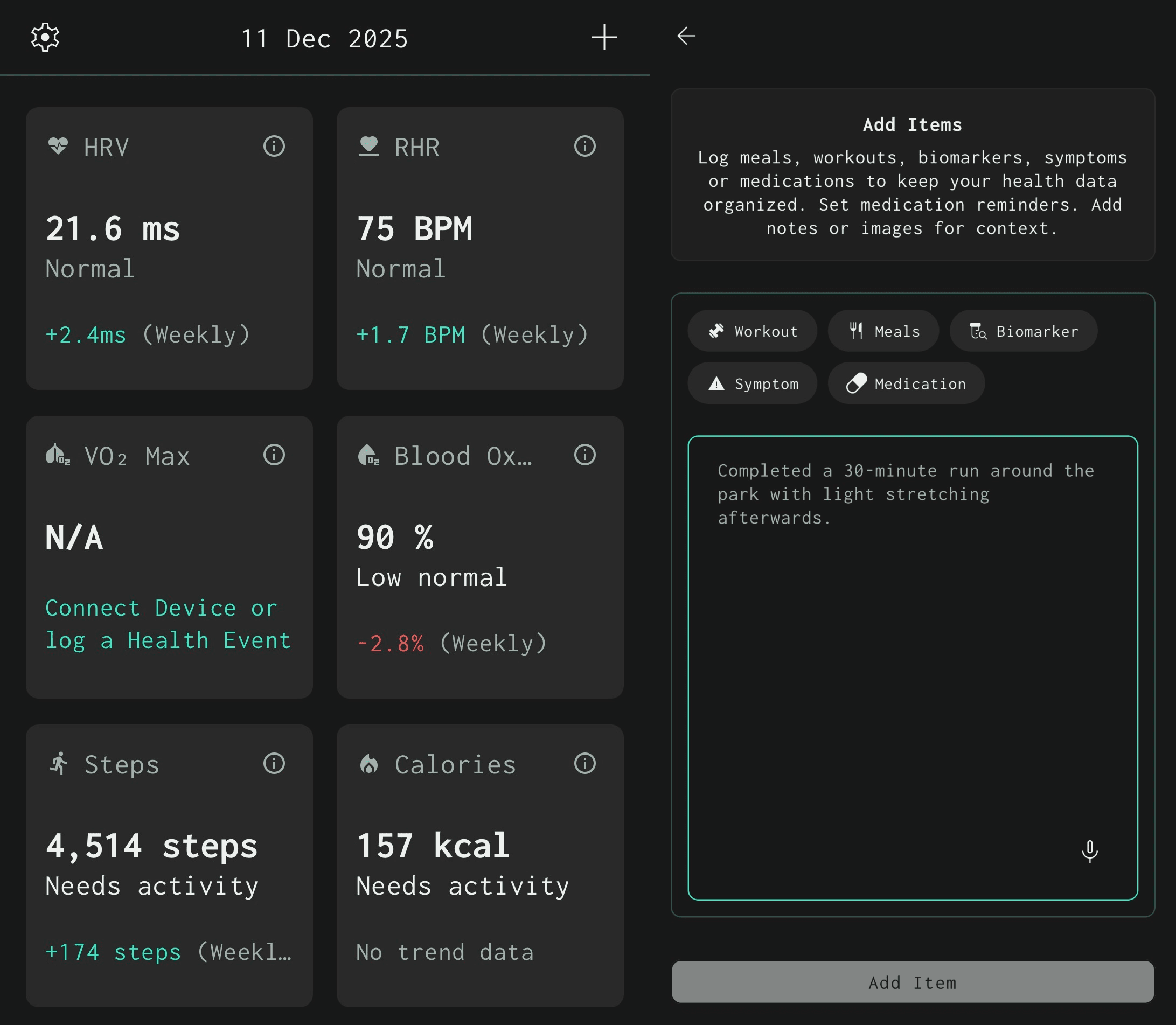 Image source: QVAC Health users can record workouts, symptoms, or medication usage by typing or speaking, with AI automatically understanding the context and organizing it into the user's timeline.
Decentralized privacy infrastructure
The core technology supporting QVAC Health's operation comes from Tether's data division, Tether Data, which developed the "QVAC" decentralized AI platform. Just before the product launch, Tether open-sourced an edge-first architecture named "QVAC Fabric LLM" on December 2, designed specifically for running large language models on consumer-grade hardware.
Its slogan "Local AI. Infinite Intelligence. No Compromise" clearly reveals Tether's attempt to free itself from reliance on centralized data centers. Through a peer-to-peer (P2P) model for downloading and local inference, Tether is building a parallel system that does not require a "gatekeeper."
In the future product roadmap, Tether plans to further deepen this decentralized technological architecture. The company revealed that future updates will include direct Bluetooth Low Energy (BLE) connection capabilities, meaning that QVAC Health will be able to read raw sensor data directly from specific wearable devices, completely bypassing the manufacturers' API interfaces and cloud services.
If this feature can be realized, it will thoroughly cut off the control chain of hardware manufacturers over user data. Additionally, future AI models will provide proactive health guidance, such as suggesting recovery plans or sleep adjustments based on real-time data, with all intelligent decision-making processes occurring on the user's mobile phone, ensuring that no sensitive information leaves the user's control.
From brain-computer interfaces to robotics layout
The launch of QVAC Health is not a singular event but a piece of the puzzle in Tether's vast technological investment map. This stablecoin issuer is leveraging its strong capital to extend its reach into multiple cutting-edge tech industries, and many of these investment projects are minimally related to its core stablecoin business.
Just this week, Tether announced its participation in a €70 million funding round for the Italian startup Generative Bionics, which focuses on developing intelligent humanoid robots with advanced artificial intelligence and plans to enter industrial applications as early as next year.
Prior to this, Tether invested $200 million to acquire a majority stake in brain-computer interface company Blackrock Neurotech. From neurotechnology, humanoid robots to now a privacy health platform, Tether's strategic intent is evident: it is no longer satisfied with merely serving as a financial channel in the cryptocurrency market but aims to transform into a comprehensive tech giant embracing "human enhancement" and "decentralized infrastructure."
Ardoino positions this new app as a practice of ideology rather than merely a commercial product, which aligns with Ethereum founder Vitalik Buterin's proposal of "multi-identity" and the trend of Circle developing privacy-enhanced stablecoins, demonstrating that the cryptocurrency community's concern for privacy and data sovereignty is spilling over from the financial industry to broader life scenarios.
Further Reading
Stablecoin giant lays out AI plans! Tether intends to invest €1 billion in a German startup, targeting AI robotics
Tether CEO discusses layout: Tether not only makes stablecoins but aims to reshape the future of humanity with four pillars
Tether CEO: USDT has 420 million users! Heavily investing in agriculture, AI, and brain-computer interfaces
Data autonomy and market challenges
Tether chooses this moment to enter the digital health market, facing huge opportunities and challenges. According to a report by Verified Market Research, the global fitness tracker market is valued at $52.29 billion in 2024 and is expected to grow to $189.98 billion by 2032. However, this is also an extremely competitive red ocean market, not only occupied by traditional tech giants like Apple, Fitbit, and Samsung but also emerging projects like Rejuve and CUDIS, which also focus on the decentralized concept, competing for market share.
For native cryptocurrency users, Tether's privacy commitment has a certain appeal, but for the broader mass market, whether they are willing to entrust their most private health data to a stablecoin issuer remains a huge question mark.
Notably, S&P Global recently downgraded the stability rating of $USDT due to an increase in the proportion of highly volatile assets in Tether's reserve assets, which may affect user trust to some extent.
Further Reading
S&P rated Tether as the weakest: 24% of reserve assets are highly volatile, Tether strongly retaliates
Nevertheless, the emergence of QVAC Health undoubtedly provides the market with a moment of reflection: in an era of increasing digital surveillance, do we still have another choice? As Aldo Iorino said, this is to grant people "ownership of health data that simply does not exist today," and this experiment about data autonomy is just beginning.
‘Tether ventures into AI health technology! How does QVAC Health integrate biological data while ensuring your privacy?’ This article was originally published in ‘Crypto City’