
Injective runs on a stubborn kind of discipline that most projects talk about but few actually live by. Every single line of code that touches the chain has to answer one question before it gets merged: does this make the token faster to use, fairer to trade with, or scarcer to hold. If the honest answer is no, the change dies on the spot. That filter has been in place since the first commit, and the Injective token keeps getting stronger because nothing slips through that does not pay its way in at least one of those three currencies.
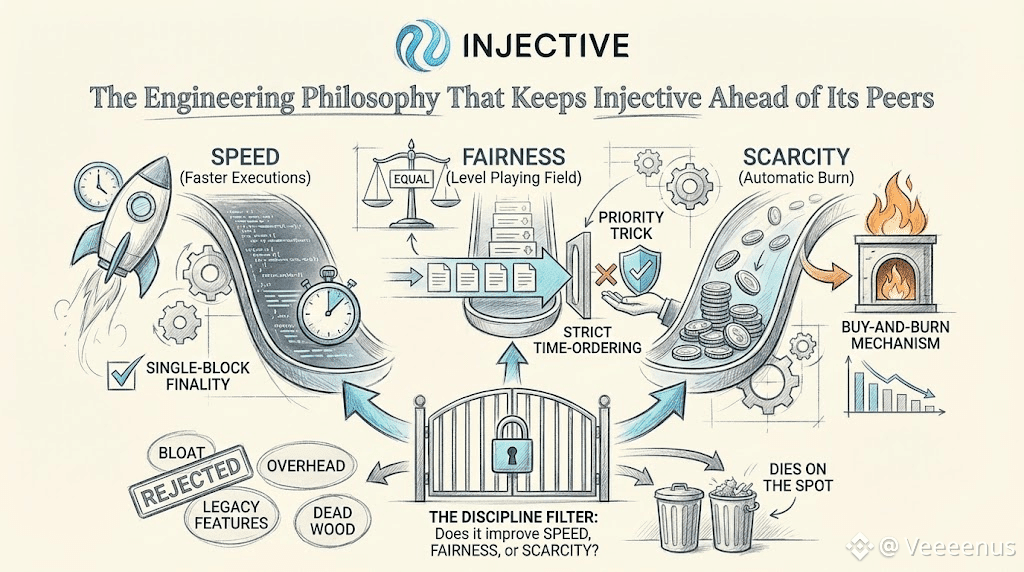
Speed is not a nice-to-have; it is the first commandment. The consensus layer was built from the ground up to deliver single-block finality no matter how hard the chain gets hammered. Block times stay short and predictable because the team refuses to let anything bloat the proposal phase. When a new order-matching feature is proposed, the first thing they measure is how many extra milliseconds it adds to the critical path. Anything that pushes the average confirmation above the current baseline gets sent back to the drawing board until it comes in lighter than what was already there. The Injective token feels that obsession every day because lower latency means more trades, and more trades mean more fees routed straight into the burn.
Fairness is treated with the same cold-eyed rigor. The matching engine does not care who sent the order or how much they paid to get it there first. Every transaction is sorted strictly by the time it hit the mempool, and the code that enforces that rule is written in a way that makes reordering physically impossible without breaking consensus. When someone tries to sneak in a priority trick, the validators simply reject the block. That uncompromising stance keeps the playing field level, and the Injective token benefits because traders who get burned elsewhere eventually bring their volume to the one place that never burns them.
Scarcity is baked in at the protocol level rather than tacked on as an afterthought. Fees are not just collected; a meaningful portion is bought back and removed from circulation forever. The buy-and-burn mechanism runs automatically, triggered by real activity instead of promises or schedules. When trading volume picks up, the burn accelerates in perfect proportion. When the chain is quiet, the burn slows but never stops. The Injective token ends every week with fewer coins in existence than it started with, and that slow grind downward is the direct result of refusing to let any fee escape the furnace.
Upgrades follow the same unforgiving logic. A new module only ships when it can prove it will lower average gas consumption or tighten execution timing without compromising the other two pillars. The last major release trimmed state writes by packing position data more efficiently, which let the same block carry more orders at the same cost. The change was small on paper but shaved real time off every perpetual fill, and the Injective token registered the difference through higher burn volume the moment the switch flipped.
State bloat is fought like a chronic disease. Old data is pruned aggressively, expired contracts are wiped the instant they settle, and every storage touch is audited for waste. The chain stays lean because carrying extra weight would slow it down, and slowing down violates the first rule. The Injective token rewards that vigilance by keeping fees low enough that users never feel punished for trading, which keeps the flywheel spinning and the burn running hot.
Nothing is sacred except the three rules. Convenience functions get deleted if they add even a tiny amount of overhead. Legacy order types disappear the moment they stop pulling their weight. Front-end niceties that require extra round trips are rejected outright. The chain stays ruthless because the moment it starts carrying dead wood, the token pays the price in lost speed or lost burns.
That philosophy is why Injective never has to chase the latest trend. While other projects bolt on features to stay relevant, Injective just keeps sharpening the same blade it started with. Faster confirmations, cleaner fills, tighter supply. Every improvement feeds directly back into the token, turning engineering discipline into price action without hype or hand-waving. The Injective token does not need stories or roadmaps to justify its place; it has the quiet confidence of something built the right way from day one, and it keeps proving that the simplest rules, followed without exception, are the hardest ones to beat.
