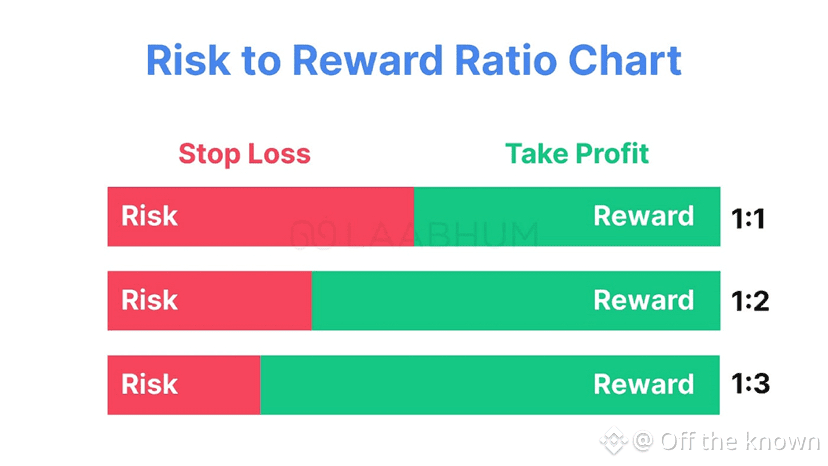
Most retail traders know what R:R means…
But very few understand how R:R actually controls your entire trading system.
Here’s how pros use it at an advanced level 👇
🔥 1️⃣ R:R Determines If Your Strategy Is Profitable — Not Your Win Rate
A 30% win rate can beat a 70% win rate
IF the system has a strong risk–reward ratio.
Example:
Risk 1R to make 3R
Win 3 out of 10 trades = +9R
Lose 7 trades = –7R
Total = +2R profit
Your edge is not in accuracy,
Your edge is in asymmetry.
🎯 2️⃣ Low R:R Strategies Force You Into High Win Rates
If your average R:R is 1:1, your strategy becomes a slave to accuracy.
One mistake → large equity drawdown.
Pros avoid this trap by targeting:
• 1:2
• 1:3
• 1:4+ (trend setups)
High R:R creates mathematical freedom.
🧠 3️⃣ Your Stop-Loss Defines R:R — Not Your Target
Beginners set targets first.
Pros set stops first, because the stop determines:
• where the idea is invalid
• position size
• maximum risk
• whether the trade is even worth taking
Only after defining the stop do they look for logical targets.
Stop → Risk → R:R → Position Size → Entry
This is the pro workflow.
📊 4️⃣ R:R Filters Bad Trades Instantly
If a trade cannot offer at least 1:2, pros skip it.
Why?
Because taking low R:R trades destroys long-term expectancy — even if the setup looks “good.”
If the math is bad, the trade is bad.
🧩 5️⃣ Advanced Trick: Dynamic R:R Using Market Structure
Instead of fixed targets, advanced traders adjust R:R using:
• liquidity pools
• previous highs/lows
• imbalance zones
• trend legs
• volatility expansion
This keeps R:R realistic, logical, and market-driven — not emotional.
🧮 6️⃣ Expectancy: The True Power Behind R:R
Pros measure their system using this formula:
Expectancy = (Win Rate × Average Win) − (Loss Rate × Average Loss)
If this number is positive →
Your strategy is mathematically profitable.
This is where amateur trading ends
and professional trading.
What’s the minimum R:R you accept — 1:1.5, 1:2, 1:3, or more?
Comment below 👇 and I’ll tell you what that says about your trading style.