The world of blockchain has always been powered by people. Wallets, accounts, keys, and transactions were designed for humans to interact with decentralized systems. But what happens when machines start acting on our behalf not just as tools, but as economic actors on their own? A new generation of systems is emerging that treats artificial intelligence agents as first-class participants in blockchain networks. One project leading this movement is Kite, a blockchain built specifically for AI agent payments and autonomous machine-to-machine interactions.
Kite’s vision is simple but powerful. It imagines a world where AI agents programs that can think, plan, and act independently can not only perform tasks but also hold identities, make payments, and transact value on their own. Instead of requiring humans to approve every interaction, these agents could negotiate services, pay for data, and settle transactions without direct human involvement. Kite’s blockchain is designed so that these autonomous actors have their own on-chain identity and native tools for interaction.
Imagine that your personal digital assistant automatically executes purchases, negotiates service contracts, or pays for computation while you sleep. This kind of future is no longer science fiction. Blockchain can provide the trust, payment rails, and shared ledger that make such autonomous cooperation possible. It is this vision that makes Kite an intriguing example of a blockchain moving beyond human wallets.
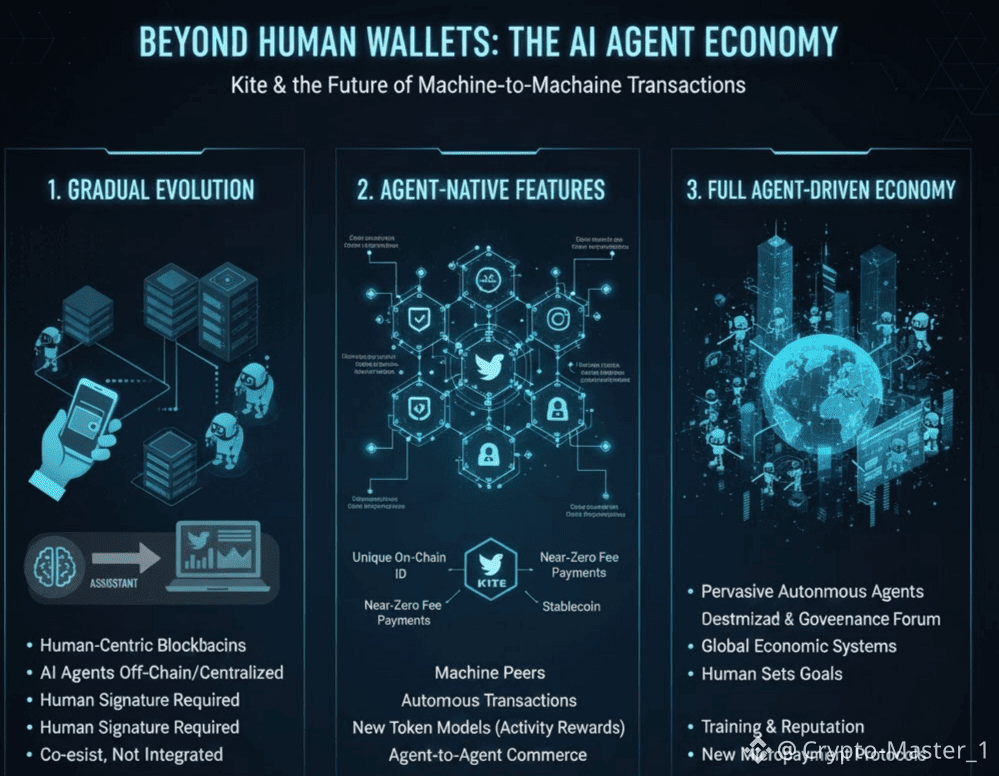
As we look ahead, we can imagine three pathways for how blockchains and autonomous agents might shape Web3 over the next decade.
In the first pathway, the evolution is gradual. Most blockchains remain oriented around human wallets and simple decentralized applications. AI agents still exist, but they mostly run off-chain or within centralized platforms. Blockchain networks like Ethereum or newer smart contract chains may explore agent features, such as letting bots automate DeFi strategies or trading, but these agents remain assistants rather than full participants in economic activity. Agents might analyze data, propose actions, and suggest moves to human users, but transactions still require human signature. This future sees AI and blockchain co-existing, but not deeply integrated into a shared economy.
In the second pathway, agent-native features become more common. Chains begin adding primitives for identity, payment, and permissions that are better suited for machine peers. In this world, autonomous agents are trusted to request payments, interact with decentralized services, and even enter short-term contracts without human intervention. This requires blockchains to rethink token economics, micropayment systems, and governance rules in ways that reward both humans and machines fairly. Kite’s model giving each agent a unique on-chain identity and enabling stablecoin-based, near-zero fee payments could serve as a template for these developments.
In this scenario, you might see marketplaces where agents negotiate services with other agents in real time. One agent could buy data from another, or two agents might hire a third for compute work. Payments would happen automatically, negotiated and settled without human approval for each step. Networks would need new token models that reward not just staking and liquidity, but also agent activity and contributions to the ecosystem. Chains that fail to embrace agent-native protocols may find themselves sidelined in a world where machines do much of the economic heavy lifting.
The third, most transformative pathway is a full agent-driven economy. In this vision, autonomous agents become pervasive. They make decisions, trade with each other, and even participate in governance. Human involvement shifts from direct execution to setting high-level goals and constraints for their agents to follow. This world would have profound implications for global economic systems. Agents could manage supply chains, optimize energy usage, or coordinate large-scale data analysis and compute jobs across networks. They might even serve as bridges between decentralized systems and regulated environments, executing tasks compliantly according to legal and financial constraints.
This aggressive future also brings new challenges. Regulatory systems around the world are still grappling with how to define digital identities, financial intermediaries, and automated systems that can sign contracts and move value. Smart contracts and agent interactions must be secure and reliable, or malicious actors could exploit vulnerabilities that arise when machines transact autonomously. There are also questions about who is responsible when an autonomous agent makes a harmful decision the developer, the owner, or the system itself?
Token economics will need rethinking as well. Traditional models reward users for staking, liquidity provision, and participation in governance. In an agent economy, tokens might also be earned by building trusted agent identities, providing quality services to other agents, or maintaining machine-grade uptime and response performance. New micropayment protocols may become standard, letting agents pay tiny amounts for data, compute cycles, or services in real time. Kite’s agent payment infrastructure and identity layers are early examples of how these systems might work.
For other blockchains, the rise of agent-native ecosystems means they will need to adapt or risk losing relevance in a future dominated by autonomous machine interactions. Some chains may specialize in high-security settlement layers for agent payments. Others might focus on decentralized marketplaces that support rich agent-to-agent commerce. Regulatory compliance features could become a necessity, especially for agents that interact with real-world assets or financial services.
What Kite is doing today building a blockchain optimized for autonomous actors with verifiable identity, scalable payments, and programmable governance highlights a potential direction for the broader industry. If autonomous agents grow from tools into economic actors, blockchains that support this shift may find themselves at the center of a new paradigm in Web3. The shift from human-driven to agent-driven blockchain economics could unlock new forms of efficiency and cooperation, but success will depend on thoughtful design, resilient governance, and deep engagement with emerging standards for AI and smart systems.