
@Terra 🌍 Powered by LUNA #LUNA #LUNC #USTC
Imagine, for a moment, that we are not talking about lines of code or financial graphs flashing in red and green. Close your eyes and visualize a digital civilization built on humanity's oldest premise: the quest for perfect stability in a world of chaos. The story of the Earth ecosystem is not just about money; it is the modern reenactment of the myth of Icarus, fused with the Japanese art of repairing what has been broken.
You, who live technology, know that every complex system tends toward entropy. But what happened to the original Earth (LUNA) was a direct challenge to financial gravity. They created USTC (formerly UST), an algorithmic stablecoin. Unlike its dollar-backed peers in a vault, USTC was backed by mathematical faith and arbitrage. It was pure kinetic energy. As long as the mechanism worked, it soared high, very close to the sun. And, like Icarus, the wax of the wings melted. The "death spiral" that followed was not just a bug; it was a black swan event that rewrote the psychology of the crypto market.
But this is where the story takes a turn that most analysts ignore, and where I invite you to look through the lens of Kintsugi.
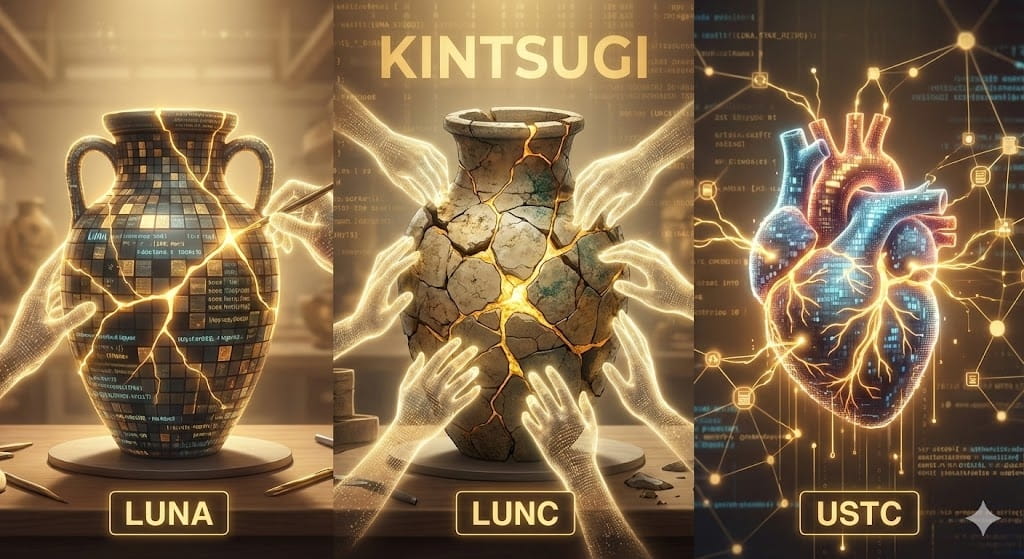
For those who do not know, Kintsugi is the Japanese art of repairing broken pottery with lacquer mixed with gold powder. The philosophy states that the piece, after being broken and repaired, is more valuable and beautiful than the original, because now it has a story.
After the collapse, the blockchain underwent a fork, a "hard fork." LUNA 2.0 was born, the attempt at a clean restart, free from the burden of the faulty algorithm, a blank slate seeking to regain institutional legitimacy. It is technology trying to forget the trauma. However, what happened to the ruins left behind is the true sociological phenomenon.
Terra Classic (LUNC) has emerged. By the laws of financial logic, it should have gone to zero and disappeared. But the community refused to let the digital city die. They occupied the ruins. Instead of discarding the fragments, the validators and holders of LUNC began to apply their own "gold" to the cracks: burn mechanisms, radical decentralized governance, and proposals for re-peg of USTC.
Notice the nuance: while LUNA 2.0 seeks corporate perfection, LUNC has become a living organism, an accidental DAO (Decentralized Autonomous Organization) driven by pure resilience. Can you feel the difference in energy? One is a product; the other is a movement.
The narrative of USTC is even more fascinating. It is the heart that stopped beating, but the community tries to revive it with algorithmic defibrillators. The idea that a currency that has lost 99% of its value could, through reverse engineering and community capital, regain a value of 1 dollar, is the boldest bet of the decade. It is the belief that code, if collectively adjusted, can reverse entropy.
When analyzing these assets today, do not just look at the market cap. Use peripheral vision. There is a subliminal message being conveyed here about the future of Web3: true decentralization only occurs when the original creators fail and the community takes control of the wreckage.
The Terra ecosystem today is a living laboratory. We have LUNA, trying to build applications on new ground, and we have the duo LUNC/USTC, operating as a cybernetic zombie that, against all odds, is learning to run again.
Why does this matter to you, technology enthusiast? Because it proves that the value in the blockchain does not reside solely in the software, but in the social consensus that supports it. The gold of digital Kintsugi is not the code; it is the people.
While the market debates prices, I invite you to observe the structure. What was broken can be fixed? Or better yet, what was broken can become something unprecedented? The answer is not in the charts but in the human ability to find value where others see only ruins. And perhaps, just perhaps, when you look at your own digital wallet now, you will begin to see not just assets, but stories of resilience waiting for the next chapter.
After all, in technology, nothing truly dies as long as there is a node running and someone believing. The question that remains is: do you prefer the security of the new vase or the resilient beauty of the vase restored with gold?


