
The image of the Psychology of a Market Cycle, popularized by Bitcoin investors, speaks for itself. It shows something that has repeated many times since 2009: markets go through predictable emotional phases.
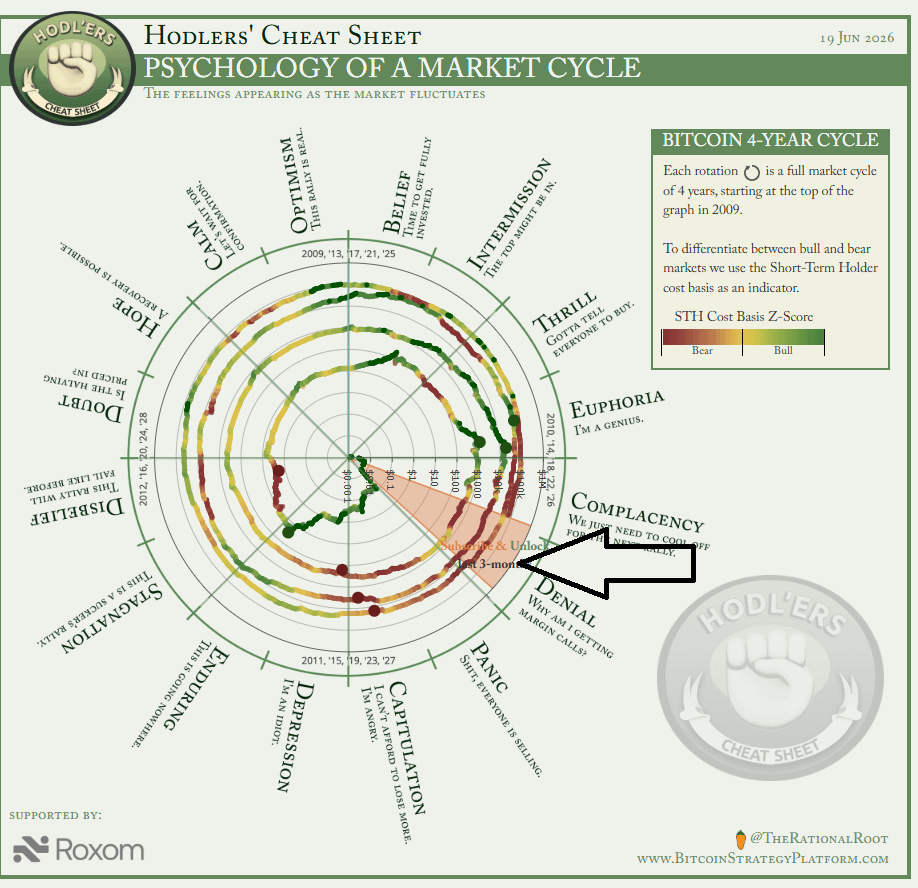
👉The Market Psychology that never fails
Many traders believe that the historical cycle might not repeat this time.
After years of discussion about ETFs, institutional adoption, corporate buys, and programmed scarcity, the narrative has grown that Bitcoin has matured and left behind the traditional bull and bear cycles.
However, according to the historical interpretation of this short-term indicator, it's exactly this kind of thinking that tends to arise in the denial phase (where we are now).
At this stage, after the first stronger corrections, the market tends to believe that any drop is just temporary and that the uptrend will return quickly. Historically, this psychological behavior has preceded periods of greater volatility and, in some cases, much deeper corrections than most expected.
This doesn't necessarily mean a major bear market is inevitable. However, the psychology of cycles suggests that overconfidence can be as dangerous as extreme fear.
When the majority starts believing that 'this time it's different', the market often finds a way to challenge collective expectations.
This could be the biggest threat to Bitcoin in the coming months and weeks.
When a narrative becomes absolute consensus, the market usually looks for ways to surprise the majority.
Bearish catalysts 🥀
The short-term outlook is bearish. 🐻
Persistent inflation 🤔
Even though inflation has cooled off from the peaks of 2022, it remains a global concern.
If a new inflationary wave occurs due to:
geopolitical conflicts; rising oil prices; global logistical issues; increased government spending;
central banks might be forced to keep interest rates high for longer.
This reduces the liquidity available for risk assets like Bitcoin.
High interest rates 💥
Bitcoin was born in a world of near-zero interest rates.
Now, high-income investors can achieve reasonable returns that are safer and less volatile in government bonds, American fixed income, and corporate bonds.
The higher the risk-free return, the lower the incentive to take risks in volatile assets.
This doesn't necessarily mean Bitcoin is going to drop.
But this means that cycles might slow down, become less explosive, and more unpredictable.
3. Strong dollar (DXY) 💵
Historically, there is an inverse correlation between:
Bitcoin Gold Global Liquidity
and the American dollar index (DXY).
When the DXY rises:
capital is flowing back to the U.S.; emerging currencies are weakening; risk assets tend to face pressure.
If the dollar enters a prolonged appreciation cycle, Bitcoin may face significant headwinds.
The fragility of the agreement between Trump and Iran 🚀🔥
Another known factor is geopolitical risk.
Even if there are negotiations or temporary agreements involving the U.S., Israel, and Iran, the region remains extremely unstable.
The issues include: nuclear disputes; proxy conflicts; tensions in the Strait of Hormuz; risk of oil supply disruptions.
If any peace agreement proves temporary or fails, the market may react with:
rising oil prices; increasing global inflation; strengthening dollar as a safe haven; capital flight from risk assets.
In this scenario, Bitcoin could face severe corrections even in a period that many expect to be bullish.
Will Micro Strategy break? 👻
The history of Bitcoin shows a curious pattern: the bottom of the bear market is often found when some event occurs that seems unthinkable during the euphoria phase.
It was like this with Mt. Gox in 2014, with Terra/Luna and FTX in 2022.
In each cycle, a company or structure emerges that is considered indispensable to the market.
When this confidence is broken, a widespread capitulation occurs.
Right now, a lot of investors see entities like Binance, Micro Strategy, and the big ETF managers as rock-solid pillars of the industry.
However, the psychology of cycles suggests that the biggest risks often lie exactly where most believe there are none.
Conclusion 👍
The long-term thesis for Bitcoin remains extremely strong due to: programmed scarcity; increasing institutional adoption; ETFs; accumulation by companies; continuous reduction of available supply.
However, investors who only believe in the 4-year cycle may be ignoring important factors in the market cycle.
And