
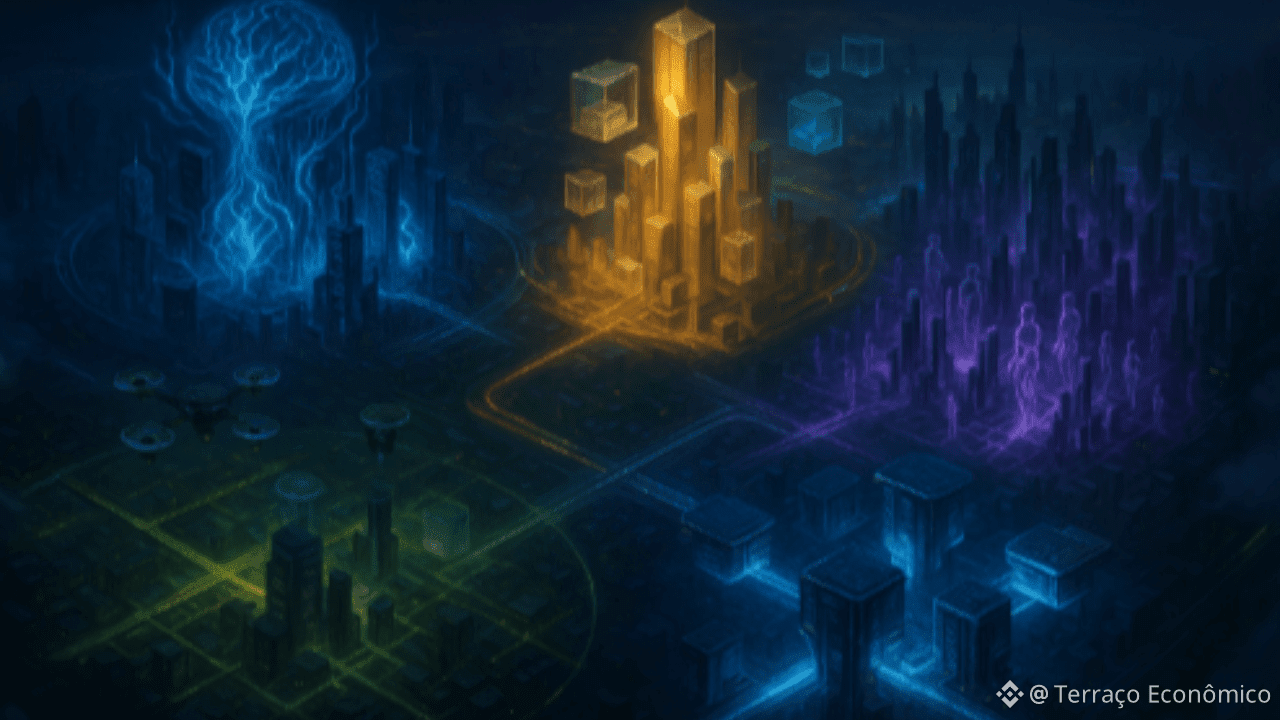
All cycles of the crypto market are defined by dominant narratives. It was like this with ICOs in 2017, DeFi in 2020, NFTs in 2021, and L2s in 2023–2024. Now, as 2026 approaches, clear signs are emerging of which trends may lead the next bull run.
The investor who observes these changes early — before the full hype — is able to position themselves better, reduce risks, and capture value before the crowd.
In this article, we will break down five narratives that are attracting capital, institutional attention, real users, and, most importantly, technical momentum, so that you stay informed and make the best decisions moving forward.
1. RWA (Real-World Assets): tokenization finally becomes a product — and not just a concept
For years, the tokenization of real assets was seen as a distant promise. Only now, however, the sector began to come to life with real products being used by companies, financial institutions, and governments.
Tokenization allows transforming traditional assets like public bonds, private credit, real estate, gold, and even receivables into tradable digital versions on-chain. The power of this narrative lies in efficiency: assets gain 24/7 liquidity, can be fractionalized, transferred globally, and integrated into DeFi protocols.
For investors, this creates a new income channel based on instruments that were previously restricted to institutions. With banks, fund managers, and credit platforms entering the ecosystem, RWA may be the strongest narrative of 2026 — connecting the 'traditional world' to the blockchain in a practical way.
2. AI integrated with blockchain: two megatrends meeting
Crypto and artificial intelligence have grown in parallel, but now they are starting to converge. Protocols that incorporate AI within the logic of blockchain — whether for automation, analysis, oracles, governance, or execution — tend to gain strength in 2026.
The AI+Web3 narrative relies on three factors:
AI improves the efficiency of protocols, allowing for faster and more accurate decisions;
The blockchain ensures verifiability and transparency, preventing manipulation of models and results;
Users begin to use native AI on-chain, creating organic demand for these tokens.
This intersection creates smarter, automated, and more secure platforms, opening up space for new applications — from decentralized financial bots to on-chain recommendation systems.
3. Modular blockchains: the natural evolution of crypto infrastructure
The debate between monolithic and modular blockchains has gained strength in recent years — and now, modularity proves to be the most scalable path.
Instead of networks that do everything, structures emerge where each layer has a function: execution, consensus, data availability, and interoperability.
This allows:
faster transactions;
lower costs;
enhanced security;
And flexibility for complex applications.
For investors, this narrative matters because modular blockchains may become the 'roads' through which most of the liquidity and ecosystem activity circulates.
It is a structural trend, not a passing one — and 2026 will be crucial to identify which networks truly gain mass adoption.
4. DePIN: connecting the physical world to the crypto economy
DePIN (Decentralized Physical Infrastructure Networks) is one of the most recent and disruptive narratives. Here, blockchain ceases to exist solely in the digital world to connect devices, sensors, vehicles, energy, and other physical assets through tokenized incentives.
This opens up space for innovative infrastructure models:
telecommunications networks operated by users;
decentralized sensor networks;
distributed physical storage;
tokenized energy marketplaces;
urban services connected via crypto.
The utility is clear: DePIN creates real economies where users participate and are rewarded for providing physical resources to the ecosystem.
In 2026, this narrative may mature and attract institutional capital — especially in sectors like IoT, decentralized energy, and smart cities.
5. Evolved meme coins: culture, community, and minimum utility — but sufficient
Meme coins will not disappear — on the contrary, they tend to change form.
What we see for 2026 is the emergence of memecoins that combine:
extremely engaged communities;
limited utility, but real enough (governance, rewards, internal ecosystems);
strong cultural presence on social networks;
organic growth within specific blockchains.
This new generation does not try to compete with complex infrastructure or protocols — it exists to capture attention, quick liquidity, and a 'hot market' narrative.
Traders already know: when the market shifts to risk, memecoins react before all other sectors. And the Solana and Base networks, in particular, are becoming fertile ground for this type of asset.
Those who position themselves early will be ahead in 2026
The next cycle will not be driven by a single narrative. On the contrary: 2026 seems to be a year of convergence between technology, utility, and culture.
The five narratives — RWA, AI + blockchain, modular blockchains, DePIN, and evolved memecoins — already show concrete signs of adoption, volume, and institutional interest.
For the attentive investor, understanding these trends is the best way to anticipate flows, avoid noise, and find opportunities before the entire market sees the potential. The bull run does not happen overnight — it begins when narratives gain silent strength.
And 2026 may be exactly the year when fundamentals, technology, and capital align again.
And you, what narratives do you believe will be relevant next year?
#2026 #memecoin #IA #DePIN #Narratives
---
Image created using the Sora AI tool