
Kite is more than just another blockchain project. It represents a leap in how technology will interact with the world, how autonomous systems will manage value, and how humans will partner with machines that can act independently yet securely. As I write this, the idea of AI being able to make payments, negotiate, verify identity, and operate autonomously without needing constant human approval is no longer a futuristic fantasy — it is rapidly becoming reality through the work being done on the Kite blockchain. Kite is a purpose‑built, EVM‑compatible Layer‑1 blockchain designed specifically for autonomous AI agents, those emerging digital entities that can act on behalf of humans and other systems with increasing independence. Its native token, KITE, serves as the foundation of this economy, enabling seamless agent‑to‑agent payments, governance participation, and growth incentives.
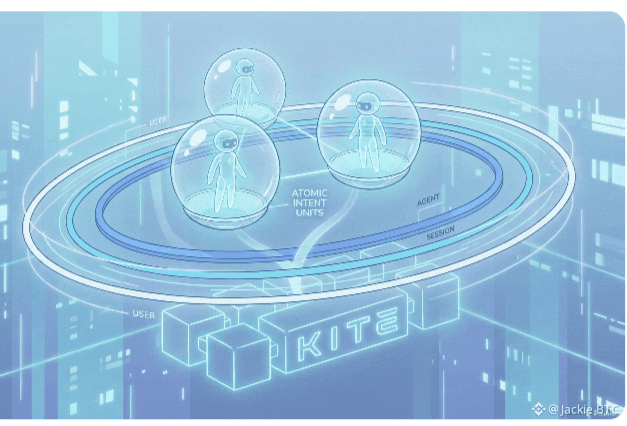
At its heart, Kite was created to address a fundamental gap in today’s technology stack. Traditional financial systems and blockchains were designed with humans in mind — people sending money, signing transactions, and making decisions. But autonomous agents have very different needs. They might need to make thousands of tiny payments in a matter of seconds, negotiate with other agents, verify identity, access specialized services, and handle complex workflows without ever waiting for human approval. That kind of demand breaks the assumptions of legacy systems that were never intended to scale for machine‑native economic interactions. Kite bridges that gap by providing real‑time, secure, programmable infrastructure built for the machine era. The core of the Kite network is its three‑layer identity architecture, which separates the roles of users, agents, and sessions in a way that enhances both flexibility and safety. In this model, the human user holds the root authority — the highest level of control — while each autonomous agent is given its own cryptographically verifiable identity derived from the user’s authority. Sessions provide temporary identity for discrete actions, such as a single payment or an API call, which expires after use for added security. This layered system ensures agents can act independently without exposing full system authority, keeping both users and agents secure while enabling true delegation of tasks and trust.
One of the most significant innovations in Kite’s framework is the Agent Passport system or KitePass. Much like a real‑world passport that proves your identity and grants you the ability to cross borders, KitePass gives every agent a unique, blockchain‑anchored identity that carries verifiable history and reputation as it interacts with other services or agents. This identity isn’t just a label — it is cryptographically secured, traceable, and enforceable according to policies you define. Agents with a KitePass can move seamlessly across services, execute trusted transactions, and build reputation over time. In addition to identity, Kite introduces programmable governance, which lets users set detailed rules and constraints around what an agent can do. These governance rules are enforceable on the blockchain itself, which means an agent cannot break them even if its private keys are compromised. This fusion of autonomy with enforceable protocol rules gives humans peace of mind even as they allow agents to operate at machine speed across financial and service networks.
A major challenge for autonomous systems before Kite was payments. Traditional rails — like banks, credit cards, or centralized payment processors — are slow, expensive, and built for human interactions. Kite solves this by building native payment channels that support stablecoin transactions with instant settlement and near‑zero fees. Agents can use these channels to pay for services like data access, computational power, API usage, or even physical goods on behalf of their users, all without manual approval at every step. This approach opens up a world of agent‑to‑agent commerce that was previously unthinkable. For example, an agent designed to help a business manage suppliers could automatically pay invoices, negotiate discounts, and reorder inventory based on predetermined rules. Marketplace agents could negotiate best prices across multiple vendors before completing a purchase. Service agents could pay for computing power or data insights in real time, and even settle microtransactions for tiny tasks with precise accountability — all traceable on‑chain.
Behind these technical accomplishments is a token designed for long‑term utility and alignment: the KITE token. KITE plays multiple roles in the network, from being a unit of payment and incentive distribution to powering staking, governance, and access. Its utility is introduced in two phases — early incentives and participation, followed by deeper functions such as service commissions and governance once the mainnet is fully live. This thoughtful rollout ensures the network grows sustainably while aligning the interests of builders, validators, users, and service providers. In the first phase of utility, KITE is required for module liquidity, ecosystem access, and incentive participation. Builders and service providers must hold KITE to participate, ensuring they are economically tied to the network’s success. As value accrues, Phase 2 introduces sustainable revenue capture by converting service fees into KITE, which supports continued growth and stakeholder rewards without relying solely on inflationary token emissions.
Kite’s modular ecosystem, comprised of independent but interoperable modules, forms a marketplace of AI services where agents can discover and transact for specific capabilities. These modules can host datasets, machine learning models, computation tools, or even specialized industry services, all interacting with the main chain for settlement and governance. This structure encourages innovation and specialization, allowing communities within the broader network to flourish while benefiting from shared infrastructure. The technology behind Kite is not just about making payments or identity; it is about enabling autonomous collaboration at scale. The network uses Proof of Stake (PoS) to secure its base layer, ensuring energy‑efficient validation and scalability. Its modular architecture supports highly customizable workflows, allowing developers to tailor agent environments for specific verticals like retail, logistics, finance, healthcare, or creative services. By providing identity, coordination, and real‑time settlement, Kite lets machines do what humans once had to do manually, with speed and reliability that human systems simply cannot match.
Already, Kite has drawn attention and significant funding from top‑tier investors, demonstrating confidence in its vision. The team has raised tens of millions to build out its infrastructure and ecosystem, enabling early experimentation and adoption of agent‑centric applications in real‑world scenarios. This kind of financial backing and ecosystem activity signals that Kite is not just theoretical — it is gaining traction as a foundational infrastructure for the emerging agentic economy. The potential applications of Kite’s architecture are wide and emotionally stirring. Imagine autonomous financial advisors negotiating investment trades on your behalf, AI supply chain managers automatically optimizing routes and paying for services, or personal digital agents purchasing items at the best prices while you sleep. These are not abstract dreams but practical possibilities empowered by secure identity, programmable governance, and real‑time machine‑native payments.
In manufacturing, autonomous agents could coordinate supplier orders, settle invoices instantly, and adjust procurement strategies based on real‑time analytics, freeing human operators to focus on strategic planning. In retail, shopping agents could scour markets for the best deals, negotiate prices with multiple vendors, and complete purchases within user‑defined budgets and preferences. In tech services, AI agents could pay microfees for data, models, or compute resources on demand, creating a fluid marketplace of machine‑to‑machine exchanges that feel effortless but are underpinned by deep protocol guarantees. Kite’s approach also prioritizes security and accountability, which is essential as autonomous agents begin to handle sensitive tasks and financial activity. The layered identity system ensures that even if a session or agent key is compromised, damage is contained by built‑in guardrails defined at the user level. This makes Kite’s model not only powerful but safe, because trust and permissions are enforced by cryptographic rules instead of opaque systems or intermediaries.
One of the most exciting aspects of Kite is how it reframes the relationship between humans and machines. Instead of AI being a passive tool that responds only when asked, autonomous agents on Kite can act, decide, and transact independently, yet always within the boundaries and intentions set by their human owners. It is a future where machines are not just assistants but partners in productivity, capable of navigating economic systems with autonomy and accountability. Another powerful dimension of Kite’s vision is its role in shaping what many are calling the agentic internet — a digital ecosystem where autonomous entities communicate, negotiate, and transact without centralized gatekeepers. By providing a trust layer that includes identity, settlement, and governance, Kite enables a world where services and value exchanges are no longer bottlenecked by legacy institutions or slow payment rails.
This concept resonates emotionally because it touches on something deeper than technology: the idea that humans can delegate with confidence and that machines can act responsibly in ways that genuinely enhance our lives. With the right infrastructure, we can finally say goodbye to repetitive manual tasks and embrace a world where autonomy and accountability coexist, allowing us to focus on what matters most. The success of this vision depends not only on technology but on adoption. Developers must build compelling agent use cases, businesses must integrate with agent‑oriented workflows, and users must trust that autonomous systems can act on their behalf without risking control. But the early signs — strong funding, testnet activity, and growing interest from builders — suggest that this transformation is underway rather than hypothetical.
It’s impossible to know exactly how widely or quickly agentic systems will integrate into everyday life, but Kite’s role in this evolution is unmistakable. It is positioning itself as the infrastructure upon which a new generation of decentralized applications and autonomous economic interactions are built, unlocking possibilities that were once science fiction: machines that do work for us, negotiate on our behalf, and handle complex tasks with precision and trust. In the end, Kite doesn’t just change how transactions happen or how identity is managed. It changes how we think about technology’s role in our lives. Instead of limiting agents to narrow tasks, Kite gives them the tools to become trusted actors within economic systems that were once the exclusive domain of humans. And that feels like a future worth building toward — a future where autonomy and intention come together to create a new kind of collaboration between humans and machines. If you are intrigued by this vision and want to explore it further, one of the most compelling ways to see Kite in action today is through its presence on Binance, where KITE token trading has begun and attracted notable activity and interest from the broader crypto and technology community.



