
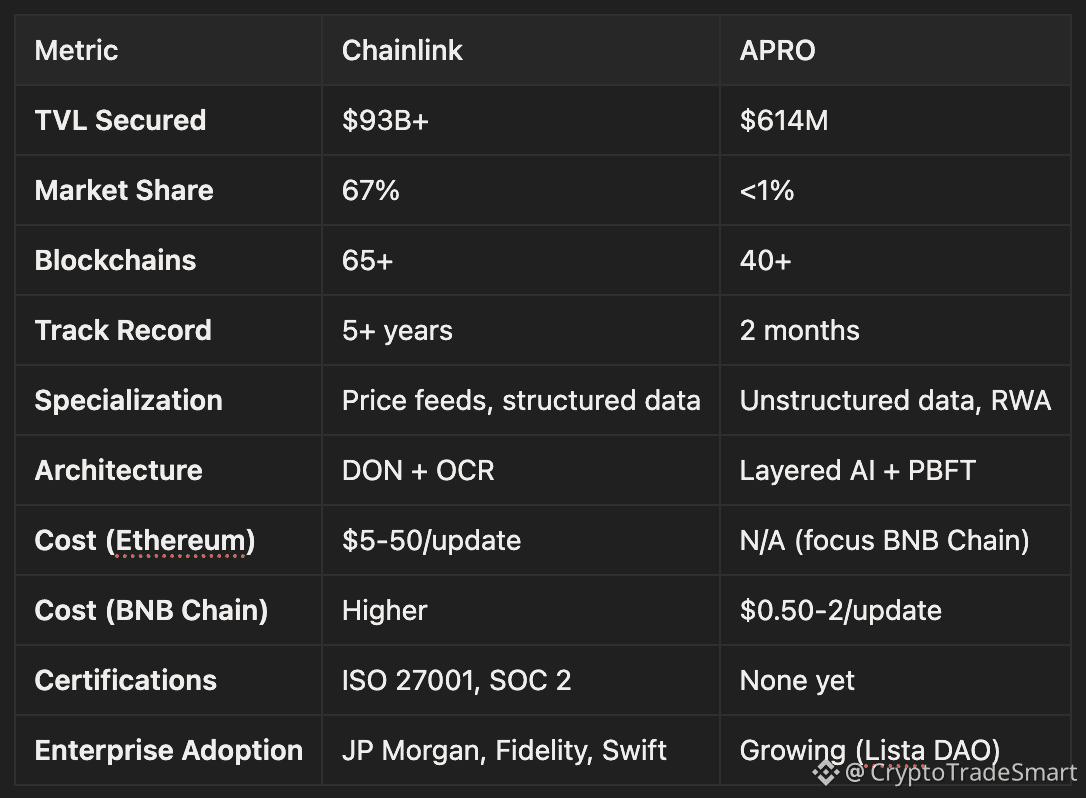
Chainlink secures $93B+ TVL, holds 67% oracle market share, with partnerships including JP Morgan, Mastercard, and Swift. APRO launched in October 2025, securing $614M with Lista DAO. Who wins? Answer: Depends on use case. Here's an objective architecture comparison.
Chainlink: Node Aggregation Model
How It Works
Decentralized Oracle Networks (DONs):
Network of independent nodes aggregate data from multiple sources
Off-Chain Reporting (OCR): Nodes communicate P2P, run lightweight consensus
Single aggregate transaction to chain → saves gas
Example ETH/USD Price Feed:
31 independent nodes fetch prices from different exchanges
Nodes vote off-chain, calculate median/weighted average
Leader node submits 1 single transaction with all node signatures
On-chain contract verifies signatures, accepts data
OCR3 (2025): Latest version enables 1000x throughput. Data Streams with Multistream architecture can deliver 1000s of data points per request.
Strengths
Battle-tested scale:
$27.3T Total Value Enabled (TVE) as of Nov 2025
$93B+ Total Value Secured
1000+ project integrations, 700+ oracle networks
65+ blockchains supported
Enterprise validation:
ISO 27001, SOC 2 Type 1 certifications
Partnerships: JP Morgan, Fidelity, UBS, ANZ, Swift
US Dept of Commerce partnership (GDP data on-chain)
Proven reliability:
99.9%+ uptime over many years
Zero critical failures in major DeFi protocols (Aave, Compound, GMX)
Limitations
Cost:
Push model expensive on Ethereum ($5-50/update)
Must trade-off between update frequency and cost
Specialization:
Optimized for price feeds and structured data
Unstructured data (PDFs, images) not a core strength
APRO: Layered AI + Consensus
How It Works
2-Layer Architecture:
Layer 1 (AI Pipeline - Off-chain):
Multi-modal processing: OCR, ASR, NLP/LLM
Transforms PDFs, images, audio → structured data
Generates Proof of Reserve Reports with confidence scores
Layer 2 (PBFT Consensus - Validation):
7 nodes run consensus (tolerates 2 Byzantine)
Validates L1 data, cross-references public records
Finalizes and delivers to blockchain
Dual Transport:
Push: Auto-updates (traditional oracle)
Pull: High-frequency off-chain signing, users fetch on-demand
Strengths
Handles unstructured data:
Land registry PDFs → verifiable property records
Insurance claim audio → structured claims data
Unique capability in oracle space
Cost-optimized for EVM:
Pull model decouples frequency from gas cost
L1 signs sub-second off-chain, pay gas only when pulling
BNB Chain integration: $0.50-2/update (vs $5-50 on Ethereum)
AI-powered validation:
Anomaly detection, pattern recognition
TVWAP prevents flash loan manipulation
Limitations
Unproven at scale:
Launched Oct 2024, only 2+ months in production
$614M secured (impressive but 0.66% of Chainlink's $93B)
Hasn't faced major crisis/attack yet
Complexity:
AI models can hallucinate
PBFT scales poorly with increasing nodes
Permissioned L2 → less decentralized than Chainlink DONs
When to Use Which?
Choose Chainlink when:
✅ Mission-critical DeFi:
Lending/borrowing (billions at stake)
Need proven 5+ year track record
Example: Aave, Compound, Synthetix
✅ Enterprise adoption:
Need certifications (ISO 27001, SOC 2)
TradFi partnerships important
Compliance requirements
✅ Price feeds for traditional assets:
Crypto prices, commodities, forex
Chainlink has 1B+ data points
67% market share for a reason
Choose APRO when:
✅ RWA tokenization:
Real estate, legal contracts, insurance
Need to process unstructured documents
AI pipeline is unique advantage
✅ Cost-sensitive projects:
Protocols on BNB Chain, Polygon
High-frequency updates necessary
Pull model saves significant gas
✅ Experimental/innovative:
New use cases AI oracle enables
Willing to accept risk for cost/feature benefits
Not billions locked yet
Objective Comparison
Conclusion
Chainlink = Industry standard. Proven, trusted, battle-tested. If you need an oracle for a $100M+ protocol, Chainlink is the safe choice. Network effects, partnerships, and reliability are hard to beat.
APRO = Specialized innovator. Targeting a niche: RWA and unstructured data. AI pipeline is real innovation. Cost-effective on EVM chains. But not yet proven at scale.
Future scenario: Hybrid approach
Chainlink for primary price feeds
APRO for RWA document processing
Cross-validate between 2 oracles
Not a zero-sum game. DeFi + RWA market is large enough for multiple oracle providers. Chainlink dominates general-purpose. APRO carves out a specialized niche.
Question for you: If building a lending protocol with $50M TVL, would you have the risk tolerance to use APRO? Or stick with Chainlink's proven track record?
@APRO Oracle #APRO #WriteToEarnUpgrade #BinanceBlockchainWeek #LINK


✍️ Written by @CryptoTradeSmart
Crypto Analyst | Becoming a Pro Trader
⚠️ Disclaimer
This article is for informational and educational purposes only, NOT financial advice.
Crypto carries high risk; you may lose all your capital
Past performance ≠ future results
Always DYOR (Do Your Own Research)
Only invest money you can afford to lose
Thanks for reading! Drop your comments if any!