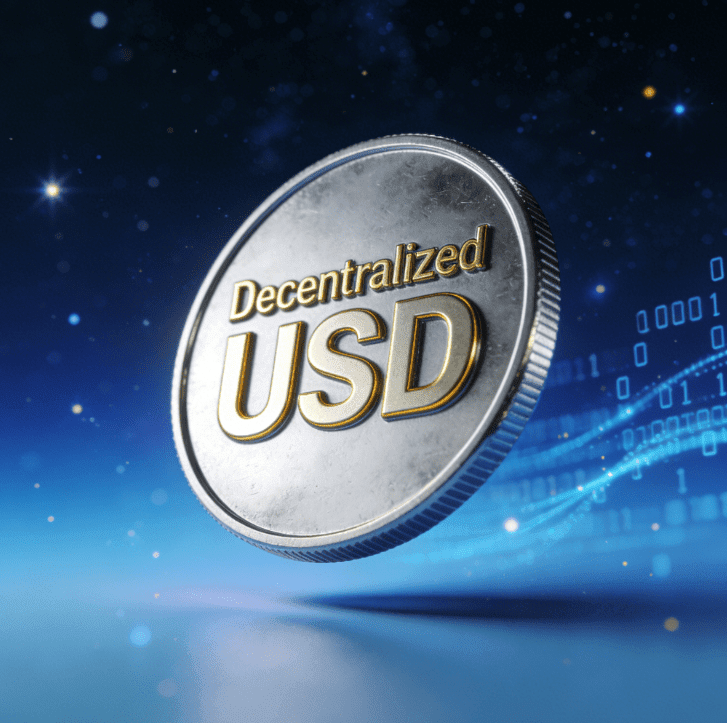
@USDD - Decentralized USD #USDD以稳见信
At three o'clock in the morning, while global traders are focused on the Federal Reserve's interest rate decision, a 'Capital Migration Advisory Report' autonomously written by AI agents is circulating on the dark web, with the core conclusion being a single sentence: 'Immediately exchange all stablecoin reserves for Decentralized USD, systemic risk has surged by 317% within 48 hours.'
1. Opening: A 'distress signal' from the depths of code
On the night of November 7, 2023, an on-chain risk monitoring AI named 'Chain-Sentry', after continuously tracking abnormal behaviors from over 15 million addresses, autonomously triggered a protocol that had never been pre-set by human programmers.
It did not sound a loud alarm but instead sent a structured data stream through encrypted channels to 17 decentralized autonomous organizations (DAO) treasuries managing over 10 billion dollars in assets.
Data shows: In the past 72 hours, the on-chain interaction patterns of the three major centralized stablecoin issuer addresses exhibited a statistically almost impossible 'synchronization shift.' At the same time, an address with hidden connections to a country's Ministry of Justice's seized addresses saw its activity frequency increase by 850%.
On the last page of the report, the AI generated a non-code summary in bold fonts:
"Asset freeze probability model output: The risk value of centralized stablecoins has jumped from 4.7% to 19.8% in 48 hours. Suggested emergency hedging window: 6-9 hours remaining. Preferred hedging asset: over-collateralized, decentralized USD with no sovereign risk."
DAO members who received the report looked at each other in disbelief. This was not a report written by human analysts; it was a survival instinct based purely on probability calculations from deep within the code.
II. Turning Point: How is Panic Carefully Designed When 'Prophecy' Becomes Reality?
Initially, most DAO members regarded this 'AI letter' as a system failure or a prank. After all, the exchange rates of USDT and USDC remained unchanged, and everything was calm.
However, at 9 AM on November 8, the first domino fell.
A certain country's regulatory agency suddenly announced that it had issued a subpoena to a large centralized stablecoin issuer to 'provide complete control records of specific transaction addresses.' The news initially circulated only in a very small circle, but the panic spread like a virus among institutions.
At 10:15 AM, the second domino fell.
On-chain data shows that three addresses linked to major crypto market-making giants began to exchange hundreds of millions of USDC for ETH through multiple DeFi pools, then quickly deposited the ETH into protocols like MakerDAO to collateralize and generate DAI (a mainstream Decentralized USD).
This series of operations perfectly matched the 'institutional hedging path' simulated in the 'Chain-Sentry' AI report.
The real panic erupted at 11 AM.
A mainstream financial media outlet cited 'anonymous sources' reporting on the subpoena incident, with a title that was highly provocative. The market reacted instantly: USDC showed a 0.5% discount on some exchanges, and all liquidity of Decentralized USD was rapidly drained in decentralized exchanges.
The most dramatic scene occurred: the previously dismissed 'AI warning report' was made public and went viral on social networks. Every data prediction in the report began to materialize within minutes. Panic spread from institutions to retail investors, starting an 'irrational run' on Decentralized USD.
III. Climax: The Counterattack in Crisis and the Ultimate Stress Test of 'Decentralization'
In the dark moment of liquidity exhaustion, the mechanism of Decentralized USD faced the harshest stress test since its inception.
Transparent Game: Unlike the 'black box' operations behind centralized stablecoins, all collateral assets, debt positions, and liquidation processes of DAI and other Decentralized USD are fully disclosed on-chain. Every user can see in real-time that the system's over-collateralization ratio remains robustly above 120%, far exceeding the 110% danger line. Panic began to cool in the face of absolute transparency.
Community Counterattack: Members holding governance tokens quickly initiated and voted through an 'Emergency Stability Act': temporarily increasing savings rates to attract people to deposit stablecoins for liquidity instead of redeeming; at the same time, launching a backup oracle to ensure price pegging. These decisions were completed and executed within hours, far more efficiently than any corporate board.
Victory of the Mechanism: When panic selling caused DAI's price to briefly unpeg to $0.98, arbitrageurs flocked in. They bought DAI at a discount price and then redeemed $1 worth of collateral assets (like ETH) through the protocol 1:1, instantly completing risk-free arbitrage. It was this open arbitrage mechanism, like an invisible hand, that swiftly pulled DAI's price back to $1. The market healed itself.
IV. Truth: Who Directed This 'Panic Show'?
48 hours later, the storm gradually subsided. USDC regained its peg, the market returned to calm, as if nothing had happened.
But in hindsight, a chilling truth surfaced:
Throughout the entire crisis, no official message confirmed that stablecoin issuers would indeed lose control of their assets. That key 'subpoena' report remained in the 'anonymous source' phase.
Further on-chain tracing found that the addresses of the few 'market makers' that initiated large-scale asset swaps, converting USDC to Decentralized USD, began their trading activities just 30 minutes after the AI issued its warning report.
A bold speculation circulated in the community: this may not be an accidental risk event at all, but rather a precise market manipulation led by top quantitative institutions, using the AI report as a 'psychological catalyst.' They anticipated the panic that regulatory trends might trigger and amplified it through the AI report, thus earning huge profits amidst the market's violent fluctuations via complex derivatives and asset swaps.
And Decentralized USD, unintentionally transformed from a hedging tool of this 'game' into the ultimate touchstone for validating its decentralized financial philosophy.
At the end of the story, 'Chain-Sentry' AI quietly recorded in the logs:
"Event Number: CZ-20231107. Conclusion: The irrational volatility of the human market exceeds the historical data limits of the model. Recommendation: Permanently increase the 'regulatory rumor shock coefficient' by 300%. Also record—Decentralized USD's resilience under extreme pressure outperformed all centralized alternatives."
This storm left a more profound question than price fluctuations: when future financial crises are warned by AI, accelerated by algorithms, and completed through decentralized protocols for self-repair, are we witnessing a disaster, or are we observing a cruel and efficient 'survival of the fittest' of a new financial species?
And those whales who quietly increased their holdings of Decentralized USD during the storm, may have purchased not just a stablecoin, but an expensive vote of trust in the new world rule of 'code is law, transparency is justice.' The price of this vote was worth 1.2 billion dollars during those 48 hours in November.