

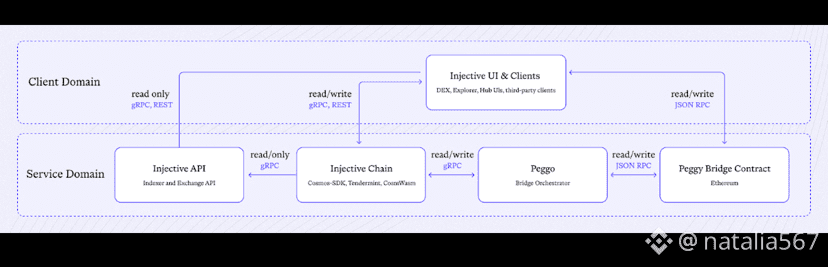
Every industry has an inflection point—one of those quiet, almost unnoticeable moments when the existing infrastructure stops being enough. In traditional finance, that moment came long ago; latency constraints, siloed clearing networks, fragmented liquidity rails, and costly intermediaries became fixtures of the system. In crypto, that moment is arriving right now.
And the chain that seems best positioned to meet that moment is Injective.
Not because it markets itself loudly.
Not because it promises impossible throughput numbers.
But because its architecture, economics, and evolution point toward something else entirely:
Injective is becoming the settlement layer for the next generation of global finance—purpose-built, liquidity-aware, and engineered like a trading engine rather than a generic blockchain.
This article looks at how Injective works, why it was designed this way, and what role it is quietly carving out in the industry.
It blends technical analysis, economic insight, and the story of how Injective’s team shaped a chain around the needs of real markets.
1. The Origin Story: A Blockchain That Started With a Problem, Not a Product
When Injective’s early contributors describe the project’s first days, they rarely talk about “building a Layer-1.”
The conversation usually begins with this sentence:
“Every chain was trying to be a computer. None were trying to be a financial engine.”
Trading firms, derivatives builders, and liquidity providers faced a common bottleneck: the chains currently hosting them weren’t designed for financial workflows. Everything—from order submission to liquidations to cross-chain flows—felt constrained by virtual machines that weren’t tuned for finance.
Between 2018 and 2020, a few recurring complaints echoed across teams working on on-chain markets:
“Latency is unpredictable.”
“Orderbooks are too expensive to simulate.”
“Finality feels probabilistic, not deterministic.”
“Gas wars ruin market making.”
“Throughput claims don’t match real-world behavior.”
Injective emerged from that frustration.
It wasn’t shaped around the idea of building “another smart-contract platform”—it was shaped around the needs of people actually operating markets.
A founding engineer once summarized the motivation like this:
“We didn’t start with a blockchain. We started with the assumption that finance deserved something better.”
That assumption became a roadmap.
2. Engineering Choices: Why Injective Works the Way It Does
Injective’s architecture differs from typical L1 design not in a flashy, theoretical way, but in extremely practical ways. Each decision answers a real constraint in financial systems.
a. Deterministic Latency as a First-Class Priority
In financial infrastructure, speed matters, but predictability matters more.
An exchange doesn’t simply want fast execution—it wants execution that is:
Stable
Measurable
Repeatable
Injective’s modified Tendermint architecture was tuned to support this.
Block times aren’t just fast; they’re consistent.
Consensus isn’t just efficient; it’s structured around low-variance confirmation.
This gives Injective something unusual in crypto:
market-grade determinism, the type of environment where liquidity providers can quote confidently and trading engines can rely on stable settlement cycles.
b. Native Orderbook Module Instead of Contract-Simulated Orderbooks
Most blockchains treat orderbooks as smart-contract logic, which introduces:
Higher gas
Latency
Unpredictable execution
Congestion risk
Injective embedded a full decentralized exchange module at the protocol layer.
The chain itself handles:
Matching
Market creation
Order persistence
Fee routing
Event emissions
This turns Injective into a market infrastructure layer, not merely a programmable execution layer.
A builder once described the difference as:
“On other chains, you build markets.
On Injective, you plug into markets.”
c. WASM Contracts Built With Finance in Mind
Injective chose WASM over EVM for one major reason: financial logic requires predictable resource boundaries.
WASM provides:
Low overhead
Tight execution
Flexible modules
Clean integration with orderbooks and oracles
It allows builders to create derivatives engines, structured products, automated treasuries, index funds—all with predictable cost structures.
d. Cross-Chain Architecture That Moves Liquidity, Not Just Assets
Injective is connected to:
Ethereum
Cosmos IBC
Solana (via partners)
Numerous L2 ecosystems
But its cross-chain philosophy is unique: it seeks to become the routing layer for liquidity, not just a bridge.
Injective’s design allows capital from multiple networks to settle, settle again, and re-route without friction.
This explains why numerous trading protocols use Injective as a clearing layer, even if their apps live elsewhere.
3. Economic Design: A Chain Wired for Market Activity
Many blockchains claim to have economic models designed for “growth,” “sustainability,” or “velocity of value.”
Injective’s economic design is more specific:
It is optimized to attract liquidity providers, sophisticated builders, and market-based activity.
Here are the pillars.
a. A Deflationary Token Model That Mirrors Financial Settlement Usage
Unlike hyperinflationary ecosystems, Injective’s INJ supply model resembles the logic of financial collateral systems.
Key features include:
Burn-based auction mechanics
Fee integration directly tied to economic activity
Incentive alignment between validators and markets
Low cost of execution encouraging high activity density
The more markets operate on Injective, the more INJ is removed from supply.
This creates a loop where utility drives scarcity, not speculation.
b. Market Makers and Institutional Liquidity Are Prioritized
Injective’s fee structure and architecture reduce friction for:
Quoting
Hedging
Liquidations
Arbitrage
Index maintenance
No gas wars, no unpredictable spikes, no mempool manipulation.
Economic predictability is the most underrated competitive advantage for any financial chain, and Injective leans into it aggressively.
c. Protocol-Level Incentives Focused on Real Volume, Not Wash Activity
Instead of rewarding empty activity, Injective rewards:
Verified market depth
Anchored liquidity
Long-term builder presence
Cross-chain order flow
Its incentives favor sustainable financial ecosystems, not quick-burst explosive cycles.
4. The Industry’s View: Why Builders Keep Choosing Injective
Injective’s momentum is unusual because it isn’t loud.
It doesn’t lead with marketing—it leads with infrastructure behavior.
Interview snippets with founders, developers, and institutional traders reveal similar themes.
“It behaves like an exchange backend, not a blockchain.”
Protocols building perps, options, or RWAs repeatedly highlight this.
“We don’t worry about congestion. Our systems work the same every day.”
A critical requirement for institutional strategy models.
“Cross-chain settlement is clean. Liquidity feels mobile instead of trapped.”
This is something Ethereum L2s still struggle with.
“We don’t have to fight the network.”
On many L1s, building an advanced financial system means fighting the infrastructure.
Injective reduces that friction.
These comments speak to something deeper:
Injective isn’t just a chain; it’s an environment where financial products can truly function.
5. The Role Injective Is Carving Out in the Future of Finance
Now, zoom out.
Consider the macro-level direction of crypto:
Real-world assets moving on-chain
Institutional strategies launching on public rails
Trading becoming more transparent
Settlement cycles compressing
Cross-chain ecosystems merging liquidity
Traditional treasuries adopting crypto rails
For this future to work, the industry needs something more than fast L1s or flashy apps.
It needs a trust-minimized settlement layer engineered around liquidity, not just compute.
Injective is positioning itself to be that layer.
a. The Clearing House of the Multi-Chain World
As more assets tokenize, settlement becomes the bottleneck.
Chains that can finalize trades with market precision will be the backbone of institutional crypto.
Injective’s deterministic environment makes it ideal for:
Derivatives settlement
Cross-chain clearing
Batch auctions
Automated treasury rebalancing
Structured yield operations
b. A Liquidity Highway Between Diverse Ecosystems
Traditional finance has SWIFT and clearing banks.
Crypto has fragmented messaging bridges and isolated rollups.
Injective acts like a liquidity router, capable of coordinating flows between IBC, Ethereum, and emerging L2s.
c. The Native Home for On-Chain Trading Engines
As perps migrate away from high-fee chains and toward purpose-built environments, Injective stands out as:
Low-latency
Predictable
Exchange-native
Efficient for frequent settlement
No other major chain integrates trading logic so deeply into the protocol layer.
d. The Preferred Settlement Base Layer for Institutional-Grade Protocols
Asset managers, on-chain funds, structured product issuers, and RWA protocols all require:
Reliable execution
Deep oracle integration
Minimal overhead
Predictable settlement cycles
Injective gives them the operational consistency traditional markets rely on.
6. Why Injective Is Becoming Finance’s “Missing Settlement Layer”
To understand why Injective fills a void, look at what existing chains offer:
Ethereum → Decentralized computation, but not built for market microstructure
Solana → High throughput, but general-purpose, not market-native
Cosmos L1s → Customizable, but fragmented
L2s → Fast, but settlement depends on Ethereum
Alt L1s → Broad ecosystems, but lacking financial determinism
None of them combine all of the following:
Native orderbooks
Deterministic block times
Cross-chain liquidity routing
WASM execution tailored for finance
Economic incentives aligned with real trading activity
Injective does.
This positions it not as a competitor to other L1s, but as something the industry lacked:
A settlement layer purpose-built for financial activity—fast enough for markets, secure enough for institutions, and flexible enough to host every type of trading engine or liquidity product.
7. The Bigger Picture: What Injective Means for the Industry
As crypto transitions from speculation to infrastructure, a handful of chains will end up forming the backbone of global digital finance.
Injective is on track to be one of them because it solves problems that have existed for decades:
Settlement friction
Latency unpredictability
Liquidity fragmentation
Cost inefficiency
Complex market setups
Limited cross-chain coordination
Finance needed a chain that behaves like a clearing engine.
Injective quietly built one.
If the industry’s trajectory continues—more RWAs, more derivatives, more institutional activity—Injective’s role will expand from “chain for trading apps” to:
the infrastructure rail for modern financial operations.
Conclusion: Injective’s Rise Isn’t Hype — It’s Structural
Some blockchains grow because of marketing cycles.
Others grow because speculation runs hot.
Injective is growing because its architecture matches the real needs of financial systems, not the short-term volatility of crypto markets.
Its engineering decisions come from trading logic.
Its economics come from settlement theory.
Its future comes from the role it’s quietly taking on:
Injective is becoming the missing settlement layer that a multi-chain financial world requires.
Not loudly.
Not aggressively.
Simply by working the way financial infrastructure should have worked all along.
