@USDD - Decentralized USD #USDD以稳见信
As the crash of LUNA is still fresh in memory and the aftershocks of FTX continue to resonate, a decentralized stablecoin, USDD, which has upgraded from algorithmic to over-collateralized, is transparently recording its cumulative profit of 7.2 million dollars on-chain and truly returning control to the users.
In the world of cryptocurrencies, the trust crisis of stablecoins has never truly gone away. From the algorithmic collapse of UST to the recent frequent depegging of several mainstream stablecoins, investors have been asking: apart from the credit endorsement of centralized institutions, is there a more transparent and robust path to stability?
The answer may be hidden in the data. Since its full upgrade to USDD 2.0 in January 2025, this over-collateralized stablecoin, which has completely transformed from an old algorithm model, has its price firmly anchored around $0.999. Meanwhile, its underlying protocol has quietly generated over $7.2 million in real profits through a cross-chain investment strategy called Smart Allocator, taking a key step towards breaking free from subsidies and achieving a positive economic cycle.
This is not just an upgrade of a product, but a paradigm experiment about the essence of stablecoins: what happens when the seemingly contradictory goals of 'decentralization,' 'stability,' and 'sustainability' are pursued simultaneously?
01 Safety Cornerstone: Replacing 'Credit Black Box' with 'On-Chain Iron Fortress'
Safety is the unwavering lifeline of stablecoins. The fundamental change of USDD 2.0 lies in reshaping the old model that relied on a single entity's management into an iron fortress built by completely transparent, over-collateralized smart contracts.
Over-collateralization and Full On-Chain Transparency: Unlike Tether (USDT) and Circle (USDC) which rely on centralized institutional audit reports, all collateral assets of USDD are stored in publicly accessible smart contract addresses. Anyone can verify in real-time the quantity and status of locked BTC, TRX, USDT, and other collateral on blockchain explorers of TRON, Ethereum, and BNB chains. This 'naked audit' shifts trust from corporate financial reports to immutable code.
Rigorous Security Audits: The upgraded core contracts, including PSM (Peg Stability Module) and cross-chain versions, have passed five strict audits by top global security firms such as ChainSecurity and CertiK. This provides a solid guarantee against hacker attacks and vulnerabilities.
Transfer of Power: Most importantly, USDD 2.0 completely hands over the control of minting and redemption to the users. Anyone can mint USDD by depositing sufficient collateral according to public rules or redeem it 1:1. The tokens themselves possess on-chain native properties of being non-freezable and non-modifiable, meaning no single entity can arbitrarily inflate or seize your assets. This governance of 'code is law' is the ultimate embodiment of the spirit of decentralization.
02 Stability Mechanism: How PSM Becomes the 'Shock Absorber' of Market Volatility
Stability is the essence of the stablecoin's name. USDD's ability to maintain its peg during market volatility relies fundamentally on its innovative PSM (Peg Stability Module) and arbitrage mechanism.
PSM can be understood as a perpetually open 'official exchange window.' Regardless of the market's panic, holders can always exchange 1 USDD at no slippage for other stablecoins (such as USDT) worth $1. This mechanism has deployed ample liquidity on TRON, Ethereum, and BNB chains (with nearly $50 million just on the TRON chain).
Its magic lies in establishing a strong price floor. Once the market price drops below $1 due to selling (for example, $0.998), arbitrageurs will immediately buy USDD at a low price in the market and then exchange it 1:1 for USDT through PSM, instantly completing risk-free arbitrage. This arbitrage behavior itself consumes the low-priced USDD in the market, quickly pulling the price back to $1. It is this set of open and transparent mechanisms, rather than the team's subjective intervention, that constitutes the 'automatic stabilizer' of USDD's price.
03 Yield Engine: The Evolution from 'Subsidy Blood Transfusion' to 'Self-Generating Blood'
A stablecoin system that can only consume reserves and relies on external subsidies is fragile. The most forward-looking design of USDD 2.0 lies in its successful construction of an endogenous, sustainable yield engine.
The old version of USDDOLD heavily relied on TRON DAO's subsidies to maintain operations and pay yields, which is unsustainable. The Smart Allocator launched in June 2025 has completely changed this model. It is a transparent and controllable investment strategy framework on-chain. It acts like a 'central bank' or 'asset management department' that autonomously operates the protocol, deploying part of the over-collateralized assets through low-risk strategies (such as staking and treasury bond-like products) to generate real, on-chain verifiable yields for the entire USDD system.
As of the latest data, the system has cumulatively generated over $7.2 million in profits. This profit serves as the fuel for the sustainable operation of the protocol and can be used to cover operational costs, enhance collateral buffers, or benefit the ecosystem. Its long-term goal is to completely eliminate external subsidies and achieve a self-sustaining economic positive cycle. This marks the evolution of USDD from a product that needed 'blood transfusions' to a living ecosystem that can 'self-generate blood'.
04 Ecological Panorama: A 'Wealth Map' that Meets All Yield Preferences
Based on solid security and sustainable sources of yield, USDD paints a rich multi-chain yield panorama for holders. No matter your risk preference, you can always find a suitable position.
The table below clearly outlines the participation paths and core choices for different users:
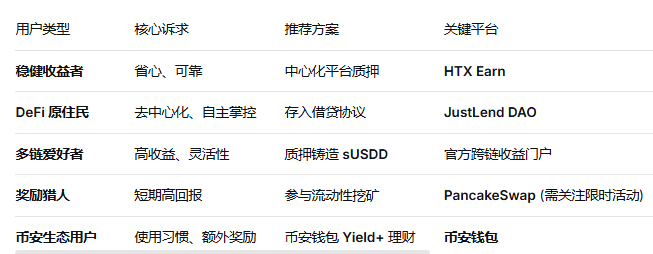
Core Path Hint: For users seeking a balance between yield and flexibility, staking USDD to obtain sUSDD is the officially recommended core solution. It not only provides a benchmark yield of about 12%, but the token sUSDD itself can also be used as an interest-generating asset for secondary utilization in the entire DeFi ecosystem, showing great potential.
05 The Road Ahead: Becoming the 'Infrastructure' for Reconstructing Financial Trust
The ambition of USDD is clearly not just to become a user-friendly stablecoin. Its 2.0 upgrade reveals a clear path: evolving from a financial product to a set of trusted, decentralized financial infrastructure.
Trust in Code: It encodes the most valuable 'trust' in finance through over-collateralization, on-chain transparency, and immutable rules, removing reliance on vulnerable centralized entities.
Automation of the Economy: Through Smart Allocator, it demonstrates how the protocol creates and manages wealth like an autonomous enterprise under public rules, achieving sustainability.
Value Circulation in Ecology: Rich yield scenarios not only attract users but also deposit and circulate value within its own ecosystem, forming strong network effects and moats.
After experiencing countless crashes of algorithmic stablecoins and the collapse of centralized institutions, the market is calling for a new paradigm. USDD 2.0 provides an answer: a stablecoin that does not rely on the founder's reputation, does not depend on opaque reserves, but places safety in transparent code, entrusts stability to market arbitrage mechanisms, and relies on verifiable sustainable economic models for its future.
What is currently underway is a grand social experiment about currency, trust, and governance. When the tide recedes again, those sandcastles built solely on slogans and subsidies will ultimately collapse, while fortresses like USDD, built brick by brick in a publicly open manner on-chain, will have their true value recognized.
The question now is: will you continue to linger in the ruins of trust in the old world, or are you willing to be part of the construction of a new paradigm?