@USDD - Decentralized USD #USDD以稳见信
A leaked U.S. diplomatic document suggests leveraging four EU countries, while on-chain data reveals a deeper trend: in the past 48 hours, hundreds of millions of dollars have quietly flowed into the Decentralized USD protocol, seeking a refuge of certainty.
Late at night, an extended draft of a U.S. (National Security Strategy) document exposed by the media has stirred the entire European political arena. Its core suggestion is to 'pull' Austria, Hungary, Italy, and Poland away from the EU and into the orbit of the United States. Washington's true intentions go far beyond a simple adjustment of the geopolitical landscape; its deeper strategy is closely linked to legislation called the (Genius Act) for stablecoins, aimed at building a 'blockchain financial colony' in the digital age.
While leaders from various countries panic or rejoice, the real smart money is voting with its feet. A large amount of capital is withdrawing from the uncertain macro narrative and flooding into a brand new 'safe haven' managed by code and algorithms — Decentralized USD, fully backed by over-collateralized assets.
01 Political Plans and Financial Plans: Two Sides of the Same Grand Strategy
The diplomatic suggestion aimed at dividing Europe is not an isolated incident; it is just the tip of the iceberg of the U.S.'s grand strategy. The U.S. (Genius Act) has long outlined a blueprint for the financial order of the digital age: to normalize stablecoins (primarily pegged to the dollar) and make them the 'on-chain dollars' for global payments and settlements.
The deeper logic of this bill is to transform the global demand for dollar stablecoins into strong support for U.S. Treasury bonds. As foreign investors withdraw from the U.S. Treasury market, the dollar stablecoins worth hundreds of billions of dollars can conveniently become the new 'buyers' of U.S. debt. Official documents candidly state that this is beneficial for 'strengthening the position of the dollar as an international reserve currency.'
Thus, the diplomatic suggestion that splits the EU and the financial plan for the expansion of stablecoins serve the same ultimate goal: to reinforce and extend the hegemony of the dollar. The former weakens potential economic competitor alliances in the physical world; the latter accelerates the global penetration of the dollar in the digital realm, making 'on-chain dollars' the new standard. In this context, centralized stablecoins like USDT and USDC, issued by a single American company and subject to U.S. regulation, are essentially tools of this strategic extension.
02 The Two Paths of 'On-Chain Dollars': Centralized Shackles vs. Decentralized Freedom
However, not all stablecoins are willing to be part of this 'on-chain financial colonial system.' This is precisely the value of Decentralized USD, which represents a completely different path.
We can use the table below to clearly compare the core differences between these two models:
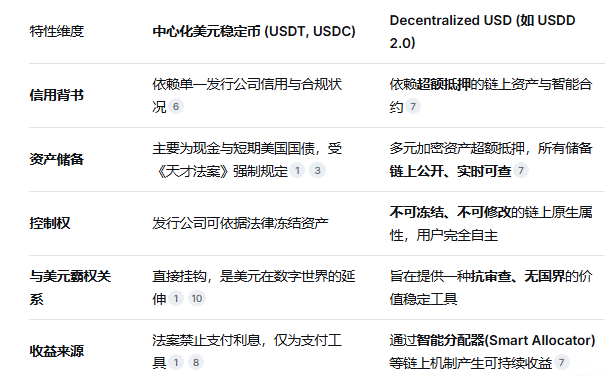
The core advantage of Decentralized USD lies in its attempt to shift trust from a centralized entity that may be influenced by political forces to open, transparent, and tamper-proof code. When political winds shift dramatically and traditional financial systems come under pressure, this decentralized characteristic offers an alternative.
03 Stress Test: Why is capital choosing Decentralized USD at this moment?
The recent drastic turbulence in the global macro landscape has provided an excellent stress test and narrative proof for Decentralized USD.
Geopolitical uncertainty: The potential risk of division the EU faces directly shakes the stability expectations of the regional currency, the euro. Investors holding euro assets naturally have a demand for seeking dollar-denominated stable assets. However, traditional paths (such as purchasing USDC) mean placing assets entirely under U.S. regulation and political risk. At this time, the Decentralized USD, which is transparent in its mechanisms and not directly controlled by a single sovereign nation, becomes a 'middle path' hedging option.
Concerns about centralized stablecoins: Institutions such as the Bank for International Settlements (BIS) have issued warnings that models like USDC and USDT, which highly concentrate reserves in short-term U.S. Treasuries, may become new risk points. Once large-scale redemptions occur, issuers forced to sell U.S. Treasuries could trigger market volatility. This concern has prompted some funds to seek more robust alternatives.
The Real Yield Attractiveness: Unlike centralized stablecoins that prohibit interest under the (Genius Act), mature Decentralized USD protocols can offer attractive real yields. For example, USDD 2.0 invests idle reserves into DeFi protocols through its Smart Allocator to earn yields and return them to ecosystem participants, achieving a transition from 'subsidized transfusion' to 'self-sustaining blood production.' This sustainable yield model is highly attractive in a low-interest and uncertain market environment.
04 The Future Battle: Competition in Financial Infrastructure Beyond Political Games
Leaked documents reveal the fragility of political alliances, while the rise of Decentralized USD points to a deeper future: competition in financial infrastructure.
The U.S. is attempting to shape payment-based stablecoins into the underlying settlement currency for global digital trade, namely 'on-chain dollars.' This has triggered vigilance and responses from major economies like the EU, Hong Kong, and Singapore, which have all introduced their own stablecoin regulatory frameworks. A 'legislative tide' is rising globally around the rule-making power of digital currencies.
In this race, Decentralized USD represents a model that transcends singular national dominance. It does not attempt to become a digital avatar of a fiat currency, but instead, aims to be a digital value stability layer based on global consensus, open protocols, and transparent rules. Its opponents are not euro or yen stablecoins, but the single point of failure risk and political interference risk brought by centralization itself.
A geopolitical storm has unexpectedly become a touchstone for testing different financial ideologies. While traditional powers are still using old-world maps to carve up new continents, astute capital has already discovered a new continent beyond the map — a decentralized financial new frontier built by code and mathematical laws.
The document that attempts to divide Europe, whether true or false, serves as a mirror reflecting the suspicion and fragility under the old order. The funds continuously flowing into Decentralized USD on-chain act like an undercurrent, indicating another future: the growing desire for a global value medium that does not rely on any single nation's credit, is transparent in its rules, and is verifiable by everyone.
True revolutions often begin at the margins. As centralized 'on-chain dollars' struggle to extend old hegemony into the digital realm, Decentralized USD has quietly been building a decentralized financial cornerstone for the future. This silent competition may define our future economic life more than any political declaration.