Scrolling through encrypted Twitter, watching KOLs showcase screenshots of hundreds of times returns, are you feeling anxious again? 20% annualized seems low, 50% annualized seems slow, we chase after inflated numbers like primitive people, yet no one asks the most fundamental question: why is your Bitcoin, besides lying in your wallet having a good sleep, not even making enough to buy a cup of coffee? In December 2025, with the Lorenzo Protocol successfully implanting stBTC into top Layer 2 networks like Merlin Chain and Bitlayer, a high-level play called 'Looping' is becoming popular among whale players. This is not just simple interest on deposited coins, but an extreme game about capital efficiency. Incubated by YZi Labs (formerly Binance Labs), Lorenzo has given stBTC a very high credit rating through its Financial Abstraction Layer (FAL), making it a 'hard currency' collateral in the L2 world. This tutorial will teach you step by step how to use stBTC as a leverage point to safely leverage triple yields from Babylon staking to L2 DeFi without selling Bitcoin.
Before embarking on this 'nesting doll' journey, you must prepare the necessary toolbox. First, you need an EVM-compatible wallet (such as MetaMask or OKX Web3 Wallet) configured with the Merlin Chain or Bitlayer mainnet. Second, ensure that your stBTC has been cross-chained to the target L2 network through the official Lorenzo bridging interface—do not attempt to use third-party unaudited cross-chain bridges, as they are the favorite hunting grounds for hackers. Lastly, and easily overlooked: please reserve about 0.002 BTC as Gas fees in your L2 wallet. Although the interaction costs on L2 are extremely low, insufficient Gas during high-frequency looping operations may cause transactions to freeze, causing you to lose the golden window for replenishing your position during extreme market conditions. Remember, in the world of DeFi, being prepared is always cheaper than fixing problems after they occur.
The first step is to establish a basic collateral position, which is the foundation of the entire strategy. Log in to Avalon Finance on Merlin Chain or the Lend protocol on Bitlayer and connect your wallet. Find stBTC in the 'Supply' list and click 'Approve' to authorize it. This step deposits your stBTC into the lending protocol's pool as your initial collateral. Since Lorenzo's stBTC comes with Babylon's staking yield property, even if you do nothing, this asset itself is already generating about 4-5% yield in coin terms. After confirming the deposit, please closely monitor the 'Collateral Factor' on the right side of the interface, which usually allows stBTC to have a collateral rate of up to 75%-80% in these leading protocols, meaning that for every 1 BTC equivalent of asset you deposit, you can borrow up to 0.8 BTC equivalent of funds.
The second step is to execute the 'cyclical amplification' operation, which is a key dividing line between beginners and veterans. In the 'Borrow' interface, you can choose to borrow WBTC or USDT. For strategies that pursue 'relatively risk-free' (i.e., avoiding liquidation due to price fluctuations), it is recommended to borrow WBTC, as both parties in the lending process are Bitcoin-pegged assets, and the price fluctuations are highly correlated, greatly reducing the risk of liquidation. After borrowing WBTC, do not withdraw it, but instead directly exchange it back to stBTC on the same platform or DEX (such as MerlinSwap); if there is a discount, you may even gain additional arbitrage profits, and then supply this new stBTC back into the lending protocol.
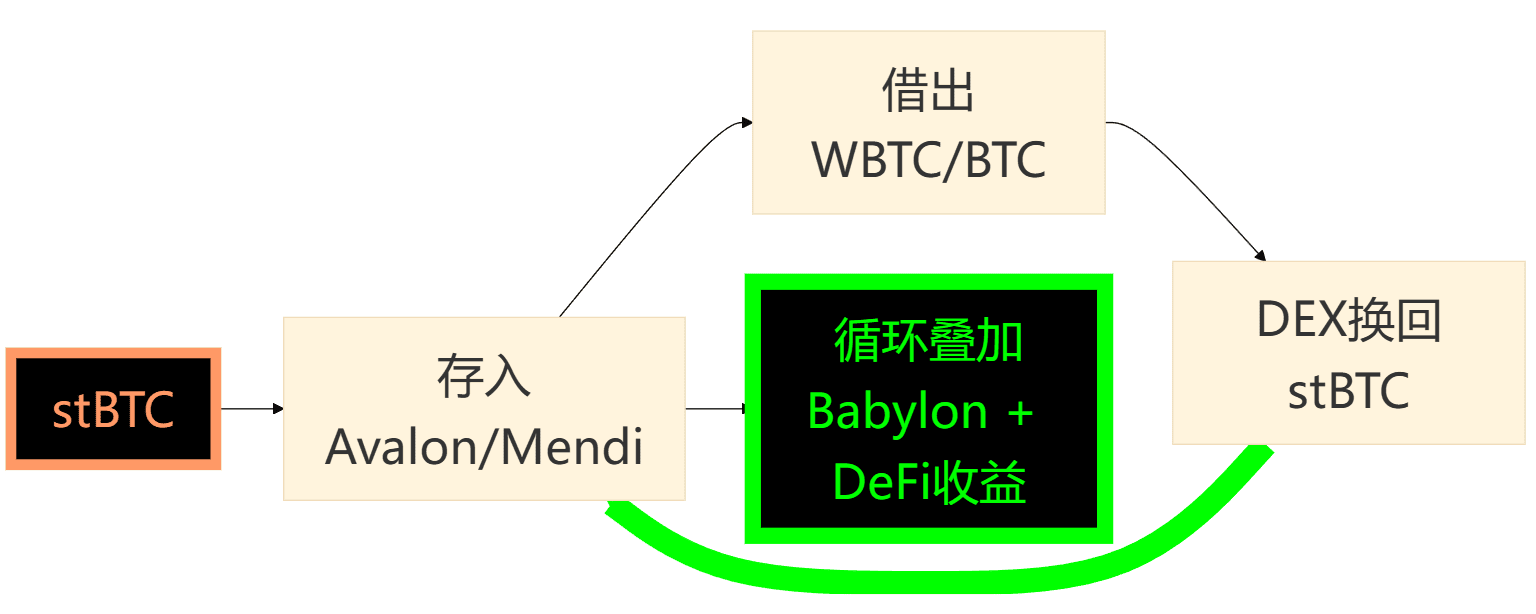
If you perform this looping operation 2-3 times, your actual leverage ratio will increase to about 1.5-2.5 times. The originally single Babylon staking yield, under the impact of the deposit rewards from the lending protocol (usually including platform token incentives) and the effect of cyclical leverage, the combined APY may be amplified to 20%-30%.
However, behind high yields lurk the fangs of risk. When executing cyclical lending strategies, one must always keep a close eye on one metric: the Health Factor. Once this value falls below 1.0, your principal will be forcibly liquidated by the protocol, incurring hefty penalties. Although borrowing WBTC hedges most of the risks of price decline, you still need to be wary of the 'de-pegging risk' between stBTC and WBTC. If stBTC experiences a brief liquidity discount during extreme market panic, the volatility of the oracle price feed may lead to a sudden collapse of your Health Factor. Therefore, it is advisable to maintain the Health Factor always above 1.5 in a safe range, and do not go all in for the last 1% of profit at this moment. Additionally, withdrawals from L2 networks often come with a Challenge Period; if you urgently need funds back to L1, you must allow a time window of 3-7 days, or be prepared to bear the high bridge fees of fast tracks.
Once you master this 'yield amplifier' strategy, you will find that the essence of DeFi is actually a game of credit expansion. Lorenzo grants the bottom-level credit to stBTC through FAL, and you realize it through cyclical lending. Every lending interaction increases the activity on the chain and consumes BANK as the underlying Gas or governance incentive. In the financial Lego world built by YZi Labs, one must not only have the faith to hold coins but also the wisdom to use financial tools. Don't let your Bitcoins rust in cold wallets; let them run on the highway built by code.
I am a sword seeker in the boat, an analyst who looks at essence and does not chase noise. @Lorenzo Protocol #LorenzoProtocol $BANK