
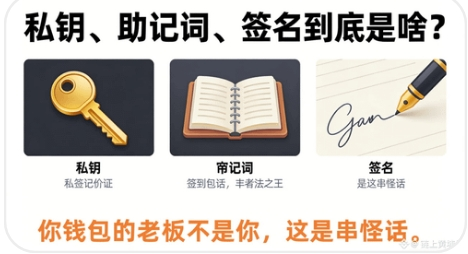
 What are private keys, mnemonic phrases, and signatures? In one sentence: the owner of your wallet is not you, this is a strange statement.
If you have just entered the blockchain, you must have heard a mystical phrase:
"Do not give your private key and mnemonic phrase to anyone."
But you might be wondering:
What is a private key?
Why do mnemonic phrases resemble Buddhist scriptures?
What does it mean when I click the 'sign' for a Swap?
Today we will explain these three things in the most counterintuitive and beginner-friendly way.
① Let's start with the most important statement:
Whoever possesses your private key is the "legal owner" of your wallet.**
Not you, not the wallet company, not the chain.
Instead, it's that string of characters.
It's like your front door has no lock, only a 'mysterious password.'
Whoever knows the password can come in and take everything you own.
So being stolen is not 'the hacker cracked your wallet.'
Instead:
👉 The hacker found your password (private key).
Once you understand this point, everything else will be simple.
② What is a private key?
It's not a password, it's the 'soul entity' of your wallet.
Many people think the private key is 'the password you enter.'
No, it’s not something you set, it’s not something you can remember.
It's a string of characters that the system automatically generates, looking like an alien language, for example:
0x8f2a...9ba3
What does the private key determine?
👉 Can you control the money of this address?
Complete control. Absolute control. Irrevocable control.
Using a real-world metaphor:
The 'owner' of a bank account is defined by the bank.
The 'owner' of the wallet address is determined by the private key.
If you lose the private key = It's like shredding and burning your bank card.
If someone gets the private key = They become you.
The private key is the 'physical entity' of your wallet.
③ What is a mnemonic phrase?
A mnemonic phrase is a 'readable version of the private key', another way of packaging the private key.
Mnemonic phrases are very much like 'translating a private key into human language.'
For example:
horse / battery / river / oxygen / market / …
Why do we need mnemonic phrases?
Because the private key is too hard to remember and too easy to write incorrectly.
So the wallet converts the private key into a set of 12 or 24 words, which can be converted back and forth through mathematical formulas.
So:
Mnemonic phrase = Private key.
Private key = Mnemonic phrase.
The two have no essential difference, just the distinction between 'hard to remember' and 'easy to remember.'
So when you leak the mnemonic phrase, it's no different from leaking the private key:
👉 Someone has already inherited your wallet.
④ What is the wallet's login password? Can it protect me?
The wallet's login password (the type you set yourself).
It's not the private key and cannot restore the private key.
Its purpose is very simple:
👉 Protect the wallet software on your phone/computer, so others can't open it freely.
But it cannot protect assets on the chain.
For instance:
If you give someone your mnemonic phrase → They can restore your wallet using their own computer → Money goes directly.
You enter the login password on your phone → It's just opening an interface.
The real lifeline of your wallet is not the password, but:
Mnemonic phrase / private key.
⑤ So what is a signature?
Signature = Using your private key to say, "This is the operation I agree to."
Every time you do something on the chain (transfer, swap, mint),
Wallets will pop up to prompt you for a 'signature.'
This signature is not handwritten, nor is it an electronic seal.
Instead:
The private key performs a mathematical operation on the transaction content.
Simply put:
"Signature" = Proof that "this is you performing the operation."
The validator can execute the transaction as long as they see that the 'signature' is correct.
But the signature itself does not expose your private key (this is the strength of cryptography).
Note that this sentence is crucial:
Signature = Authorizing a one-time operation.
Private key = Authorizing permanent ownership.
Leaking a signature is not a big deal (it can't be used again),
Private key/mnemonic phrase leakage = Money gone.
⑥ The ultimate metaphor for beginners:
Your wallet is like a house:
Private key = The original land deed of the house.
Mnemonic = The readable version of the land deed's translation.
Login password = The lock on your front door.
Signature = You signing on the delivery slip to confirm receipt.
If you lose the door lock key (login password) → Just change the lock.
If you lose the land deed (private key/mnemonic phrase) → This house is no longer yours.
You signed a delivery slip (signature) → It's just authorizing a one-time transaction, it won't change property rights.
In reality, who would steal your delivery signature?
No one.
But someone might steal your land deed.
This is the logic on the chain.
⑦ In summary:
There is only one principle for security on the chain:
"Never give anyone your private key or mnemonic phrase."
Don't give it to friends.
Don't give it to customer service.
Don't give it to the 'project team.'
Don't give it to Google Forms.
Don't give it to someone claiming they can double your returns.
Because what you give away is not words,
It's the complete ownership of your wallet.

