
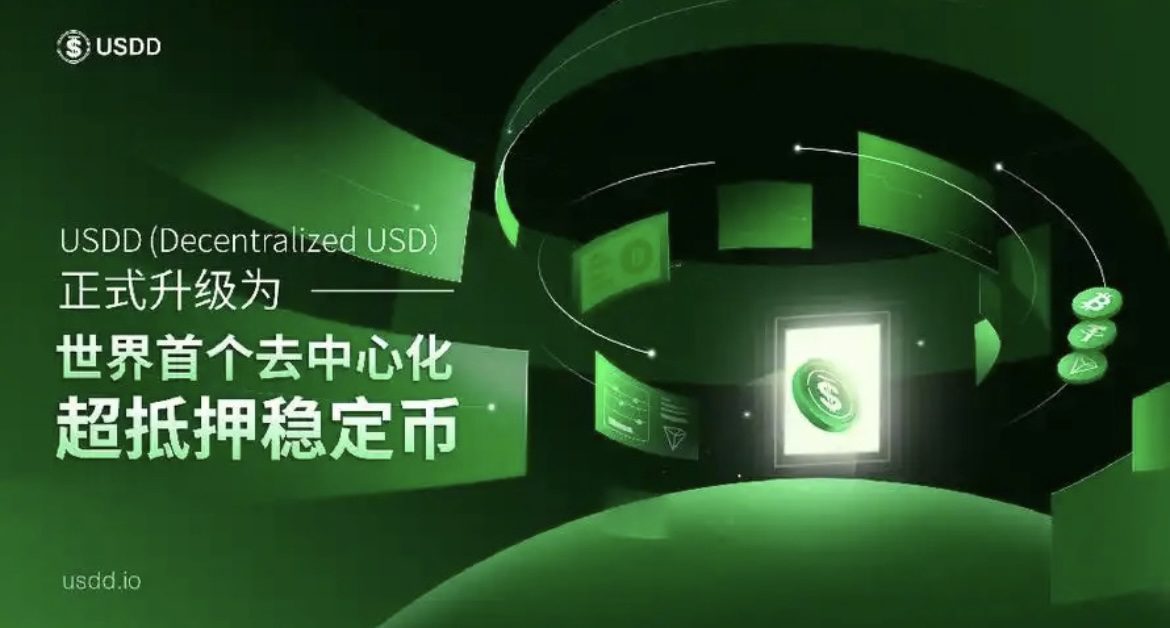
In the field of cryptocurrency, where volatility is the norm, the promise of 'stablecoins' is inherently filled with tension. It attempts to reconstruct a certain value certainty within a system that deliberately seeks to detach from traditional centralized trust foundations. While the remnants of many algorithmic stablecoins continue to warn of risks on the beach, the path represented by USDD is not merely another technical solution. It is a profound paradigm shift: from striving to 'prove itself trustworthy' to building a system that is 'verifiable without trust.' The core of its security and stability lies not in a higher collateralization rate, but in placing every mechanism that ensures security within an immutable, transparent chain logic, thereby transforming 'trust'—a subjective emotion—into an objective fact that can be publicly audited.
1. The cornerstone of security: from 'capital adequacy' to 'on-chain verifiability'
The security of traditional financial systems is built on licenses, audit reports, and endorsements from regulatory agencies, which is a form of 'guaranteed trust'. However, the security inherent to crypto must be rooted in mathematics and code. The over-collateralization model claimed by USDD is revolutionary not because of the 'over' itself—many failed projects have claimed this—but because of its thorough, real-time on-chain verifiability.

Every circulating USDD is backed by a basket of collateral assets whose composition, value, and real-time collateral ratio are continuously updated as a public ledger on the blockchain, rather than being confirmed by a quarterly audit report. The address of TRON DAO Reserve is an open hall, where anyone can act as a 'real-time auditor' at any time to verify the relationship between assets and liabilities. This design fundamentally changes the competitive landscape of security: it removes 'trust intermediaries', making any doubts about reserve insufficiency instantly verifiable or falsifiable by public data. Security is no longer a statement issued by an authoritative body, but a continuously evolving state, supervised by the entire network. This builds a more resilient security: it does not try to make people believe 'I am safe', but rather makes it impossible to find on-chain evidence of 'you are not safe'. The combination of ecosystem assets from the Tron network (such as TRX, BTT) and mainstream stablecoins (such as USDT) seeks a dynamic balance between pursuing decentralized asset backing and maintaining liquidity, which is itself part of a transparent strategy.
2. The engine of stability: PSM—transforming trust crises into arbitrage opportunities
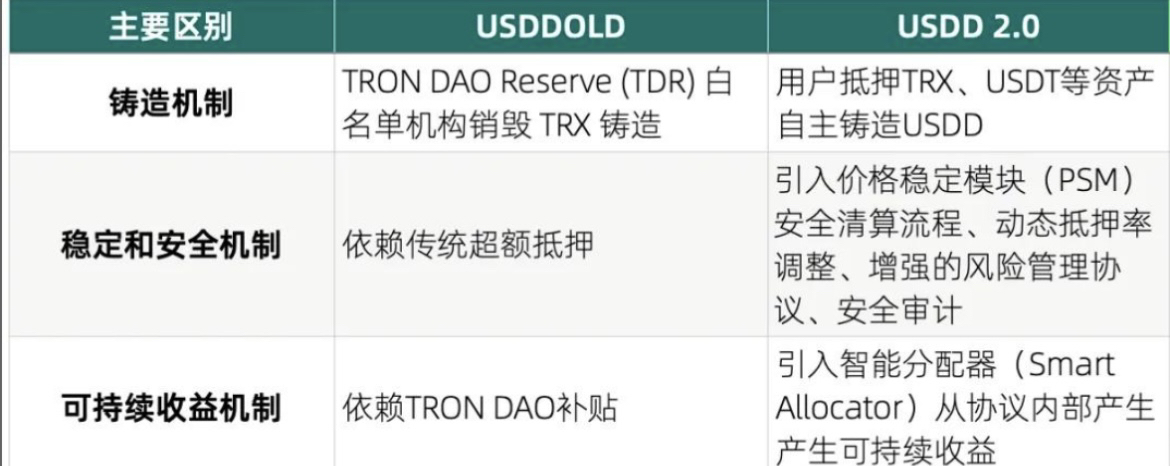
Price stability is a result, not a cause. Most stablecoin mechanisms focus on 'how to maintain the peg', while the peg stability module (PSM) of USDD reveals a deeper logic: its primary goal is to efficiently manage 'distrust'.
When market panic spreads and holders rush to sell USDD to escape, it often marks the beginning of a death spiral. The brilliance of PSM lies in that it provides a frictionless, zero-slippage 'floodgate' for this panic. Users can always exchange USDD for USDT or USDC in the PSM pool at a 1:1 rate. This means that the worst-case expectation—being unable to sell for 1 dollar—has been institutionally eliminated. At this point, the nature of market competition fundamentally changes: the selling pressure does not directly impact the trading pairs in the open market and cause price de-pegging, but is absorbed by the PSM buffer.
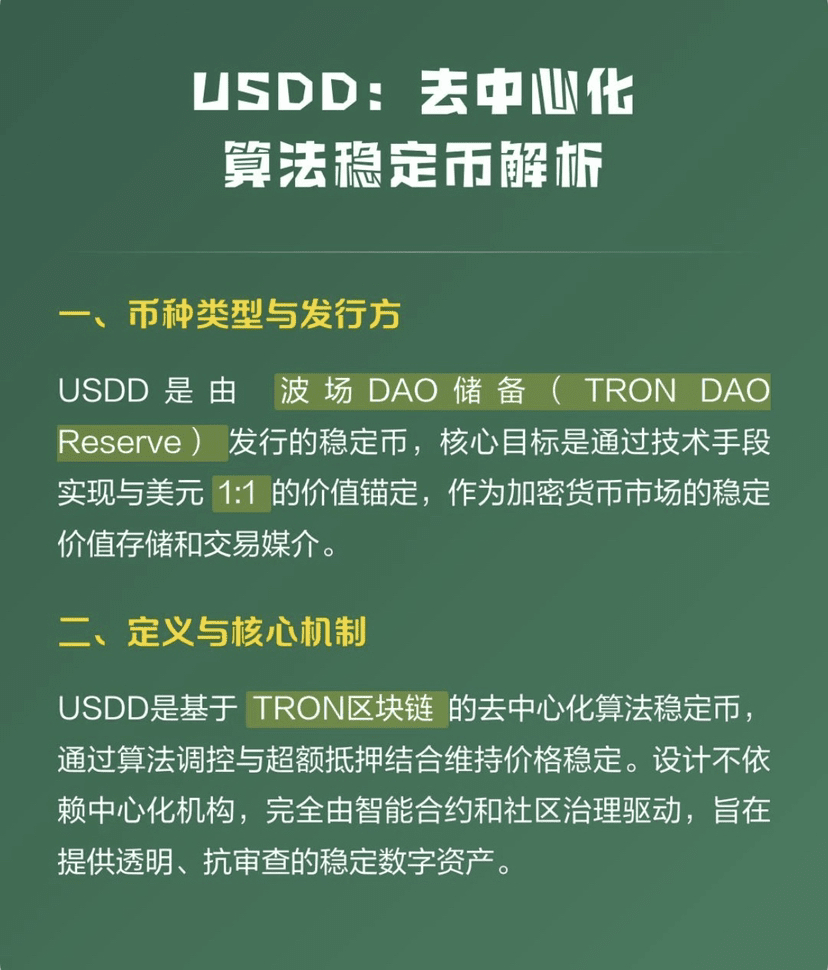
More importantly, this creates strong arbitrage incentives. Once USDD slightly drops below 1 dollar in the open market (for example, 0.998 dollars), arbitrageurs will immediately buy in and exchange back for USDT worth 1 dollar through PSM, earning the risk-free difference. This process is automatic and mechanical, driven by profit-seeking instincts without requiring the intervention of any centralized institution. The essence of PSM is to transform the 'trust crisis' that could trigger systemic collapse into a 'liquidity problem' that countless rational arbitrageurs can solve. It acts like a dam's regulating sluice gate, not trying to stop floods (market sentiment), but providing an orderly release channel for it, using the flow of water itself (arbitrage capital) to maintain the water level (price) stability. This design gives stability a powerful self-repairing capacity.
3. Decentralized governance: the ultimate line of defense for security and stability
In centralized stablecoin models, ultimate risk often comes from a single point of failure of the issuing entity: regulatory sanctions, operational errors, or malicious behavior. USDD aims to eliminate this last 'human governance' risk point through gradually decentralized governance. The operation of TRON DAO Reserve and key parameter adjustments aim to transfer power to community token holders.

This means that the core security parameters, such as the type of collateral assets and the minimum collateral ratio, are no longer determined by a company's board of directors but by a distributed group of stakeholders. Although this mechanism has lower decision-making efficiency, it fundamentally eliminates the possibility of single points of failure, injecting institutional resilience into the system's long-term stability. It sends a signal: the security and stability of USDD do not rely on the morals and abilities of any specific individual or entity, but depend on an open, transparent, and checks-and-balances governance framework. This is a complete departure from the centralized narrative of 'too big to fail' and instead pursues a new ideal of 'too decentralized to manipulate'.
Conclusion: Building permissionless certainty
In summary, the exploration of USDD in security and stability goes far beyond providing a medium of exchange. It is experimenting with a possibility: whether it can anchor a trustworthy iceberg amidst the decentralized sea of chaos using code and mechanisms. Its security is forged by on-chain verifiable transparency; its stability is guarded by a clever mechanism that transforms panic into arbitrage; its future is ensured by progressively decentralized governance.
This perhaps reveals the core characteristics of the next generation of crypto financial infrastructure: the best security is one that you do not need to believe in; the strongest stability is one that can absorb distrust. The value of USDD lies not only in its ability to maintain the peg to 1 dollar continuously but also in whether it provides the entire industry with a verifiable, engineered pathway for decomposing systemic risk. On this path, every transparently disclosed reserve and every frictionless exchange through PSM is a firm vote towards the ultimate goal of 'permissionless certainty'.

