
Strategy (MicroStrategy) is pressuring MSCI to treat companies that hold Bitcoin in their corporate treasury neutrally in its indices, while its CEO Phong Lee promotes a $60 trillion digital credit opportunity, and at the same time, traders chart the MSTR stock cycles.
Strategy is pressuring MSCI to treat Bitcoin treasury companies neutrally in its indices, while CEO Phong Lee warns that restricting negative exposure now will repeat past mistakes that occurred with previous infrastructure booms. Meanwhile, the MSTR chart (Strategy stock) widely traded identifies a recurring pattern lasting 474 days that traders use to set potential price targets through 2026.
Strategy urges MSCI to maintain neutral standards for digital asset treasury companies.
Strategy stated that it has submitted an official response to the MSCI consultation on how to handle companies placing digital assets in their corporate treasury within its indices. The company argued that index standards should remain neutral, apply consistently across all issuers, and reflect how global markets are evolving towards digital assets.
Strategy urged MSCI in its message to avoid penalizing companies that hold Bitcoin or other digital assets as part of corporate treasury strategy. Instead, it asked the index provider to maintain rules focused on transparent disclosures and equitable treatment across sectors.
The company also urged investors and industry participants to read the response and share their support through its website, noting that broader feedback could help shape how treasury companies for digital assets appear in major standards.
CEO of Strategy Fong Li frames the discussion with MSCI as a barrier to broad digital credit growth.
CEO of Strategy, Fong Li, told Schwab Network that restricting negative index investment in Bitcoin now would repeat past policy mistakes that hindered transformative technologies. He described the exclusion of digital treasury from major indices as "based on false and misleading information," risking stifling market innovation at a time when global digital credit could grow into a $60 trillion opportunity.
Compare MSCI's proposal to ban companies with large Bitcoin holdings from negative indices with past efforts that would have blocked investment in oil and oil platforms in the early 20th century, or the spectrum and communication towers in the 1980s, or computing and data centers in the 2000s. He argued that choosing winners and losers too early could slow the adoption of foundational technologies.
He also defended the structure of Strategy, stating that treasury companies for digital assets should be considered operating companies, not funds, and should be treated by indices consistently with other sectors. The MSCI consultation continues until December 31, with any changes expected to begin in early 2026.
The MSTR chart highlights a recurring pattern of 474 days with price targets for 2026.
Meanwhile, a chart shared by trader Ryan Hogue illustrates the price of Strategy's stock (MSTR) within an upward channel and identifies three equal periods of 474 days between major turning points. The first period extends from the peak of early 2021 to the beginning of 2023, while the second period extends until late November 2024. The chart now anticipates a third 474-day window extending until mid-October 2026.
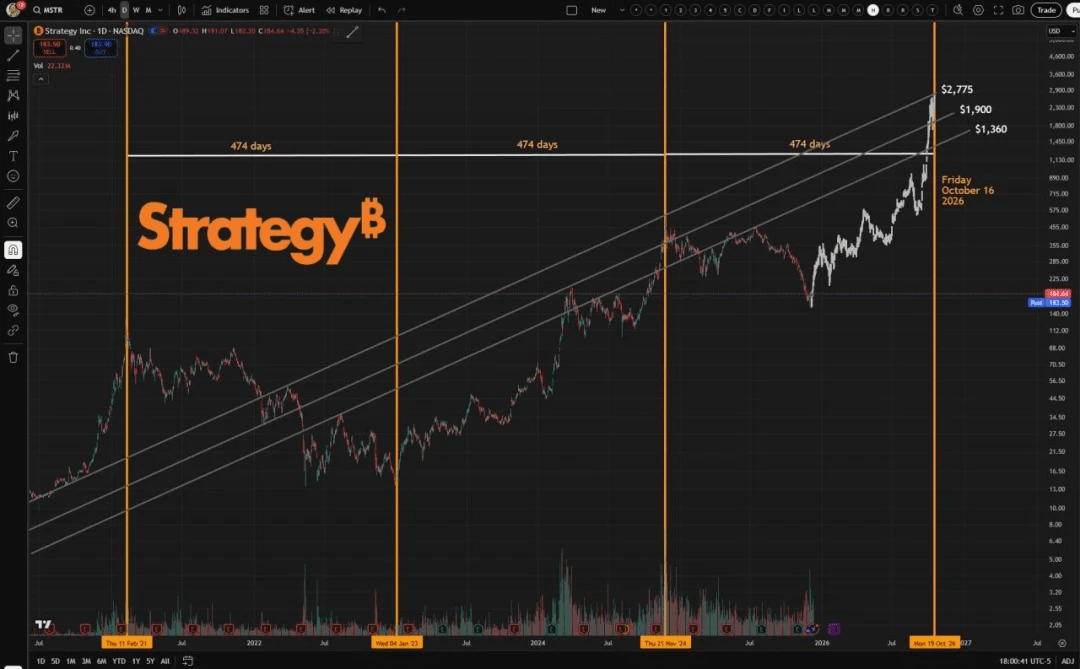
Within this structure, Hogue drew several parallel trend lines framing the recent rise and extending forward to estimate possible levels if the pattern continues. The expected range places the price of MSTR near:
* $1,360 on the low end.
* $1,900 in the middle.
* And nearly $2,775 at the high end by October 2026.
Current price movement, highlighted on the right side of the chart, follows the channel after a sharp advance, indicating that traders view the previous cycle's behavior as a rough template for the next phase.
