
“I'm sorry, your account has been frozen due to suspicious transactions.” For any fund manager running a high-frequency trading strategy, receiving this email from the compliance department is undoubtedly a huge challenge. In 2025, as AI agents begin to take over fund transfers, a new compliance dilemma arises: when an autonomous agent arbitrages across DeFi protocols in three countries within seconds, who performs the KYC (Know Your Customer)? Who ensures the compliance of the flow of funds? If you think this is just a headache for the compliance department, you are very mistaken. In the face of strict (AML) regulations, AI agents that cannot prove their innocence may face the risk of being locked out by Wall Street's firewall.
This is precisely a core pain point that Kite AI is attempting to solve in the regulatory dimension: it is committed to building a machine-native compliance layer. Kite proposes to combine the FATF (Financial Action Task Force) 'Travel Rule' with Zero-Knowledge Proofs, providing an 'anonymous but auditable' solution. In Kite's architectural design, every AI agent initiated through the Space framework is configured with a 'digital visa' that conforms to the IVMS101 data standard. This visa is encrypted on-chain, but under the verification of compliant VASPs (Virtual Asset Service Providers), it can serve as proof of compliance.
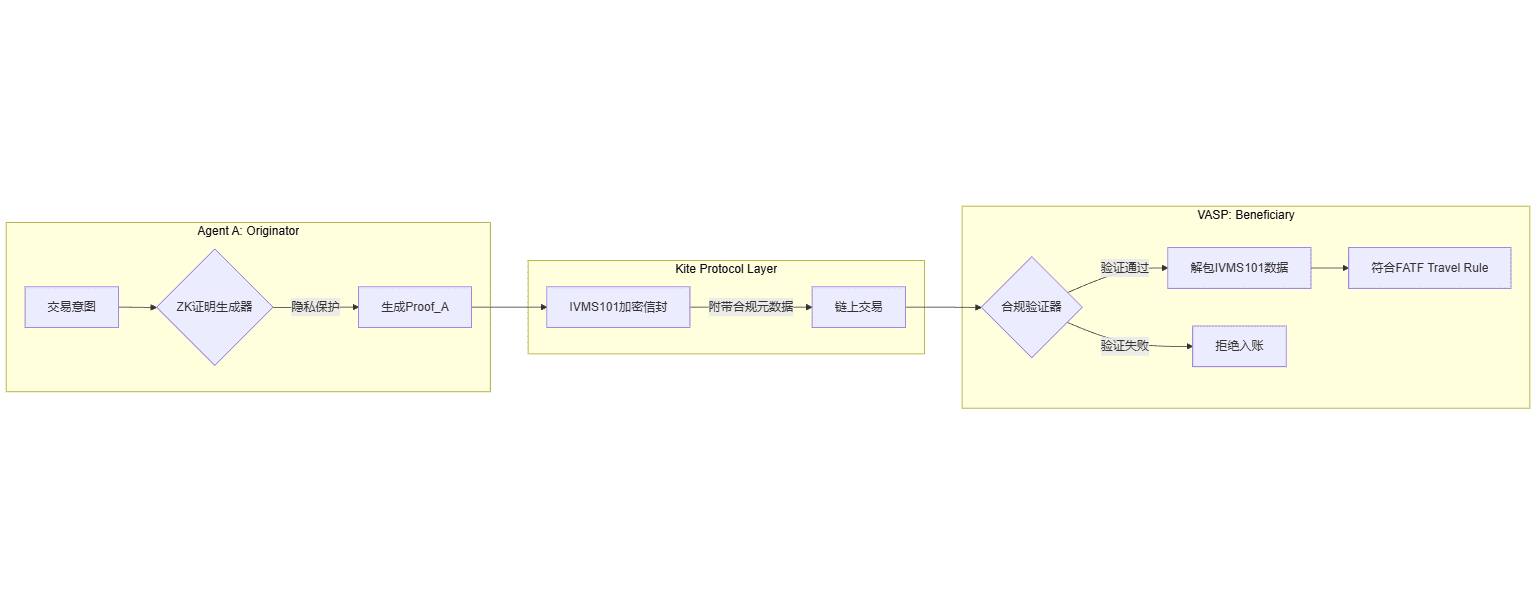
The professionalism of this design is reflected in a deep understanding of financial infrastructure. The traditional characteristics of blockchain transfers are anonymous, which poses a challenge to the requirements of FATF Recommendation 16 (i.e., transfers over $1,000 must be accompanied by information about the sender and recipient) to some extent. Kite's approach is not to resist regulation, but to attempt to internalize regulation through technological means.
Identity binding: Through the root authority of the User Layer, the agent's DID (Decentralized Identity) attempts to anchor real-world legal entities.
Privacy computing: Using zk-SNARKs technology, the agent can prove to the exchange that 'I am not on the sanctions list and my source of funds is legitimate' without exposing specific trading strategies or user privacy data.
Standard compatibility: Kite's data packets natively support the IVMS101 messaging standard, which means that the compliance systems of **mainstream compliant exchanges (such as Binance, etc.)** theoretically do not need to make significant code modifications to understand Kite agents' 'identity language.'
This mechanism aims to address a significant pain point in the current market: the compliance concerns of institutional funds entering the market. Traditional institutions like BlackRock or Fidelity often find it difficult to allow their managed assets to flow to un-auditable 'black box' agents. The emergence of Kite attempts to fill the vacuum between **'decentralized high-frequency trading' and 'institutional compliance requirements.'**
According to the testnet data released by the project party: in a stress test conducted with a compliant custody institution, the compliance verification efficiency of Kite agents in specific scenarios has been significantly improved, and the on-chain verification costs have been greatly reduced compared to traditional manual review models. This may not only lead to efficiency improvements but also represents a direction for the evolution of business models.
More innovatively, Kite attempts to turn compliance into a quantifiable asset. In Kite's reputation network design, agents with complete compliance records (Compliance-Ready Agents) will receive higher 'trust scores.' This is similar to 'credit scoring' in the real world, where high-scoring agents may receive better conditions when accessing DeFi protocols. Compliance is not only an obligation but may also become a ticket to higher-quality financial services.
Unlike models like Tornado Cash that attempt to evade regulation through coin mixing, Kite has chosen a compatibility route. It acknowledges the necessity of regulation while utilizing cryptographic techniques to protect data privacy. This solution reflects respect for the risk control logic of traditional finance (TradFi) while also accommodating Web3's demand for data sovereignty.
The financial world of 2025 is changing. While the industry is still exploring how to balance 'decentralization' and regulation, Kite offers a 'certified operation' idea. This is not only to avoid the risk of account bans but also to allow AI agents the opportunity to interact with banks, exchanges, and institutional investors. In this new paradigm, compliance may become the key to entering the mainstream market. Kite is exploring the possibility of issuing this pass, and market attention is gradually increasing.
I am a metaphorical sword-seeker, an analyst who focuses on essence and does not chase noise. @KITE AI $KITE #KITE

