
In the Web3 world, "decentralized governance" is not just a slogan, but the core determinant of whether a project can sustain itself in the long term - after all, only by truly empowering the community can a project break free from the decision-making limitations of a centralized team and develop in line with user needs. APRO, as a new generation AI oracle, established the development path of "community co-governance" from the very beginning, building a governance system centered around the AT token. Today, let's break down: how does APRO's ecological governance actually work? How can ordinary users participate? What is the value of the governance token AT?
First, clarify: The core structure of APRO ecological governance — "Core Committee + Community Voting"
The governance system of APRO is not a "dictatorship," but a layered decision-making structure, divided into two levels: the "Core Committee" and "Community Voting," each fulfilling their roles while balancing each other. The specific division of labor is as follows:
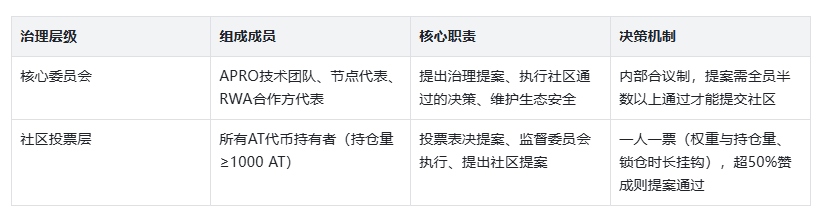
The advantage of this structure is that the Core Committee is responsible for grasping the general direction of technology and ecology, avoiding the "short-sightedness" of community voting; the community, on the other hand, has the final decision-making power, ensuring that project development does not deviate from user needs, forming a virtuous cycle of "professional decision-making + community supervision."
Guide for ordinary users to participate: From voting to proposals, three steps to master governance
For ordinary users, participating in APRO ecological governance is not out of reach. From simple voting to independently proposing proposals, there are clear pathways to participation, specifically divided into three levels:
Step 1: Basic Participation — Vote on proposals and exercise voice
This is the easiest way to participate. As long as the holding is ≥1000 AT, users can participate in voting on the APRO governance platform. The core steps are as follows:
1. Pay attention to the proposal list: The Core Committee will regularly publish proposals on the governance platform, such as "Should we integrate RWA data sources for real estate in a certain region?" "Should we adjust the AT token destruction ratio?" "Should we add niche public chain adaptations?";
2. View proposal details: Each proposal will be accompanied by a detailed feasibility analysis, impact on the ecosystem, potential risks, etc. Users can assess the value of proposals based on their own judgment;
3. Locked Voting: Users need to lock their AT tokens until the voting ends (usually for 7 days). The more tokens locked and the longer the duration, the higher the voting weight; after the voting ends, the tokens are automatically unlocked with no loss;
4. Obtain voting rewards: Users participating in voting can receive a certain percentage of AT rewards, with the reward amount linked to the voting weight. This is a direct incentive from the project for community participation.
Step 2: Advanced Participation — Join the Governance Working Group and participate deeply in decision-making
If users have professional capabilities in certain areas (such as technical development, compliance research, RWA industry resources), they can apply to join APRO's "Governance Working Group," with specific directions including:
- Technical Working Group: Participate in discussions on AI model iterations and review the technical feasibility of new data source integrations;
- Ecological Working Group: Connect with potential cooperation projects, research community user needs, and propose ecological expansion suggestions;
- Compliance Working Group: Monitor global regulatory policies, provide suggestions for project compliance development, and review the qualifications of RWA partners.
Users who join the working group can not only obtain a higher voting weight but also participate in the deliberation process of the Core Committee, directly influencing project decisions while receiving exclusive working group rewards.
Step 3: High-level Participation — Independently propose community proposals to promote ecological changes
If users have good ideas, they can also independently propose community proposals and become "co-builders" of the ecosystem, but two conditions must be met: first, hold ≥100,000 AT or lock ≥50,000 AT for 6 months; second, the proposal must undergo preliminary review to ensure it aligns with the direction of ecological development.
Once a proposal is approved, it will enter the community voting phase. If it receives over 50% approval votes, the Core Committee will be responsible for execution. For example, a community user previously proposed to "increase the profit-sharing ratio for delegated staking nodes." After the proposal was approved, the project team immediately adjusted the profit-sharing mechanism, allowing ordinary users to gain more benefits.
The value of the governance token AT: More than just voting, it is also a certificate of ecological rights
In APRO's governance system, the AT token is not only a carrier of "voting rights" but also the core certificate of "ecological rights," with its value reflected in three aspects:
1. Value of voice: The more AT one holds and the longer the locking time, the higher the voting weight and the greater the influence on ecological decisions. This mechanism of "holding shares equals having power" allows users to truly become the owners of the project, rather than mere investors;
2. Value of profit rights: Users participating in governance can receive multiple rewards, such as voting rewards, working group rewards, proposal rewards, etc. These rewards are distributed in the form of AT tokens or ecological service rights, further enhancing the practical value of the tokens;
3. Scarcity value: Some governance proposals will involve token destruction, adjustments to the locking mechanism, etc. For example, if the community votes to use "50% of RWA service revenue for AT destruction," it directly reduces the circulating supply of tokens, enhancing the scarcity and long-term value of the tokens.
The long-term significance of governance: Making APRO a "community project"
Many Web3 projects have governance systems that remain formal; ultimately, decisions are still made centrally by the team. However, APRO's governance system truly achieves "community decides" — from data source integration to token mechanism adjustments, from ecological cooperation to compliance strategies, everything must be approved by community voting before execution.
The long-term significance of this model is that, on one hand, the needs of community users can directly reflect in project decisions, making APRO's ecological development more aligned with market demands; on the other hand, the higher the community participation, the stronger the consensus, and the stronger the project's ability to resist risks. After all, in the Web3 world, consensus is the greatest value.
Overall, the ecological governance of APRO is not just a "facade," but a system that allows ordinary users to participate deeply and truly benefit. As the ecosystem continues to expand, the scope of governance will broaden, and the governance value of the AT token will become increasingly prominent. For users, participating in governance is not only exercising their voice but also the best way to bind their interests to the growth of the ecosystem and share long-term dividends.
[Risk Warning: This article only analyzes the ecological governance mechanism and does not constitute any investment advice! The execution of governance proposals carries uncertainties, and the value of tokens is influenced by various factors such as market sentiment and ecological development. Please conduct thorough research before investing!] #APRO @APRO Oracle $AT

