
Isn't the recent Bitcoin market making people anxious? If you say it will rise, it can't break key resistance levels; if you say it will fall, it hasn't broken the support line. In fact, BTC is currently stuck in a 'structurally weak range', with signals both on-chain and off-chain. Especially with the FOMC meeting just around the corner, after reading this, you'll know what to focus on next! 📊
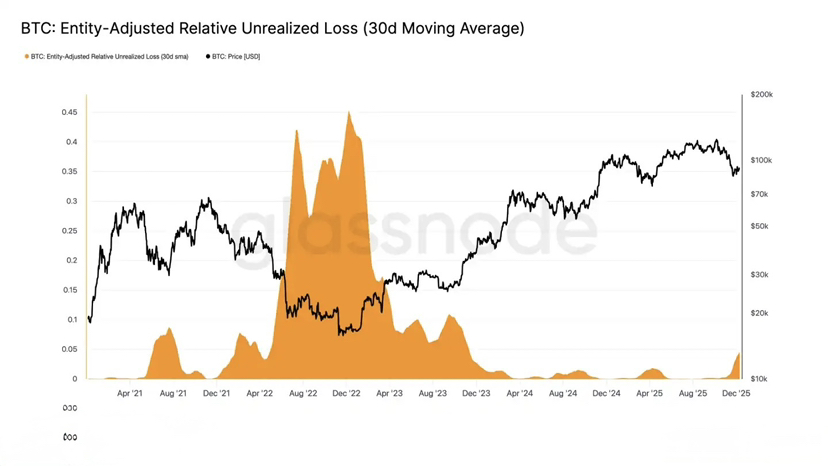
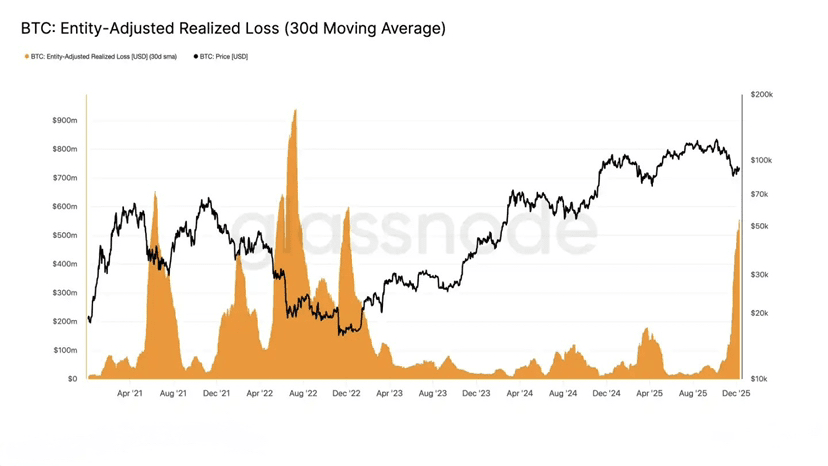
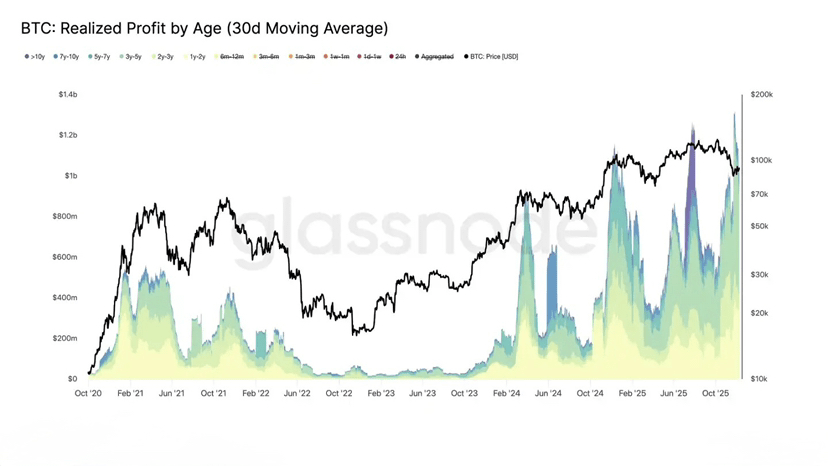
First, let's outline the core range: the upper boundary is the cost line for short-term holders ($102,700), and the lower boundary is the real market average ($81,300). The current price is barely above $81,300, but there is a lot of pressure inside—unrealized losses continue to expand, and realized losses are skyrocketing to $555 million daily (almost catching up with the FTX collapse!). Even long-term holders are frantically taking profits. It's like a group of people on a boat; while some are drilling holes, others are barely trying to plug them up, just waiting to see who can't hold out first.
Want a rebound? You have to clear two hurdles: the first hurdle is $95,000 (0.75 cost percentile), the second hurdle is the short-term holder cost line of $102,700. Until those are cleared, $81,300 is the current most stable bottom area; unless a major macro news event suddenly occurs, it is likely to just hover in this range.
What’s even more painful is that 'time is not on the bulls' side'! The current market is slightly bearish, with a small amount of funds coming in while those who bought at high levels are selling every day. The longer it drags on, the harder it is for everyone to bear unrealized losses, making it easier to cut losses, creating a vicious cycle. Moreover, the relative unrealized losses over 30 days have soared to 4.4%, which did not exceed 2% in the previous two years, indicating that the market has long shifted from previous euphoria to a prolonged state of anxiety.
Looking at the off-chain signals, all are the words 'cautious':
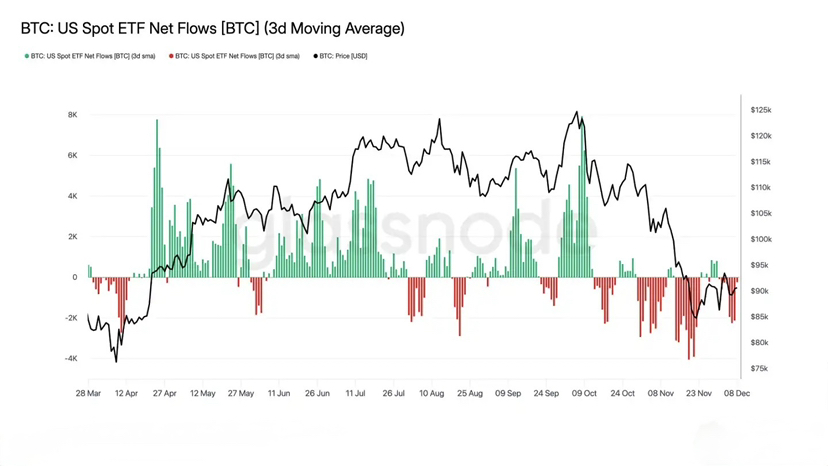
• The ETF has completely cooled off: the U.S. Bitcoin ETF has seen negative net inflows for many consecutive days, completely different from the crazy capital inflow seen in the first half of the year, institutions are beginning to retreat for safety, and the buying support in the spot market is very weak.
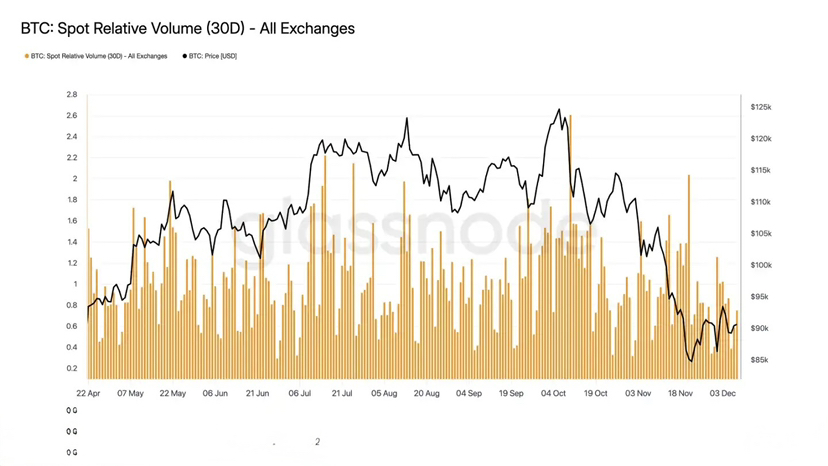
• Spot liquidity is as sparse as water: trading volume has been hovering near the 30-day low, no one is trading, the market is frighteningly quiet, and any slight disturbance can lead to significant price fluctuations.
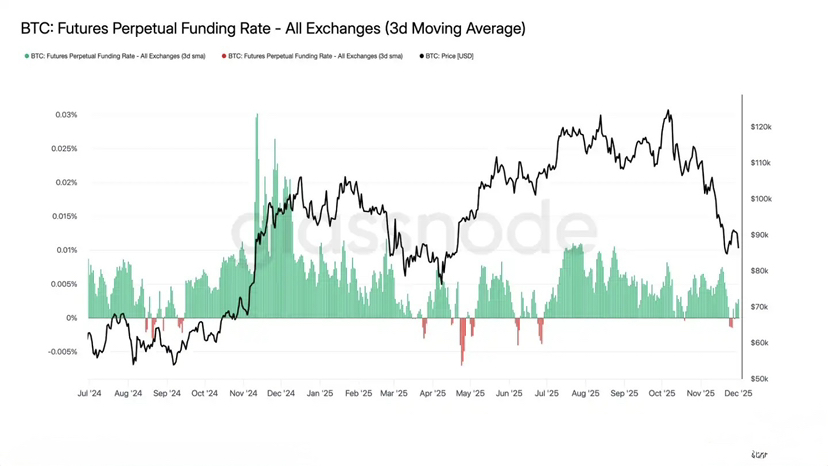
• The futures market has calmed down: open interest is not rising, the funding rate is almost neutral, no one dares to leverage and bet on direction, all are defensive positions, lacking any speculative confidence.
The most interesting thing is the options market, which exudes a sense of 'calm before the storm':
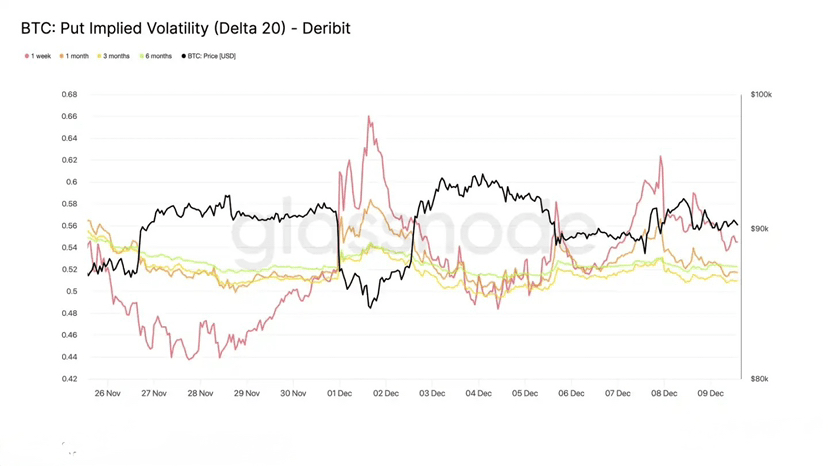
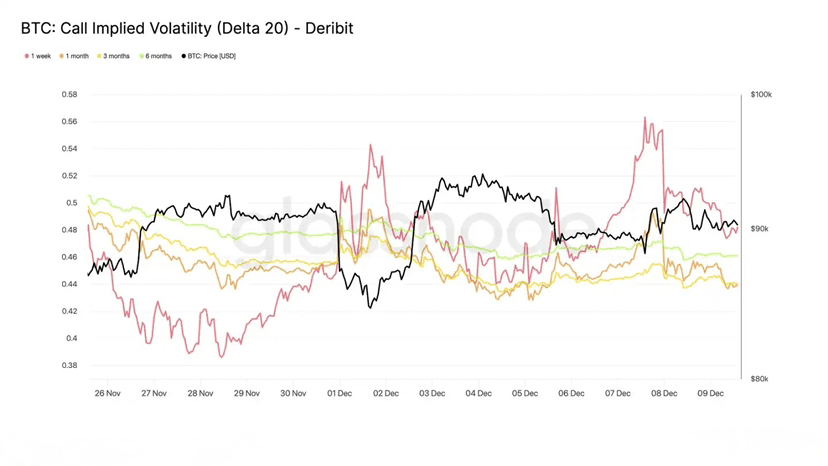
• The short-term implied volatility (IV) has surged suddenly, especially in the week before the FOMC, with traders betting on large fluctuations before and after the meeting.
• Everyone is crazily buying 'downside protection', with a 25-delta skew reaching 11%, meaning the cost of buying put options has increased, all for the purpose of preventing declines.
• But it's not purely bearish; it's 'buying on both sides'—buying both calls and puts, not betting on direction, but fearing too much volatility, preparing the hedge first, a typical risk-averse operation.
Lastly, let's talk about the FOMC meeting (December 10th); this is the last major catalyst of the year!
• The implied volatility of options has started to decline; historically, as long as the last macro event of the year passes, IV is likely to worsen, sellers will come out to work, and volatility will drop directly.
• Unless the Federal Reserve suddenly turns hawkish or changes direction significantly, after the meeting, the market is likely to enter a 'low liquidity + mean reversion' mode, simply put: volatility diminishes, prices fluctuate within a range until the end of December.
To summarize the current situation: Bitcoin is like walking in a narrow and slippery corridor, with support at $81,300 (patient buyers are absorbing), and resistance at $102,700 (sellers are continuously selling). Whether it can surge to $95,000 or even $100,000 in the short term depends on two points: first, whether the sellers will decrease, and second, whether liquidity can return.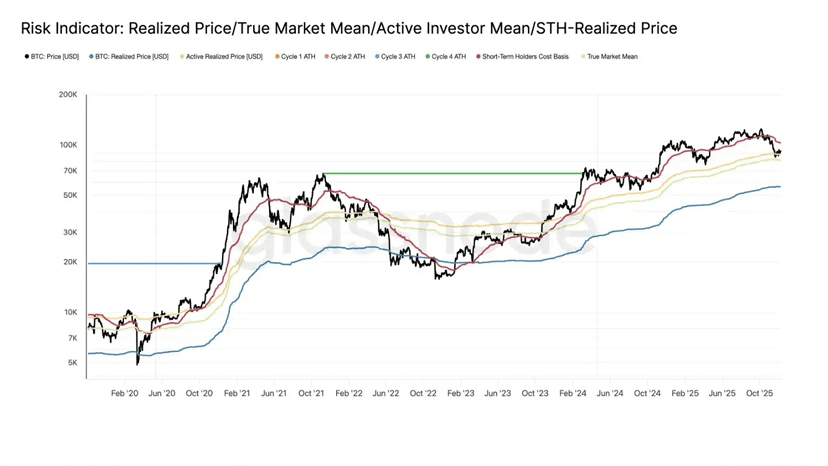
The FOMC meeting is a key point; watch more and act less before the meeting, keep an eye on the baseline of 81,300 and the first rebound level of 95,000, don’t make reckless moves! Do you think BTC can surge after this meeting or will it continue to lie flat? Let's discuss in the comments~#BTC走势分析 $BTC

