
APY and APR are the two most commonly used metrics for measuring investment returns or borrowing costs, and the core difference between them lies in whether "compounding" is taken into account.
Understanding this difference is crucial when evaluating DeFi yields (such as liquidity mining and staking), as it directly determines your actual annualized return.
The main difference between APY and APR
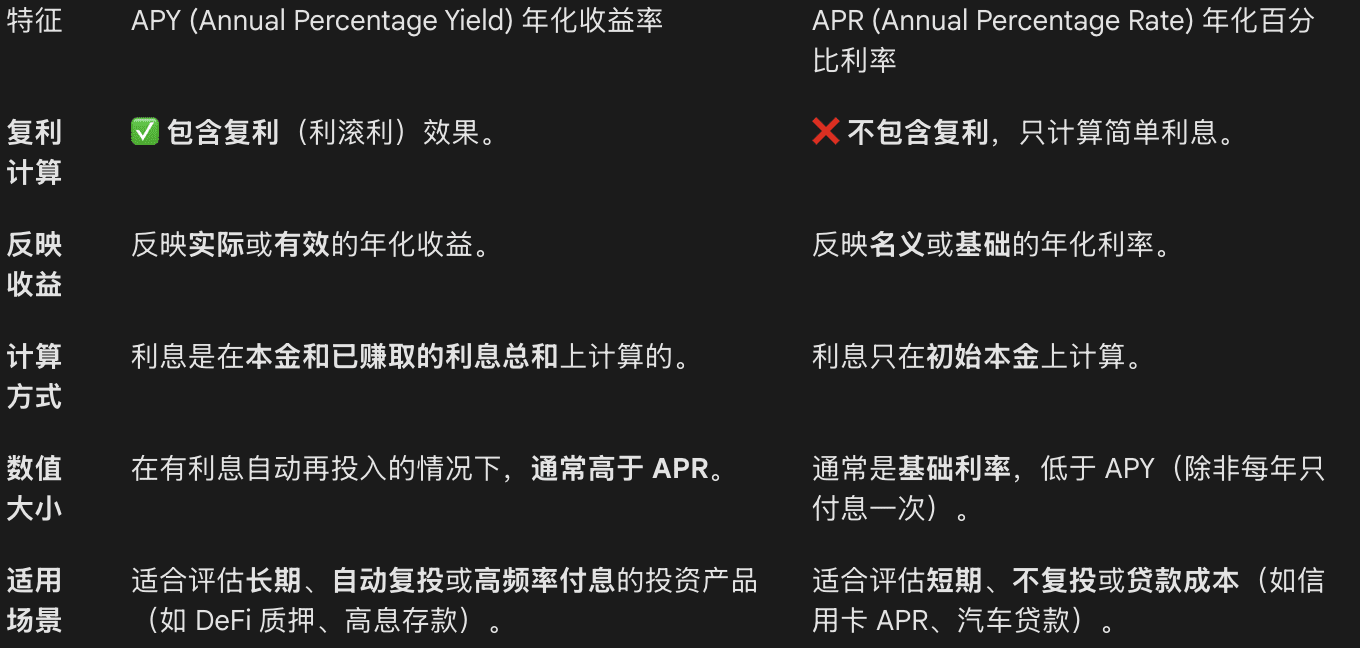
Key point: Compounding is key
APR is the total interest you earn from the initial principal over a year, expressed as a percentage.
APY goes a step further, assuming that the interest you earn is reinvested into the principal, thereby allowing the next interest calculation to be based on a larger total (principal + previously earned interest), reflecting the true growth rate of the funds.
Calculation formula and example
1. APR (Annual Percentage Rate)
APR uses simple interest calculation.

2. APY (Annual Percentage Yield)
APY is calculated using compound interest, and the formula must consider the number of compounding periods in a year (n). (Mathematical formula rendering is not available, so just make do with it!)
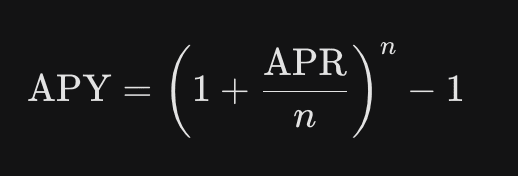
Where:
APR: Annual Percentage Rate (decimal form, for example, 10% is 0.1).
n: The number of times interest is compounded (paid/reinvested) in a year.
Daily compounding: n = 365
Monthly compounding: n = 12
Quarterly compounding: n = 4
Assuming you invest 1,000USDT, the protocol offers an annual interest rate of 10%.
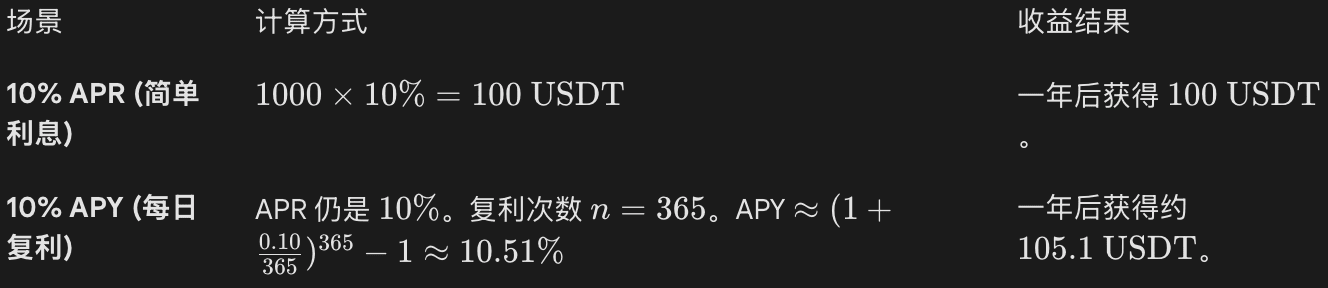
In this example, due to daily compounding, APY (10.51%) is significantly higher than APR (10%), which means your actual returns exceed the nominal interest rate by 0.51%.
Applications and importance in DeFi
In DeFi, as many liquidity pools and staking platforms settle interest and automatically reinvest very frequently (daily, or even hourly), therefore:
APY better represents your actual returns. If you see a high APR, but the protocol supports daily reinvestment, then its APY will be higher, and you should use APY as the benchmark for comparing different investments.
APY increases with the frequency of compounding. The more frequent the compounding (for example, hourly compounding), the greater the enhancement of APY compared to APR.
Pay attention to the type of tokens. In DeFi, the displayed APR/APY is sometimes calculated based on reward tokens, and if the price of the reward tokens is volatile, the actual fiat returns will also fluctuate accordingly.
When evaluating investment projects, always compare different options using APY to accurately understand the potential growth of funds.