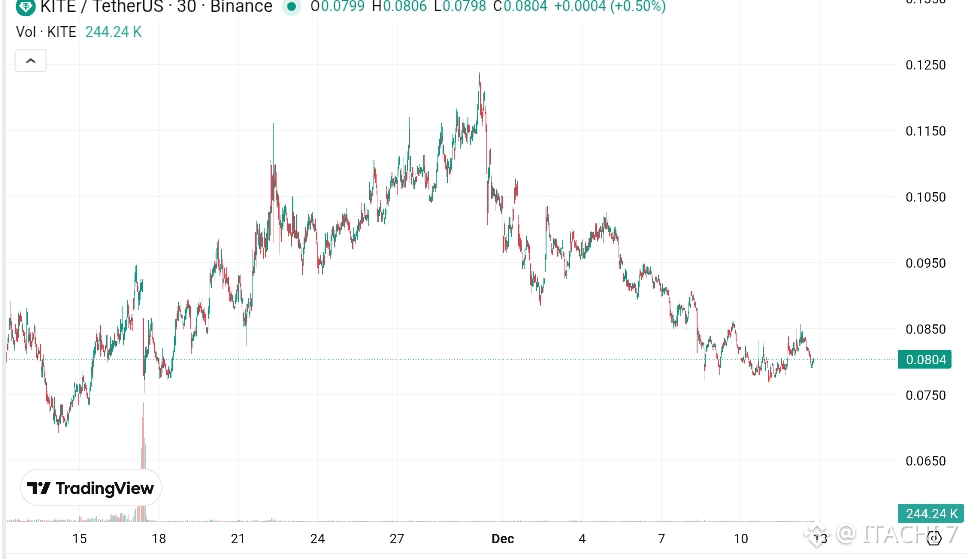
Kite is trying to build a new kind of internet layer for machines. The idea is simple to explain. Let machines pay other machines. Let software agents hold identity and money. Let them buy data and compute without a person pressing a button. That is the world Kite is aiming for.
You see this in small ways already. A bot can order a meal for you. A service can auto-renew a subscription. What Kite wants is for those actions to be native and trustable on a public ledger. That means payments, logging, permissioning, and reputation all on chain.
Kite calls this the agentic internet. That is a mouthful. What it means is that agents have identity and purpose. They are not just code. They can be counted and audited.
The project runs an EVM-style chain. That matters because many developers already know those tools. So building on Kite feels familiar. But the chain is tuned for many small payments and for identity flows.
A core feature is the agent passport. It gives a key pair, a history, and verified attestations. That record helps other parties decide if they trust the agent. It also helps track what the agent did and who paid it.
Kite also sees modules. Modules are like small ecosystems that plug into the main network. One module might sell compute. Another might sell data. A module can run its own rules while still working with the main chain.
The team talks about making payments fast and cheap. That is a must for machine commerce. If an agent pays a tiny amount every second, the fees must not eat the money. So the network design tries to make those small payments practical.
Kite is not just a research idea. They raised serious money to build it. Investors like PayPal Ventures and General Catalyst led a round. Public reports say the Series A was eighteen million dollars and the total funding reached thirty-three million dollars.
This funding paid for testnet work and for building the initial modules. It also helped with legal and compliance planning. Big backers often insist on those pieces.
Kite launched a token named KITE. The token supply is ten billion tokens. Documentation from the project and from exchange notes agree on that figure.
How those tokens are split matters. Almost half is earmarked for the ecosystem and community. This is not marketing talk. It means a lot of tokens are meant for builders, liquidity, airdrops, and rewards. Twenty percent is kept for modules. Another twenty percent goes to team and early contributors. Twelve percent is for investors. Those numbers are subject to vesting rules and unlock schedules.
Large unlocks can pressure a token price. If many tokens vest at once and the holders decide to sell, the market can move quickly. Good projects publish clear vesting and lock plans to avoid surprise dumps.
The token is supposed to be used in multiple ways. It pays for fees and services. It secures the network through staking. It also gives governance rights to holders. In theory, that aligns long-term holders with the health of the platform.
Early exchange listing gave the token initial liquidity. Binance ran a launchpool campaign and then listed KITE for trading. That helped many people buy and sell the token quickly. Early trading days saw big volume. That is common for token launches that get press and exchange backing. Volume alone does not prove sustainable demand. It proves attention.
Real demand is created when the network has paying users. Agents must buy services and do so repeatedly. If that happens, the token becomes utility rather than speculation. Watch for repeat payments as the key signal.
Kite makes several technical choices that shape economics. It is EVM compatible, so it can borrow tools from Ethereum. It uses a module pattern so different markets can grow inside the network. This flexibility may speed adoption for niche uses.
Modules could be a place for innovation. A module could be a data market that pays data providers per call. Another module could be a compute market where agents buy CPU time. Each module can reward contributors in KITE to bootstrap supply.
One important function is reputation. Agents must build a track record so counterparties trust them. That trust reduces the need for heavy human oversight and keeps the economy smooth.
Security risk is real. An agent that can move money must be robust by design. That includes safe defaults like limits on spending and clear audit logs. Kite documents mention these controls as part of the agent passport and the agent store.
Another real risk is spam and trash traffic. If anyone can spin up an agent cheaply, they could flood the system. That is why identity and reputation are central. Good reputation design can make spam expensive and slow.
Regulatory risk is also real. Payments to bots touch on anti-money laundering rules and consumer protections. Kite will likely need to work with regulators and custody providers to scale in many jurisdictions.
Competition will come. Other projects are thinking about AI and payments. Cloud providers may also offer services that look similar without the complexity of a token. Kite must show a clear advantage for builders and for businesses to choose it.
Kite wants to serve both developers and big companies. A Fortune 500 firm could use the network to let its AI agents buy compute on demand. A small developer can sell a microservice to many agents. This mix could drive real economic activity if it works.
One technical test will be micro payments. If an agent can pay fractions of a cent many times a day, the system has to be cheap and fast enough. If fees are too high, these tiny flows will not work and the use case stalls.
Another test is cross-network work. Many companies will not be all in on one chain. Kite will need bridges and clear ways to settle across networks. Those bridges are complex to build and risky if not audited.
Kite has an agent store idea. That store is like an app market for agents. Agents that pass checks can be listed. Agents can be discovered and purchased by other agents. This store can help quality control and reduce bad actors.
Community incentives will shape the early years. A big share of tokens is for community programs. Those programs can include developer grants, liquidity incentives, and airdrops. The way these programs are run matters a lot for initial traction.
Governance is tricky. Giving token holders votes sounds fair. But participation is often low in many token communities. Kite will need to make decisions easy to participate in and useful to follow.
If you are a developer, ask for proof of concept. Look for a demo of an agent paying for a real service. Check the logs to see if the payment was settled and if the agent was tracked correctly. Those simple tests are the clearest validation.
If you are an investor, ask for the vesting schedules. Look for when large blocks of tokens unlock. Check how many tokens are already circulating. That helps you estimate short-term dilution risk.
If you are a user, ask about privacy. Agents will handle personal choices and financial data. The network must make sure private data is not leaked while still letting agents prove their records when needed.
The roadmap is not a detailed timeline. There are public notes about the launch and about modules. But the wider vision will only be proved by real use over months and years. That is the reality of new infrastructure.
Some commentators note the project is well-timed. AI and Web3 interest rose together in 2024 and 2025. That timing helps attention and funding. But timing can also cause too much expectation too fast.
For general users, the impact is subtle at first. You may not need to know about agents. But you will feel the result when things work transparently. When a helper app orders the right item and pays automatically, that is the experience Kite is after.
Some people worry this removes human control. That is a fair concern. Designers of the system must make it easy to set boundaries that stop agents when they go off track. Spending limits and approval gates are typical controls to keep that trust.
Kite is an experiment in many senses. It tests whether machines need a blockchain-native money system. It tests if builders will take the time to integrate. It tests if users will trust machines with money. All those tests will take time.
If Kite succeeds, we get a different internet. One where automated agents negotiate, pay, and keep records by themselves. That opens new business models. It also forces us to think about new norms and new safeguards.
If Kite fails, it will still leave lessons. We will better understand where blockchains help and where they do not. We will see what parts of machine commerce want decentralization and what parts prefer centralized speed and convenience. Those lessons are useful for any next attempt.
I will watch a few numbers to judge progress. How many agents are active on the network each day? How many payments happen and what is their average size? How many modules have real paying customers? Those metrics will tell if this is an experiment or a real economy.
One last point on tone. This is not a get-rich-quick scheme. It is not a simple app launch. It is long work to build shared technical foundations. If you like big infrastructure plays and you can wait and watch, then Kite is worth following.