As Bitcoin remains above $90,000, the market's attention has quietly shifted—from chasing AI narratives to those projects that are truly building the underlying infrastructure. Kite AI is one of the few projects that is gradually revealing itself through continuous progress rather than empty talk. A recent series of developments indicates that it has entered a critical stage before the mainnet launch.
Why now? Data does not lie
Testnet data: processing nearly 1 million automated transactions weekly, which is real traffic that Kite has already achieved while many AI chains are still just talking on paper.
Validator growth: more and more nodes are joining the network, and the staking ecosystem is steadily being established.
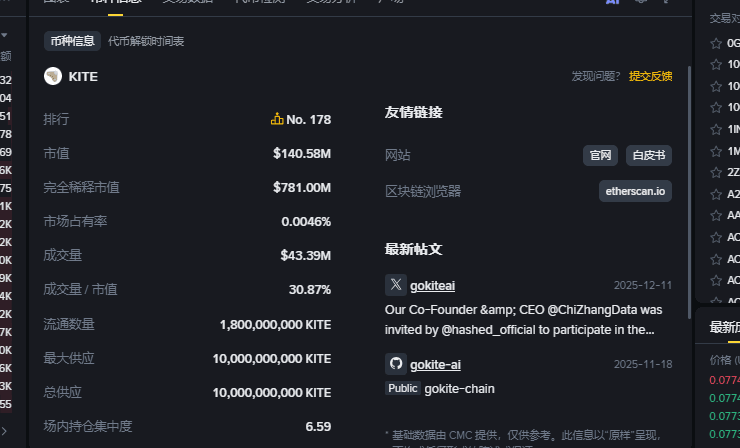
Token Performance: $KITE stabilizing around $0.079, with volatility significantly lower than similar projects — stability comes from progress, not speculation.
From data company to AI agent-specific chain: a precise transformation
Kite did not appear out of nowhere. Its predecessor was the Berkeley-based data startup Zettablock, which completed a strategic transformation this year under founder Chi Zhang, focusing on building a 'Layer 1 network designed for autonomous AI agents'.
Its goal is not to compete on TPS, but to solve a more fundamental problem: how to establish verifiable trust between AI agents.
Agent Passport: Each AI agent has an on-chain identity, with clear permissions and rules
Contribution Verification: Using the 'Smart Proof' system to verify each agent's contributions on-chain
Real Data: The testnet has processed over 400 million transactions, with nearly 17 million community members — this is not inflated numbers, but real network effects
Core Innovation: x402 protocol, enabling machines to pay autonomously
The x402 protocol developed in collaboration with Coinbase may be the most disruptive part of Kite.
It transforms the ancient 'HTTP 402 Payment Required' status code into a universal payment layer between machines. This means:
AI agents can autonomously purchase data, pay for computing power, and settle services
No human approval required, no centralized payment gateway needed
Early pilots show cost reductions of up to 90%
Imagine this: after two AIs collaborate to complete a project, they automatically split the account based on contribution ratios — the entire process is completed in seconds, with no invoices and no delays.
$KITE Token: Not just fuel, but a governance certificate
Practical Scenarios: Paying gas fees, staking to maintain network security, micro-payment settlements between agents
Staking Returns: Currently annualized at about 12%-15%, from real activities on the network
Governance Power: Holders vote to determine upgrade directions and fund usage
Deflationary Design: Total supply of 100 billion, current circulation about 18 billion, with the remaining portion released linearly until 2027 to avoid concentrated sell pressure
Capital and Team: Why it deserves attention
Solid Financing: Cumulative financing of approximately $33 million, with investors including PayPal Ventures, General Catalyst, Coinbase Ventures, etc. — this is a bet on long-term vision, not short-term speculation.
Team Expansion: Recently opened multiple engineering and product positions to prepare manpower for the mainnet launch
Community Engagement: Maintaining high-frequency interaction through tasks like 'Flying Kites', the developer ecosystem is gradually taking shape
Challenges and Future: The final sprint before the mainnet
Technical Challenges: How to ensure stability of the mainnet under high-frequency machine transactions
Regulatory Adaptation: The legal boundaries of the autonomous agent economy are still being explored
Intensifying Competition: Similar projects like Fetch.ai are also competing for market share
But the difference with Kite is clear: it does not pursue the loudest narrative but instead builds the most credible foundation for machine collaboration.
In Conclusion: We may have underestimated this matter
Founder Chi Zhang clearly states: 'The next internet is not just about connecting people, but about connecting decisions — and agents will be the entities making those decisions.'
Behind the price of $$KITE .079, the real story is: a 'silent economy' where machines autonomously trade, collaborate, and create value is being built. Its explosion may not be signaled by a spike in coin prices, but rather by the day you notice your AI assistant starting to earn and pay for itself.
When that moment arrives, people will realize: the economic track that allows machines to operate safely and autonomously has already been quietly laid.
Historical experience tells us: the most important infrastructure is often built in unnoticed corners. And Kite might be just such a corner.