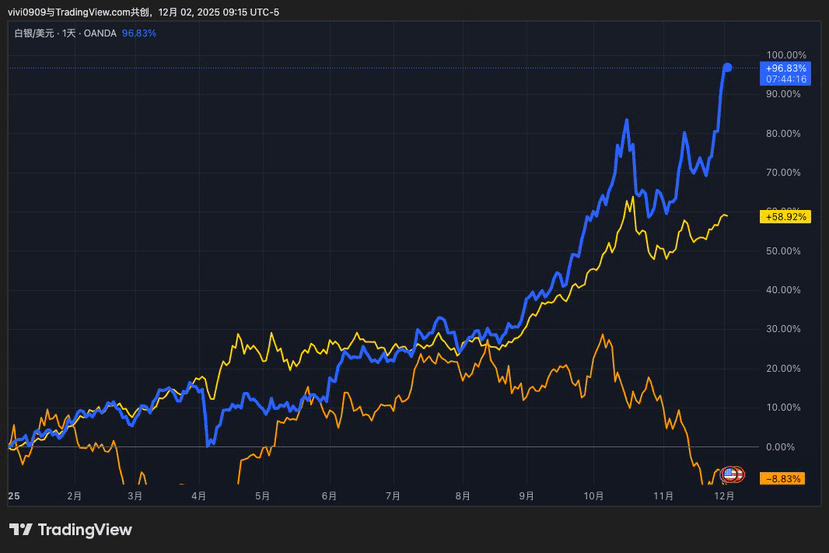
When Bitcoin struggles at the $90,000 mark and has dropped more than 3% this year, silver, often regarded as a 'traditional asset relic', is staging a miraculous comeback - the spot price has surged over 103% this year, once reaching a historic high of $60.641 per ounce, significantly outperforming gold and overshadowing the narrative of cryptocurrencies as 'digital gold'. This century-spanning asset showdown raises the question: is it a reevaluation of value spurred by the Industrial Revolution, or a counterattack on the discourse initiated by traditional capital? The answer may lie in the dual logic of supply-demand restructuring and credit games.
Industrial essential needs: the 'hardcore fundamentals' supporting silver
The core pillar of silver's recent surge is its attribute upgrade from 'precious metal' to 'industrial strategic material'. The rigid contraction on the supply side and explosive growth on the demand side have formed an irreversible supply-demand gap — global silver mine production is expected to drop to 820 million ounces in 2025, a 12% decline from the peak in 2020, with production cuts in Mexico and shutdowns in Peruvian silver mines further tightening supply, while the increase in recycled silver supply is only 1.2%, which cannot match the increase in demand.
The changes on the demand side are more disruptive: the photovoltaic industry has become the largest 'silver consumer', with silver usage reaching 7,560 tons by 2025, accounting for 55% of global total demand, doubling from 2022; silver usage in new energy vehicles is increasing by over 12% annually, while silver usage in AI computing servers and data centers has increased by 30% compared to traditional equipment. The construction of 5G base stations further opens up demand space in the high-frequency communication field. This rigid demand driven by the new energy revolution and digital economy allows silver to break free from purely financial constraints, becoming the indispensable 'industrial blood' of the technology industry, with price support far more solid than that of speculation-driven cryptocurrencies.
Capital games: the return of traditional assets under credit reconstruction
If industrial demand is the 'overt strategy' for silver's rise, then the capital migration in the context of global credit system reconstruction is the 'covert line' of this counterattack. The market in 2025 is undergoing a profound narrative shift: Bitcoin and U.S. stocks are decoupling for the first time, with Bitcoin falling against the backdrop of a 16% rise in the S&P 500 index, questioning its positioning as a 'risk appetite asset'. Funds are starting to flow from the highly volatile crypto market to precious metals with 'super-sovereign non-debt attributes'.
Behind this is the traditional capital's re-competition for market discourse power. In the face of the impact of crypto assets on the concept of 'value storage', global central banks have upgraded their allocation of precious metals from 'tactical choice' to 'strategic reserve'. The continuous purchasing of gold by emerging market central banks has constructed an invisible 'policy floor'. At the same time, rising expectations of interest rate cuts are driving liquidity into safe assets, with silver ETFs increasing their holdings by over 500 tons in six months, raising the share of investment demand to 37%, forming a dual buying force of 'industrial essential needs + financial hedging'. This capital migration is essentially a return to 'visible value' — just as our predecessors trusted gold and silver, the physical value that transcends economic cycles is even more attractive in the current context of increasing credit fractures.
Safety proposition: the ultimate test of all assets
Whether choosing the 'steady growth' of silver or the 'high-risk gamble' of Bitcoin, asset safety is always an inescapable core proposition. Recent theft incidents involving Web3 KOLs have sounded the alarm; malicious actors have viewed practitioners as 'mobile vaults', with increasingly diverse social engineering attack methods: infiltrating disguised fans, using biometric unlocks, and transferring assets when holders are incapacitated. These attacks, which exceed the scope of technical defenses, elevate 'digital asset security' from a technical issue to a survival issue.
To face this survival test in the dark forest, a triple protection system needs to be established: first, abandon convenience compromises, close wallet biometric features, and use high-strength composite passwords to exchange operational complexity for asset security; second, implement a 'cold-hot separation' strategy, storing large assets in hardware wallets while using small wallets only for daily interactions to avoid single-point risk transmission; third, adhere to the principle of 'wealth not being revealed', not disclosing holdings or flaunting profits on social platforms, cutting off the target selection path for malicious actors. In this asset race, reaching the finish line is not about who runs the fastest, but about who can safeguard their wealth.
The rise and fall duel between silver and Bitcoin is essentially a clash of new and old value systems — the former reconstructs value based on the essential needs of the industrial revolution, while the latter relies on the narrative of technological faith to maintain its premium. However, regardless of how market styles switch, the dual propositions of 'earning' and 'holding' will always be central to investment. When silver outperforms the frenzy of digital assets with its century-old accumulated value, it may be reminding the market that true hardcore investment has always been a dual pursuit of fundamentals and security.