

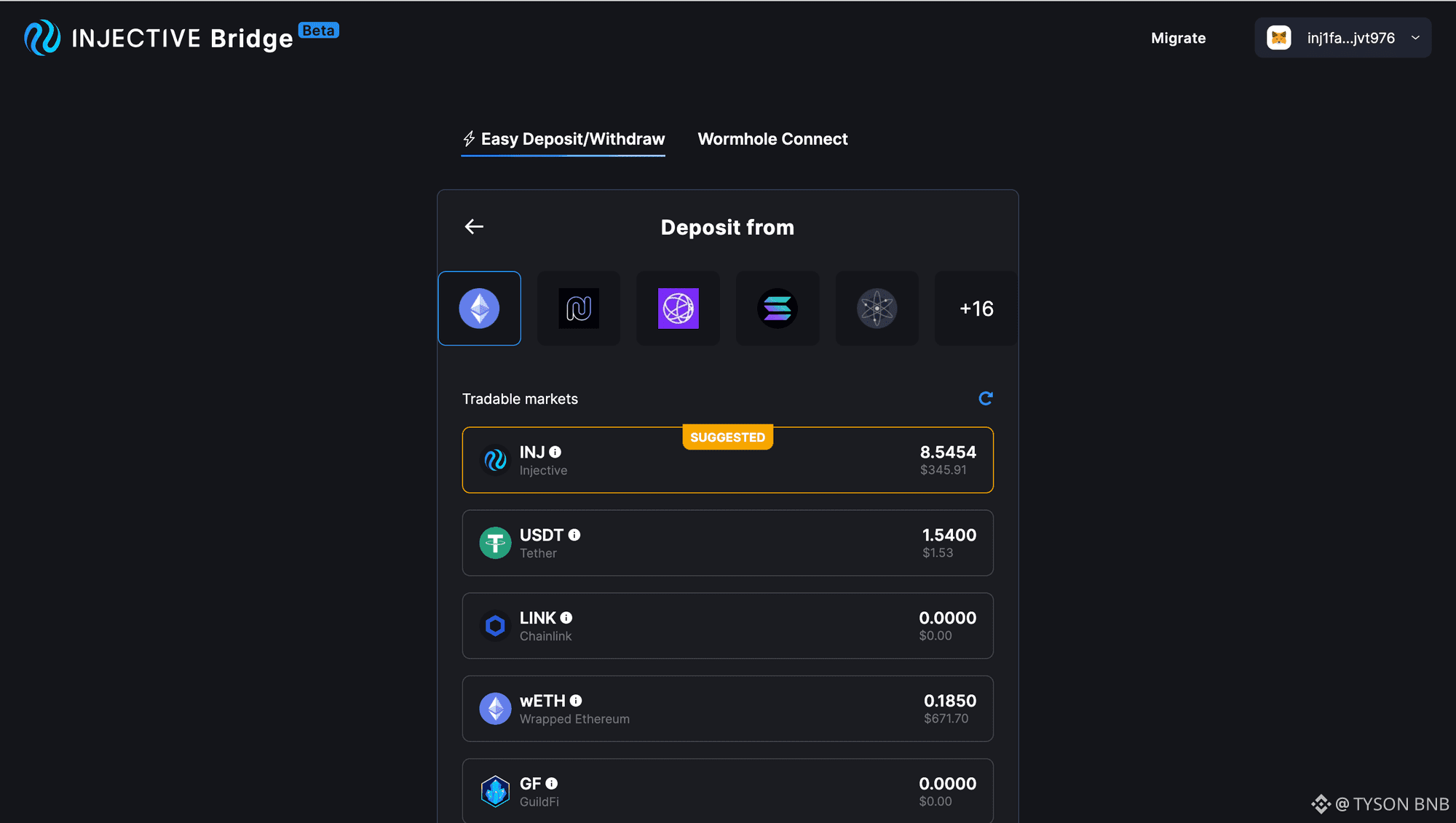
 There’s a small, nagging fear every DeFi user carries when they click “bridge”: where exactly does my money go, who holds custody while it’s traveling, and what happens if that custodian disappears? Injective’s native bridge architecture addresses that fear head-on by treating cross-chain transfers as a protocol concern rather than a third-party convenience. Its Peggy/Ethereum bridge and IBC integrations put bridging logic into the validators’ attestation and the chain’s own modules, which means transfers are processed by validator consensus, recorded on-chain, and not dependent on a centralized custodian or opaque multisig. The result is a model where moving ERC-20s to Injective mints Cosmos-native tokens using validator attestations — a trust-minimized flow backed by the Injective chain’s PoS security.
What makes Injective’s approach feel different — and safer — is that it unifies multiple interoperability methods under a single, auditable umbrella. Injective runs a Peggy-style contract on Ethereum, an orchestrator (Peggo) to relay events, and a Peggy module on the Injective chain to mint and burn representations. For Cosmos-native assets the chain leverages IBC semantics so tokens move with canonical provenance instead of being re-wrapped by opaque custodians. More recently, Injective has layered Wormhole integration and its Ionic bridge upgrades so Solana and many other ecosystems can route liquidity into Injective with minimal manual trust assumptions. Each added integration (Peggy, IBC, Wormhole) expands coverage but preserves the same underlying design goal: don’t hand custody to strangers; let verifiable on-chain machinery and validator attestations do the work.
In practice, the bridge flow is intentionally granular and verifiable. When a user deposits an ERC-20 into the Peggy contract on Ethereum, validators observe the event and, once a threshold of consensus is reached, the Injective Peggy module mints the corresponding denom on Injective. Withdrawals reverse the process: the Injective chain burns the Cosmos-native denom and validators submit signed attestations to the Peggy contract to unlock the original ERC-20. Those steps are implemented as on-chain messages (e.g., MsgSendToEth) and processed by validator sets rather than being handed off to custodial actors. That architecture reduces single-point-of-failure risks and gives users a clear, auditable trail to follow if anything goes wrong.
Injective’s recent “Ionic” and Wormhole lift further lower the friction and broaden the trust-minimized connectability. Ionic bundled IBC, Wormhole, and Peggy pathways into a unified bridge UX so users can deposit assets from IBC chains, Ethereum, or Solana with a single interface. Wormhole acts as the Solana-to-Cosmos connector, with Injective treating Wormhole’s verified messages as inputs into its own consensus-backed minting flows. Importantly, Injective doesn’t replace these interop primitives with opaque middlemen; instead, it stitches them into its protocol stack so each message or attestation is either an IBC proof or a validator-signed event the chain can validate and act on. That design both widens asset coverage and preserves the original trust-minimization intent.
There’s also a pragmatic UX dimension: Injective’s bridge is built for finance, so speed, low cost, and composability matter. The bridge V2 and Ionic upgrades emphasize near-instant deposits to Injective, low or waived inbound fees, and fast withdrawals relative to many cross-chain alternatives. For traders and builders this matters: assets that can move quickly and cheaply without relying on custodians make cross-chain liquidity and on-chain orderbooks genuinely usable. The integration with Wormhole and other connectors also means Injective can bring high-liquidity assets from Solana and other L1s into the Cosmos universe, enabling cross-ecosystem markets and yield strategies while still avoiding centralized custody risk.
Security tradeoffs still exist — no system is magically risk-free — but Injective’s model pushes the fault surface away from humans and into verifiable code and validator consensus. By anchoring minting/burning to validator attestations, using IBC for Cosmos assets, and treating Wormhole messages as validated inputs, Injective reduces the need for trusted intermediaries. The community can audit bridge contracts, monitor validator attestation thresholds, and follow release notes (the project publishes upgrades and bridge changes publicly) so governance and operators remain in the light rather than behind closed doors. That transparency is the practical corollary to trust minimization: visibility reduces the likelihood of silent failures.
For users and builders the emotional payoff is straightforward: move assets between Ethereum, Cosmos, and Solana liquidity pools without the gnawing worry that a custodian somewhere will go dark. Injective’s native bridge affords composability — assets bridged into Injective can be used immediately in on-chain orderbooks, derivatives, and DeFi rails — while preserving a clear, auditable custody model based on validator consensus and standardized cross-chain proofs. That combination — practical speed, wide coverage, and minimized custody assumptions — is what makes Injective’s bridge architecture feel like a real step forward for cross-chain finance.


