
As Web3 matures, tokenomics is no longer just about launching a token; it’s about designing a long-term economic system that aligns builders, users, and capital.
Bifrost is a strong case study within the Polkadot ecosystem. Its tokenomics didn’t emerge fully formed; instead, it evolved across three clear stages, each matching the protocol’s level of maturity.
Why Tokenomics Is the core of Web3
Tokenomics is what fundamentally differentiates Web3 from Web2. In Web3, tokens are not just speculative assets, they are coordination tools. They allow protocols to:
Raise capital efficiently
Incentivize early users
Align contributors and developers
Build loyal, self-sustaining communities
Distribute real economic value back to stakeholders
When designed well, tokenomics doesn’t just support growth, it shapes how growth happens.
Phase I: Bootstrapping by Organizing Productive Resources
At the beginning, token distribution is about one thing: organizing productive resources.
Every protocol needs:
Capital → investors and treasury funding
Talent → core team and advisors
Users → early adopters via airdrops and incentives
Liquidity & TVL → farming and staking campaigns
Ecosystem partners → grants and integrations
Bifrost fixed BNC’s total supply at 80 million tokens with no inflation, distributing them across the foundation, team, investors, collators, risk reserves, and, most importantly, ecosystem growth.
This structure allowed Bifrost to:
Fund development
Secure Polkadot parachain slots
Attract builders and users
Reach product–market fit
Today, most early allocations are fully unlocked, while a meaningful portion of ecosystem funds remains unspent, preserving flexibility for future growth.
Phase II: Scaling with sustainable, opportunity-driven incentives
Growth doesn’t come from permanent emissions, it comes from precision.
Bifrost’s strategy during expansion was simple:
Avoid fixed, long-term farming schedules
Deploy incentives only during high-impact market windows
Cap total rewards to keep costs predictable
Instead of “quest-style” or click-to-earn campaigns, Bifrost focused on real participation: staking, minting vTokens, and providing liquidity.
A clear example is the Polkadot Unlock Harvest (Oct 2023):
50,000 BNC in incentives
2.31 million DOT minted as vDOT in 42 days
Over $12M TVL increase
Each campaign had a defined goal, duration, and budget, ensuring incentives were attractive but never reckless.
In DeFi terms, token rewards are marketing spend. Misjudge reward intensity, and you destroy long-term value. Bifrost avoided that trap by tying incentives directly to productive behavior and long-term utility.
Phase III: Revenue, buybacks, and the value flywheel
At maturity, tokenomics must answer one hard question:
Why should this token hold value?
For Bifrost, the answer is certainty — a clear, mechanical link between protocol revenue and token value.
Instead of discretionary governance buybacks, Bifrost Tokenomics 2.0 introduces:
Fixed monthly buybacks
100% of protocol profits used to repurchase BNC
10% burned → deflation
90% redistributed to bbBNC holders → real yield
This creates a predictable value loop that the market can understand and price.
bbBNC: Rewarding long-term believers
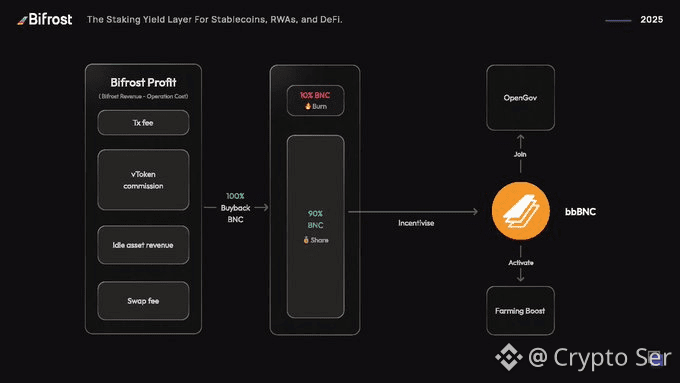
Profit redistribution flows through bbBNC, a non-transferable, ve-style token earned by locking BNC or vBNC for up to 4 years.
Key properties:
Longer locks = more bbBNC
bbBNC decays linearly over time
Rewards favor long-term commitment, not short-term speculation
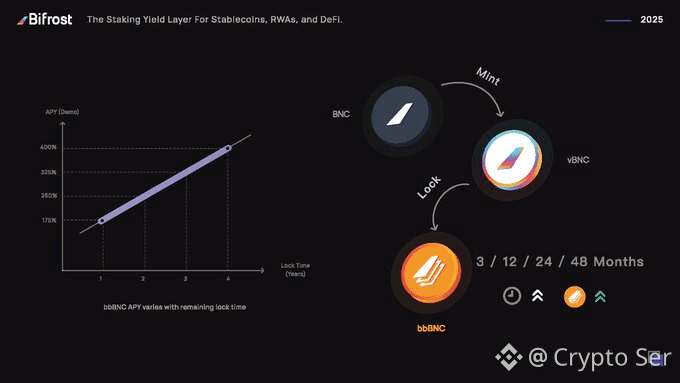
If you know veCRV, this model will feel familiar and proven. bbBNC aligns incentives toward those who:
Believe in the protocol
Stay through cycles
Actively contribute to network resilience
Final Thoughts: Build to earn
Bifrost’s tokenomics follows a simple philosophy: Build to Earn.
Rewards are not handed out for noise or vanity metrics, they are distributed based on real contribution to the network’s growth and stability.
Speculators will always exist, and that’s healthy.
But sustainable protocols are built by long-term participants — builders, stakers, liquidity providers, and believers.
Bifrost’s journey shows what mature tokenomics on Polkadot can look like:
Disciplined incentives
Real revenue
Transparent profit sharing
Strong alignment between protocol success and token holders
And that’s the standard DeFi should be moving toward.
