

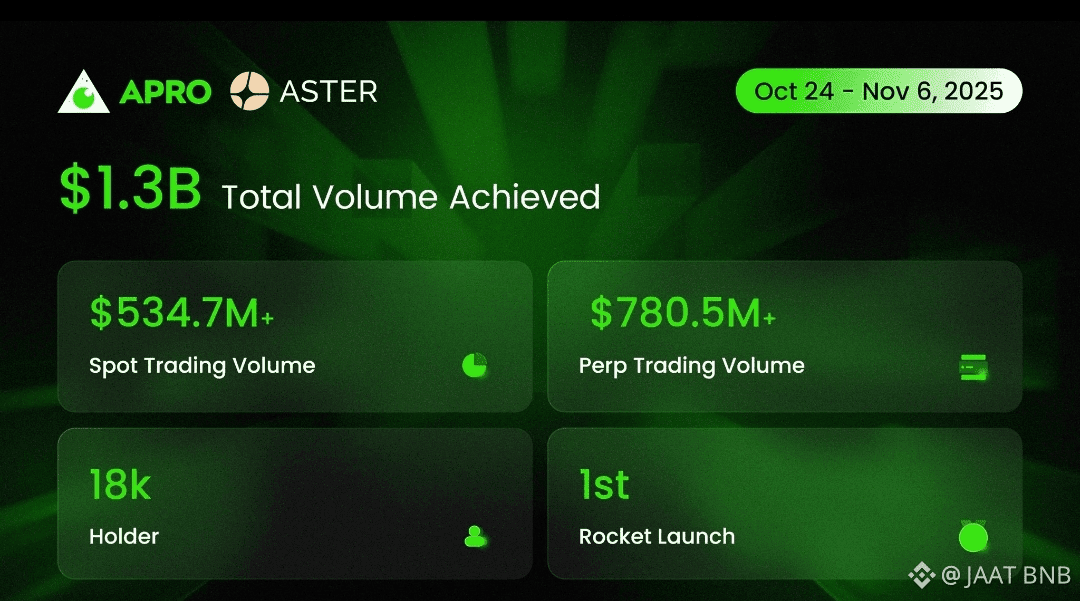
When I look at the numbers associated with APRO’s early trading phase alongside Aster, what strikes me is not the size of the figures themselves, but how quickly they formed a coherent story. In a relatively short window, total trading volume crossed 1.3 billion dollars, split naturally between spot activity and perpetual markets. That balance matters. It suggests that participation was not driven by a single style of trader chasing momentum, but by a mix of users engaging with APRO across different risk profiles and time horizons. Spot volume reflects conviction and ownership, while perpetual volume reflects liquidity, hedging, and active positioning. Seeing both develop side by side tells you the market was not shallow.
The spot trading volume, sitting above five hundred million dollars, signals something often overlooked in early-stage projects: willingness to hold rather than just flip. Spot markets tend to attract participants who believe in longer-term relevance, not just short-term volatility. At the same time, perpetual trading volume pushing past seven hundred million dollars shows that professional traders and liquidity providers found the structure efficient enough to deploy capital repeatedly. This dual participation is usually hard to achieve early, because it requires both narrative clarity and technical reliability. APRO managed to attract both without forcing one at the expense of the other.
Another detail that deserves attention is the holder count. Eighteen thousand holders in this phase is not just a vanity metric. It reflects distribution. It suggests that ownership did not concentrate instantly into a few hands, but spread across a meaningful base of participants. In decentralized systems, this kind of distribution often becomes more important than raw volume over time, because it shapes governance, liquidity behavior, and community resilience. A wide holder base tends to dampen extremes and support healthier market cycles.
The context of this activity also matters. This was framed as a first major launch phase, not a mature ecosystem with years of brand recognition behind it. Early launches often experience distorted activity driven by incentives alone. What makes this phase interesting is that the activity aligned with real usage rather than collapsing immediately into churn. Volume, holders, and market depth moved together, which usually indicates that infrastructure, incentives, and timing were reasonably well calibrated.
What this period reveals about APRO is less about hype and more about positioning. The project entered the market not as a loud announcement, but as a functioning piece of infrastructure with enough clarity for different participants to find their place. Traders found liquidity. Holders found a reason to stay. The market, in turn, produced data that looked organic rather than forced. That is not something you can manufacture easily.
In the broader picture, this early performance feels like a stress test of relevance. It shows how APRO behaves when exposed to real capital, real traders, and real expectations. Numbers alone never tell the full story, but patterns do. And the pattern here suggests that APRO’s foundation was strong enough to support both activity and belief at the same time. For an early phase, that balance is often the difference between a momentary spike and the beginning of something that compounds quietly over time.
